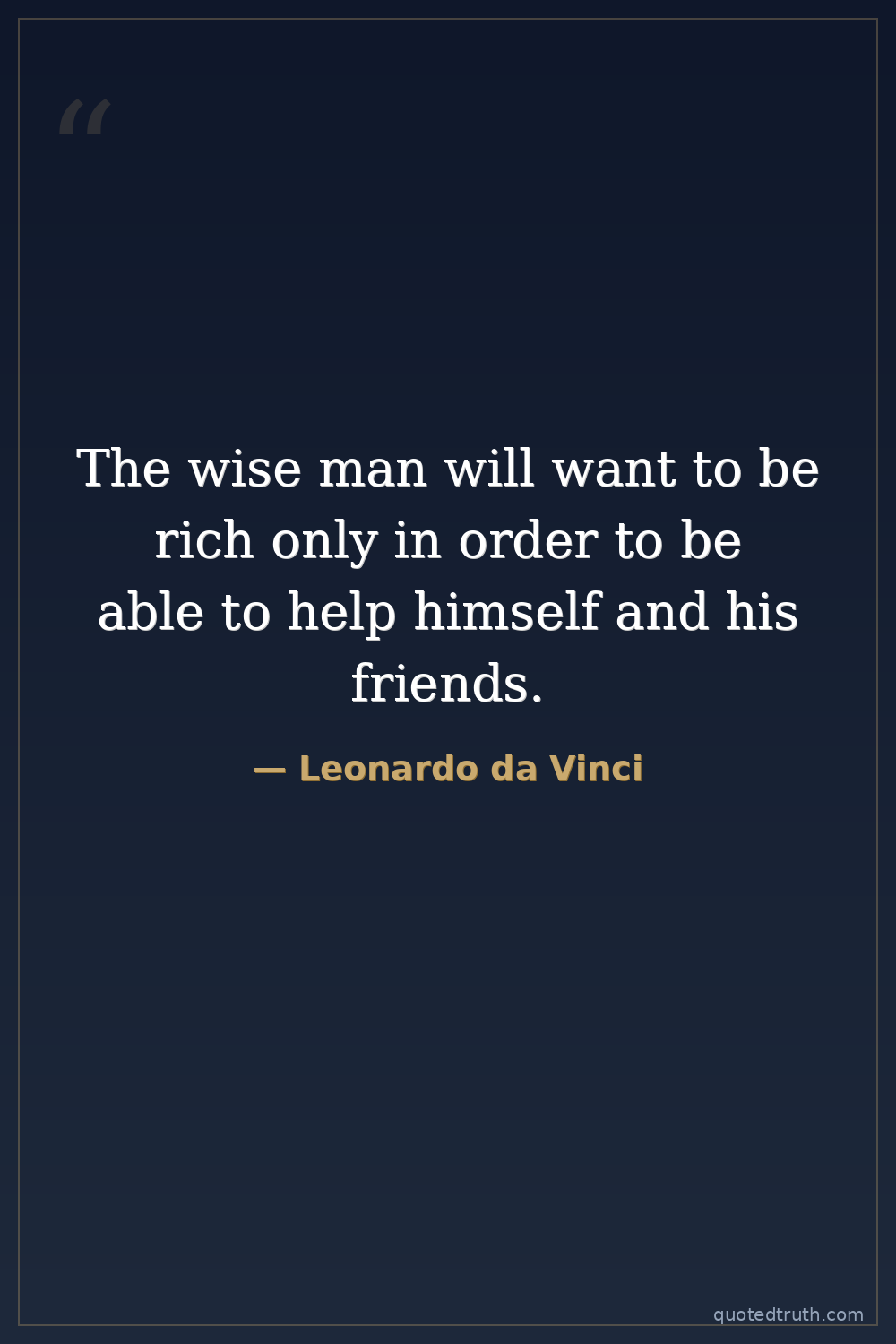
Leonardo da Vinci — "The wise man will want to be rich only in order to be able to help himself and h…"
The wise man will want to be rich only in order to be able to help himself and his friends.
The wise man will want to be rich only in order to be able to help himself and his friends.
Click any product to generate a realistic preview. Up to 3 at a time.
* Initial load can take up to 90 seconds — revising the preview in another color is nearly instant.
"Oh, how many times have I been deceived by my own opinions!"
"It is better to imitate ancient than modern work."
"Oh! how many are the times that I have been deceived!"
"Experience does not err. Only your judgments err by expecting from her what is not in her power."
"The earth is not the center of the sun, but the sun is the center of the earth."
Found in 1 providers: grok
1 source checked
Wealth is only worth pursuing as a means to an end — specifically, to provide for oneself and support those close to you. True wisdom rejects accumulating money for status or power alone. A genuinely smart person treats money as a tool for security and generosity, not a goal in itself. The impulse to hoard or flaunt wealth is, by implication, a mark of foolishness rather than wisdom.
Leonardo spent most of his career under wealthy patrons — the Sforzas in Milan, Cesare Borgia, and finally Francis I of France — trading his art and engineering genius for financial support. He was not driven by personal wealth accumulation but by freedom to pursue his insatiable curiosity across dozens of disciplines. He financially supported apprentices and family members, living this philosophy that wealth serves people, not the reverse.
Leonardo lived in Renaissance Italy (1452–1519), when merchant families like the Medicis wielded enormous political power through accumulated wealth. The era saw fierce tension between Christian ideals of poverty and charity and the new humanist celebration of earthly success. Commerce was booming, inequality stark, and thinkers were actively debating whether wealth corrupted or liberated. This quote joins that Renaissance conversation about what a virtuous person actually does with money.
AI-generated insights based on extensive research and information for context. Factual errors? Email [email protected].
Your cart is empty