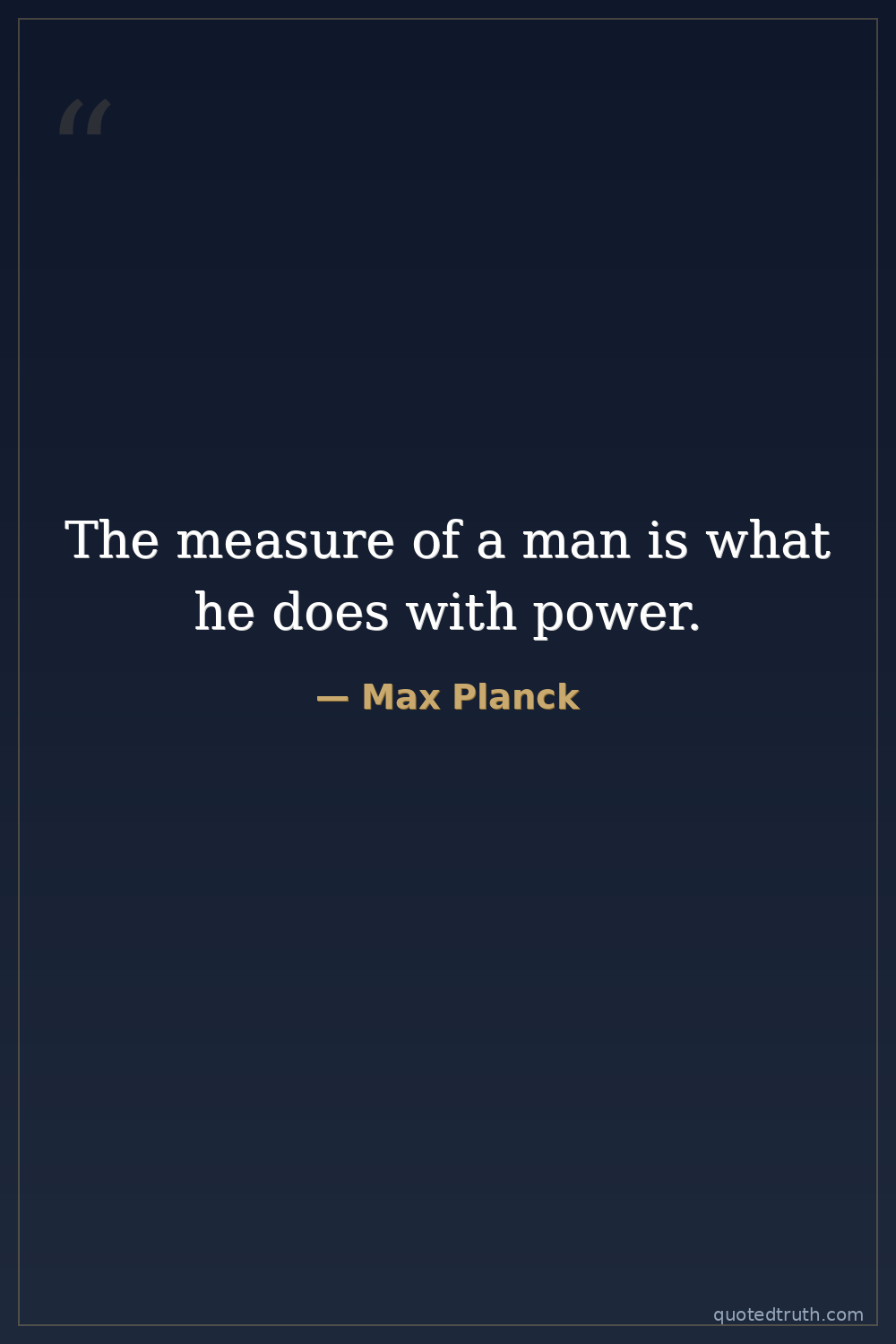
Max Planck — "The measure of a man is what he does with power."
The measure of a man is what he does with power.
The measure of a man is what he does with power.
Click any product to generate a realistic preview. Up to 3 at a time.
* Initial load can take up to 90 seconds — revising the preview in another color is nearly instant.
"The human mind is a wonderful thing. It starts working the moment you are born and never stops until you stand up to speak in public."
"The quantum hypothesis will never be overthrown."
"Religion and natural science are fighting a joint battle in an incessant, never-ending crusade against skepticism and against dogmatism, against unbelief and against superstition, and as the motto for…"
"The quantum theory is a confirmation of the fact that the world is not a collection of things, but a collection of processes."
"We have no right to assume that any physical laws exist, or if they have existed up to now, that they will continue to exist in a similar manner in the future."
Found in 1 providers: grok
1 source checked
Character is revealed not by ambition or talent but by how someone wields authority once they have it. Anyone can appear decent while powerless; real testing comes when choices affect others and there is little to stop abuse. The line argues that integrity is measured in restraint, fairness, and service when one could instead exploit, coerce, or self-enrich without immediate consequence.
Planck lived this test directly. As head of the Kaiser Wilhelm Society through the Nazi era, he held real institutional power and used it to protect Jewish colleagues, famously confronting Hitler over the purge of scientists. He refused to flee Germany, kept German science functioning under tyranny, and endured the execution of his son Erwin for resisting Hitler, choosing conscience over self-preservation.
Planck's lifetime (1858-1947) spanned Imperial Germany, Weimar collapse, and Nazi dictatorship, an era where power was violently concentrated and scientists were pressured to serve ideology. Colleagues like Haber weaponized chemistry; Heisenberg worked on Nazi fission. Against this backdrop, how an eminent German chose to use influence, silence, or resistance had life-and-death weight, making the ethics of power an urgent, not abstract, question.
AI-generated insights based on extensive research and information for context. Factual errors? Email [email protected].
Your cart is empty