Dmitri Mendeleev — "I have no need of proof; the laws of nature, unlike the laws of grammar, admit o…"
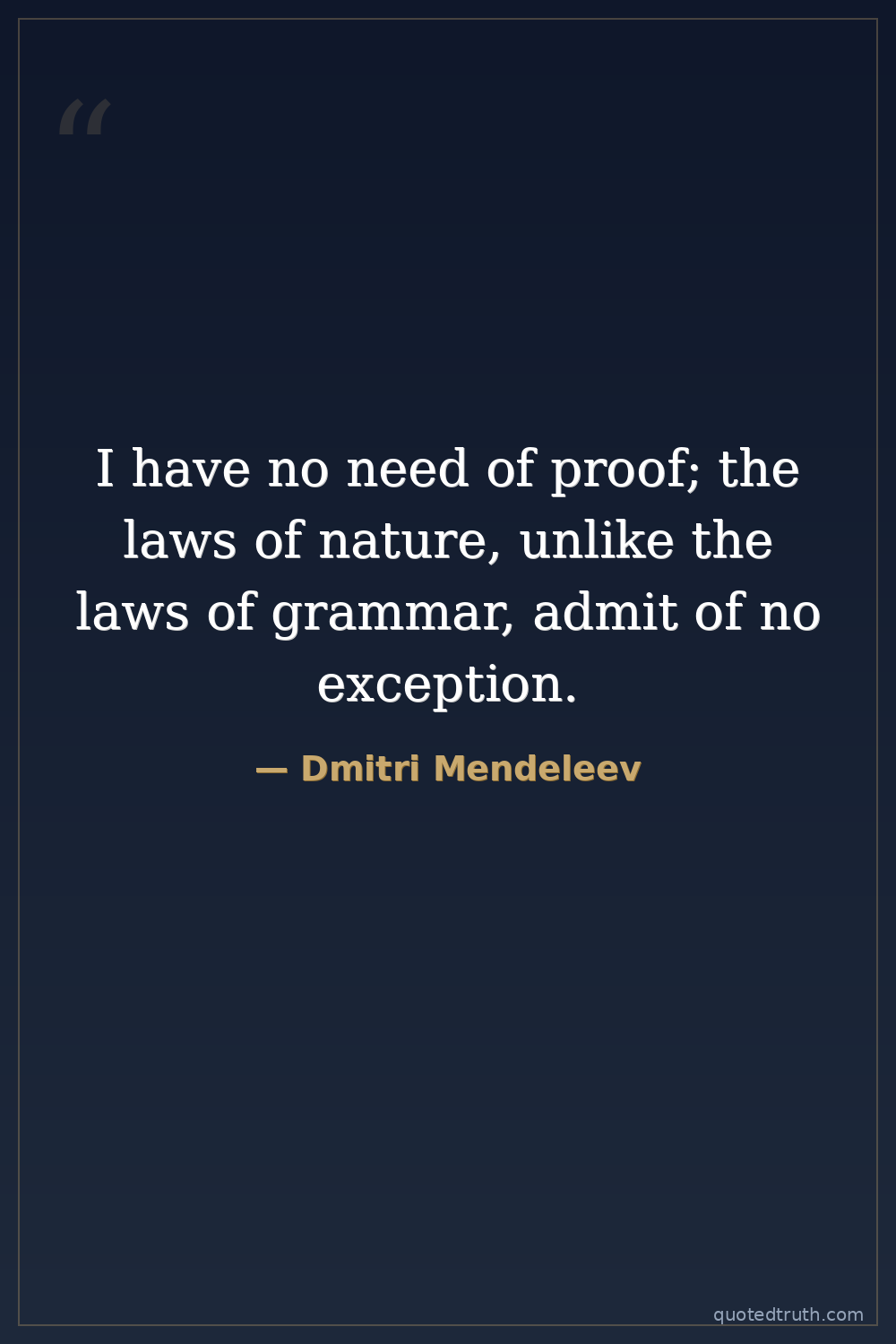
I have no need of proof; the laws of nature, unlike the laws of grammar, admit of no exception.
I have no need of proof; the laws of nature, unlike the laws of grammar, admit of no exception.
Click any product to generate a realistic preview. Up to 3 at a time.
* Initial load can take up to 90 seconds — revising the preview in another color is nearly instant.
"Hypotheses help and guide scientific work — the search for truth — as the tiller's plough helps the cultivation of useful plants."
"The weight of the atom is not the only criterion; there are other considerations."
"The spirit of scientific inquiry must be cultivated in all children."
"To tell the truth, I never thought of myself as a genius; I just worked hard."
"Doctor, you have science, I have faith."
Found in 2 providers: deepseek,gemini
2 sources checked
Natural laws operate with absolute consistency, unlike human-made rules such as grammar which are full of irregularities and exceptions. The speaker dismisses the need for external validation because the universe itself reliably demonstrates these principles through repeatable behavior. Where human conventions are arbitrary and inconsistent, the physical world follows strict patterns that hold true everywhere, making proof unnecessary beyond observation of nature's own unwavering regularity.
Mendeleev built the periodic table by trusting that elements obey strict underlying laws, even leaving blank spaces for undiscovered elements whose properties he predicted from periodicity alone. When gallium, scandium, and germanium were later found matching his predictions, nature itself confirmed his system. His confidence in lawful regularity over authority or tradition defined his chemistry, reflecting a worker's faith that the universe's structure speaks for itself.
Mendeleev worked in late 19th-century Russia during a ferment of scientific positivism, when chemists were racing to classify over 60 known elements and distinguish genuine natural laws from mere taxonomic convenience. The era saw tension between empirical science and religious or philosophical authority, while Russian intellectual life wrestled with Western rationalism. Against this backdrop, asserting nature's inviolable regularity was a statement of scientific confidence in an age still debating science's proper reach.
AI-generated insights based on extensive research and information for context. Factual errors? Email [email protected].
Your cart is empty