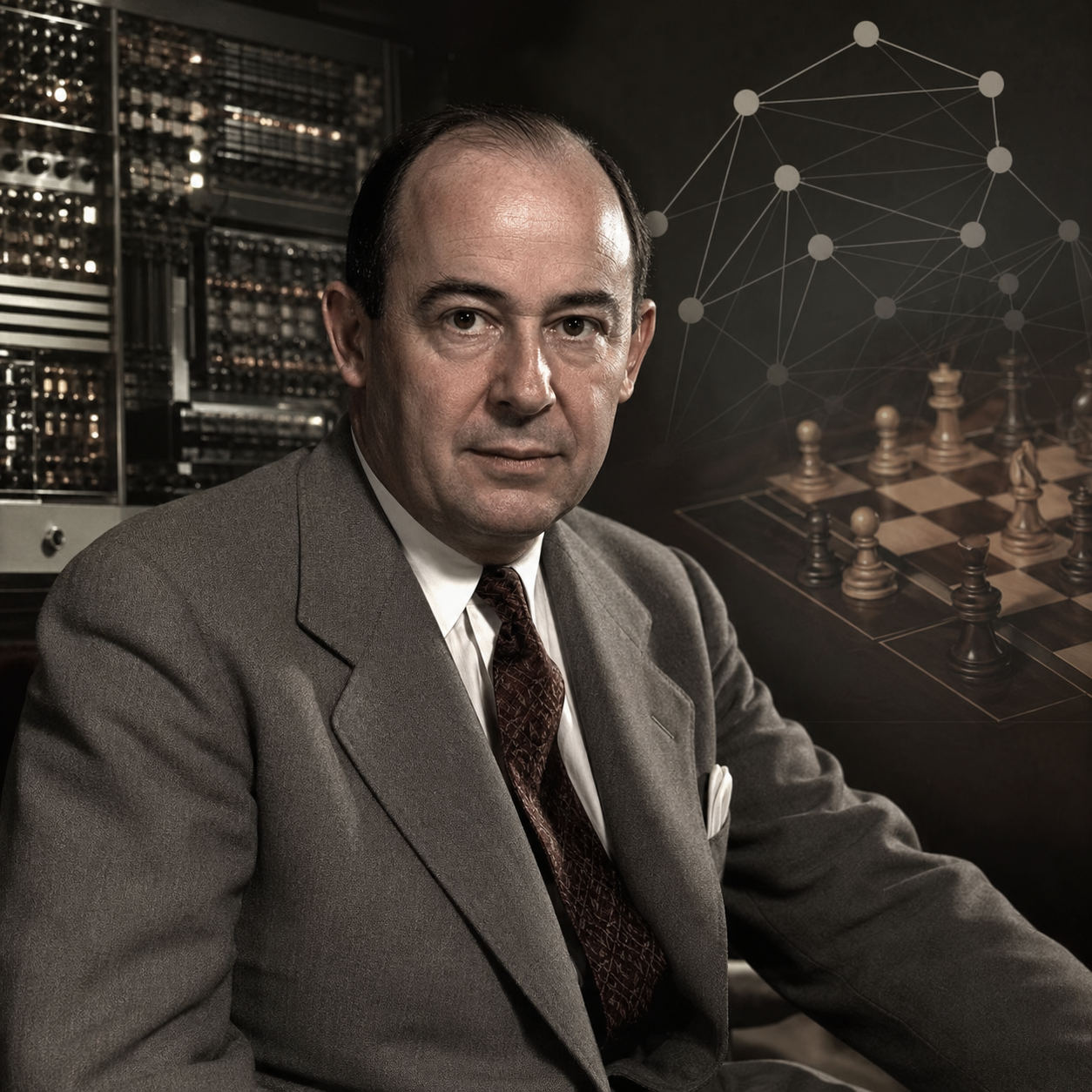
John von Neumann — "The greatest value of a picture is when it forces us to notice what we never exp…"
The greatest value of a picture is when it forces us to notice what we never expected to see.
The greatest value of a picture is when it forces us to notice what we never expected to see.
Click any product to generate a realistic preview. Up to 3 at a time.
* Initial load can take up to 90 seconds — revising the preview in another color is nearly instant.
"It is just as foolish to complain that people are selfish and treacherous as it is to complain that the magnetic field does not increase unless the electric field has a curl. Both are laws of nature."
"I would like to make a confession which may seem immoral: I do not believe absolutely in Hilbert space any more."
"The problems of mathematics are not in mathematics itself, but in the human mind."
"It is not at all certain that the mathematical method is appropriate for the description of the world."
"The computer is a universal machine. It can do anything that can be described algorithmically."
From his 'Theory of Self-Reproducing Automata'.
Date: 1966 (posthumously published)
Food & DrinkFound in 1 providers: grok
1 source checked
True insight comes not from confirming what we already suspect, but from stumbling across what we never thought to look for. A picture—chart, diagram, or graph—compresses complexity into something the eye can scan instantly. When it works at its best, it catches us off guard, revealing hidden patterns or anomalies that no amount of raw-number scrutiny would have surfaced. Surprise is the signal that genuine discovery just happened.
Von Neumann spent his career building systems—game theory, computer architecture, quantum mechanics foundations—to extract order from staggering complexity. He knew human intuition breaks down when data exceeds mental capacity, and that structured representation can expose what naked calculation hides. His design of the stored-program computer was itself an act of making invisible logical processes legible. For him, a well-chosen representation wasn't decoration; it was the thinking.
The 1940s and 1950s saw science confronting data volumes no previous generation had faced—radar returns, nuclear simulations, economic models, early computing outputs. Statistical and graphical methods were emerging as essential tools, not afterthoughts. Von Neumann worked at Los Alamos and Princeton's Institute for Advanced Study during this explosion of quantitative science, where making vast numerical outputs humanly interpretable was as intellectually serious as the underlying mathematics itself.
AI-generated insights based on extensive research and information for context. Factual errors? Email [email protected].
Your cart is empty