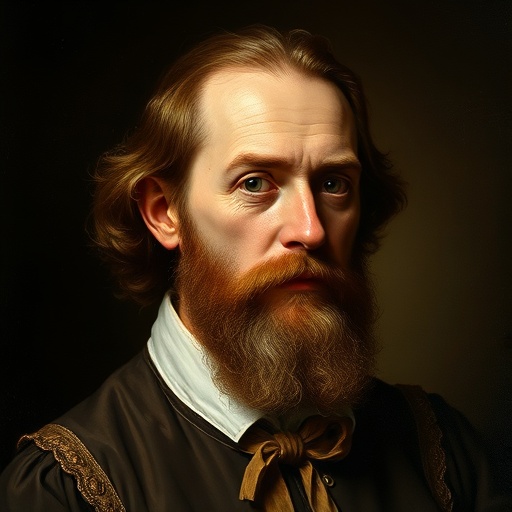
William Harvey — "I am not afraid to confess that I am a man who loves to dissect."
I am not afraid to confess that I am a man who loves to dissect.
I am not afraid to confess that I am a man who loves to dissect.
Click any product to generate a realistic preview. Up to 3 at a time.
* Initial load can take up to 90 seconds — revising the preview in another color is nearly instant.
"The left ventricle of the heart ejects blood into the aorta."
"The blood flows from the right ventricle through the lungs to the left auricle."
"The physician must be a lover of wisdom."
"The truth is always simple, but the way to it is complex."
"The book of nature is the only book that offers a wealth of content on every one of its pages."
English physician whose On the Motion of the Heart and Blood in Animals (1628) demonstrated blood circulation, overturning 1,400 years of Galenic medicine. Closely associated with Francis Bacon (his contemporary in the new English empiricism). For an intellectual contrast, see Galenic medicine, the 2nd-century Greek medical tradition (humors, blood-as-consumed-fuel) — Harvey calculated that the heart pumps more blood per hour than the body could possibly produce as fuel — a single quantitative observation that demolished the entire Galenic-Aristotelian medical worldview. The cleanest example in medical history of arithmetic disproving 14 centuries of authority.
A personal and perhaps provocative statement of his passion for anatomical study.
Date: c. 1650s (attributed)
WisdomFound in 1 providers: gemini
1 source checked
The speaker openly embraces a deep, perhaps obsessive curiosity about how living things work — willing to cut open bodies, examine organs, and probe nature's hidden mechanisms rather than accept inherited wisdom. It signals intellectual courage: admitting that hands-on investigation, not armchair theorizing, is how truth is found. The word 'confess' implies self-awareness that this passion might seem morbid or transgressive to others.
Harvey spent decades performing dissections on animals and human cadavers to map how blood circulates through the body. His 1628 treatise De Motu Cordis overturned Galenic medicine through direct anatomical observation. His willingness to dissect contradicted Church-influenced taboos and academic deference to ancient texts, making this declaration both a personal credo and a defiant methodological statement from the father of modern physiology.
In early 17th-century Europe, dissection was legally restricted, morally contested, and culturally disturbing — corpses were often obtained illicitly. Galen's 1,400-year-old anatomical theories still dominated medical education, and challenging them risked professional censure. Yet the Scientific Revolution was stirring: Vesalius had begun reforming anatomy, and empirical observation was slowly displacing scholastic authority, making Harvey's confession a landmark declaration of the emerging experimental method.
AI-generated insights based on extensive research and information for context. Factual errors? Email [email protected].
Your cart is empty