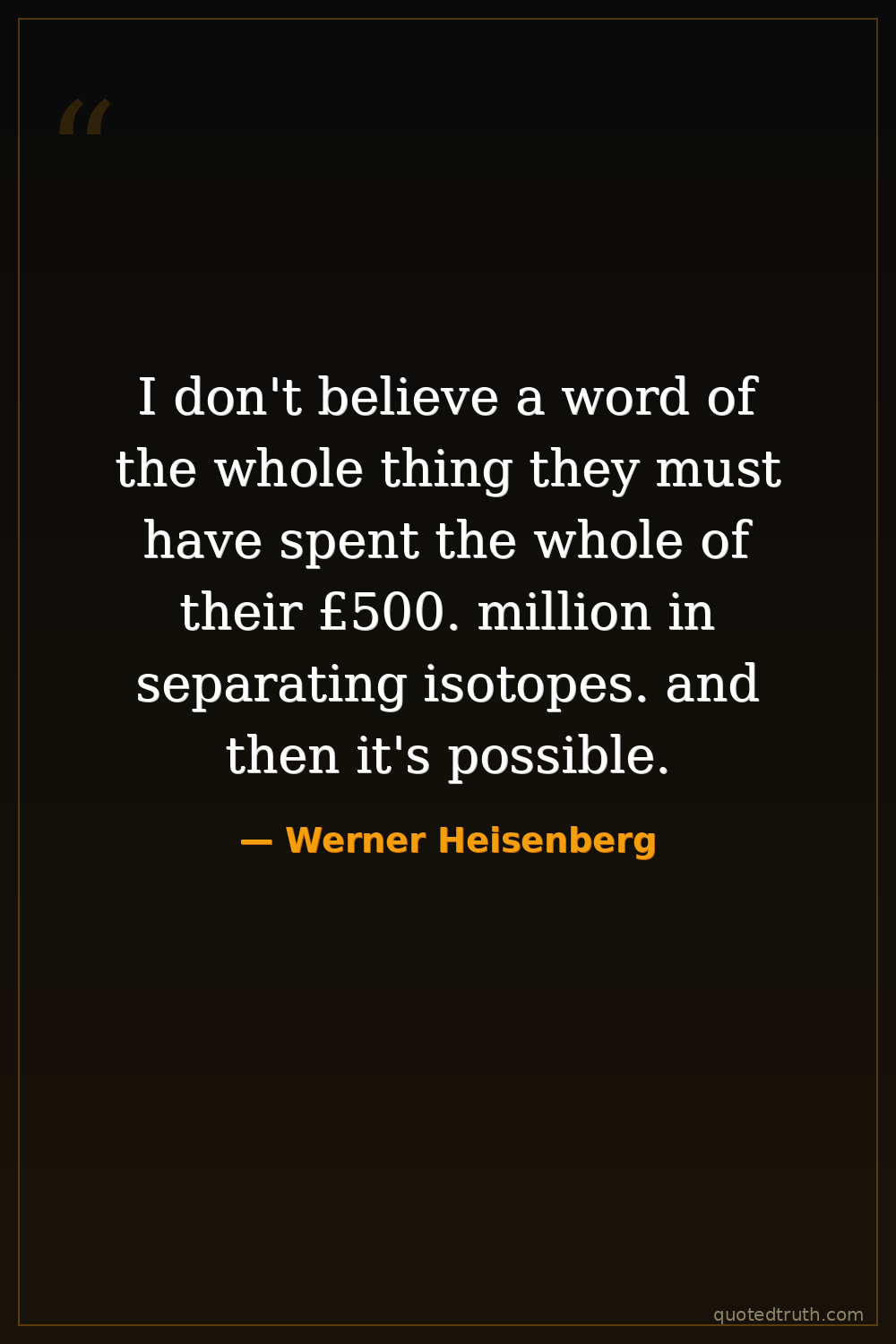
Werner Heisenberg — "I don't believe a word of the whole thing they must have spent the whole of thei…"
I don't believe a word of the whole thing they must have spent the whole of their £500. million in separating isotopes. and then it's possible.
I don't believe a word of the whole thing they must have spent the whole of their £500. million in separating isotopes. and then it's possible.
Click any product to generate a realistic preview. Up to 3 at a time.
* Initial load can take up to 90 seconds — revising the preview in another color is nearly instant.
"An expert is someone who knows some of the worst mistakes that can be made in his subject and how to avoid them."
"One can't say that one could equally well say that's the quickest way of ending the war."
"I am firmly convinced that we must never judge political movements by their aims, no matter how loudly proclaimed or how sincerely upheld, but only by the means they use to realize these aims."
"The path to the nucleus is easy to find, but the nucleus itself is hard to reach."
"I would say that I was absolutely convinced of the possibility of our making a uranium engine. but I never thought that we would make a bomb. and at the bottom of my heart. I was really glad that it w…"
His initial reaction upon hearing about the atomic bombing of Hiroshima, expressing disbelief at the scale of the Allied effort and success.
Date: August 1945
ShockingFound in 1 providers: gemini
1 source checked
The speaker flatly rejects a claim about some massive achievement, suspecting the reported cost alone—£500 million spent separating isotopes—proves the story impossible or exaggerated. In plain terms: he thinks the figure is absurd, and that even if such a fortune were poured into the hardest step of building a bomb, pulling it off would still be barely credible. Disbelief grounded in technical skepticism about scale, expense, and feasibility.
Heisenberg said this at Farm Hall in August 1945, secretly recorded by British intelligence after hearing Hiroshima had been bombed. As Germany's lead nuclear physicist, he had failed to build a working reactor and underestimated the critical mass needed. His incredulity exposes how far behind the Nazi program was, and reflects his lifelong tendency to reason from first principles while defending his wartime record.
August 1945: the atomic bomb had just ended the Pacific war, and captured German scientists were interned at Farm Hall in England. The world was absorbing that nuclear weapons were real, Allied industrial might had outpaced Axis science, and the Cold War arms race was beginning. Heisenberg's stunned reaction captured a pivotal moment when physics shifted from academic pursuit to geopolitical weapon, forcing scientists to reckon with moral responsibility.
AI-generated insights based on extensive research and information for context. Factual errors? Email [email protected].
Your cart is empty