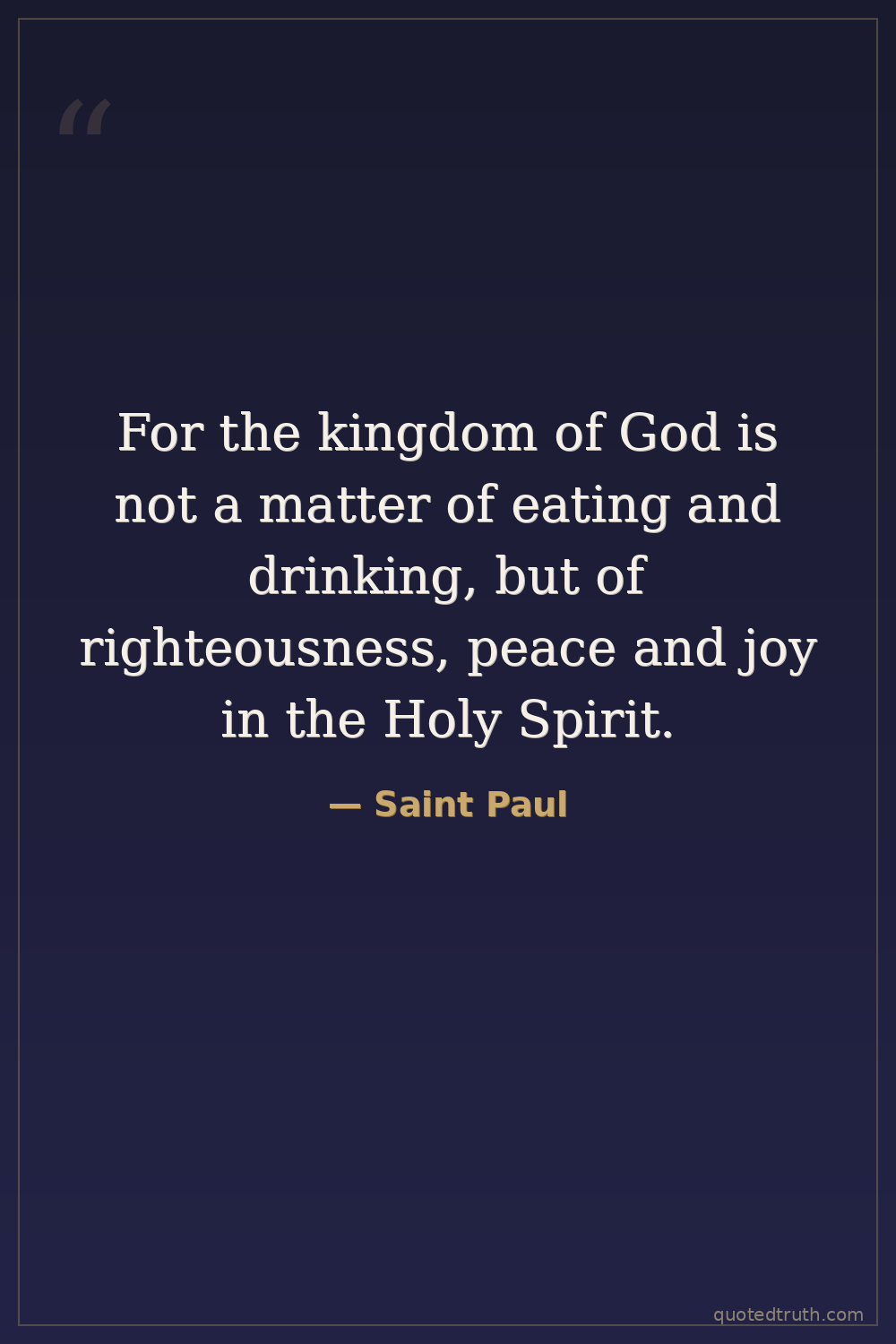
Saint Paul — "For the kingdom of God is not a matter of eating and drinking, but of righteousn…"
For the kingdom of God is not a matter of eating and drinking, but of righteousness, peace and joy in the Holy Spirit.
For the kingdom of God is not a matter of eating and drinking, but of righteousness, peace and joy in the Holy Spirit.
Click any product to generate a realistic preview. Up to 3 at a time.
* Initial load can take up to 90 seconds — revising the preview in another color is nearly instant.
"Not all of those who descend from Israel are Israel."
"Awake to righteousness, and sin not; for some have not the knowledge of God: I speak this to your shame."
"I thank my God, I speak with tongues more than ye all."
"But when completeness comes, what is in part disappears."
"Therefore, if anyone is in Christ, he is a new creation. The old has passed away; behold, the new has come."
Found in 2 providers: grok,gemini
2 sources checked
True spiritual life isn't defined by external rituals, dietary rules, or religious customs around food and drink. What actually matters is living rightly with others, maintaining inner peace, and experiencing genuine joy through a connection to something greater. The point: stop arguing over surface practices and focus on the deeper qualities that define a meaningful, ethical existence. Character and inner state outweigh ceremony.
Paul spent his ministry mediating fierce disputes between Jewish and Gentile converts over kosher laws, circumcision, and meat sacrificed to idols. A former Pharisee trained under Gamaliel, he knew ritual law intimately but reframed Christianity around inward transformation rather than dietary observance. This line, from Romans 14, captures his core pastoral strategy: refuse to let secondary practices fracture communities he planted across the Mediterranean.
First-century Mediterranean communities were obsessed with food purity: Jewish kashrut rules, Greco-Roman temple sacrifices, and pagan feast customs. Early Christian congregations mixed Jews and Gentiles who disagreed violently about what believers could eat. Meat sold in markets often came from idol temples. Paul wrote during Nero's reign, when small house-churches risked splintering over these disputes, and unity mattered for survival against Roman suspicion.
AI-generated insights based on extensive research and information for context. Factual errors? Email [email protected].
Your cart is empty