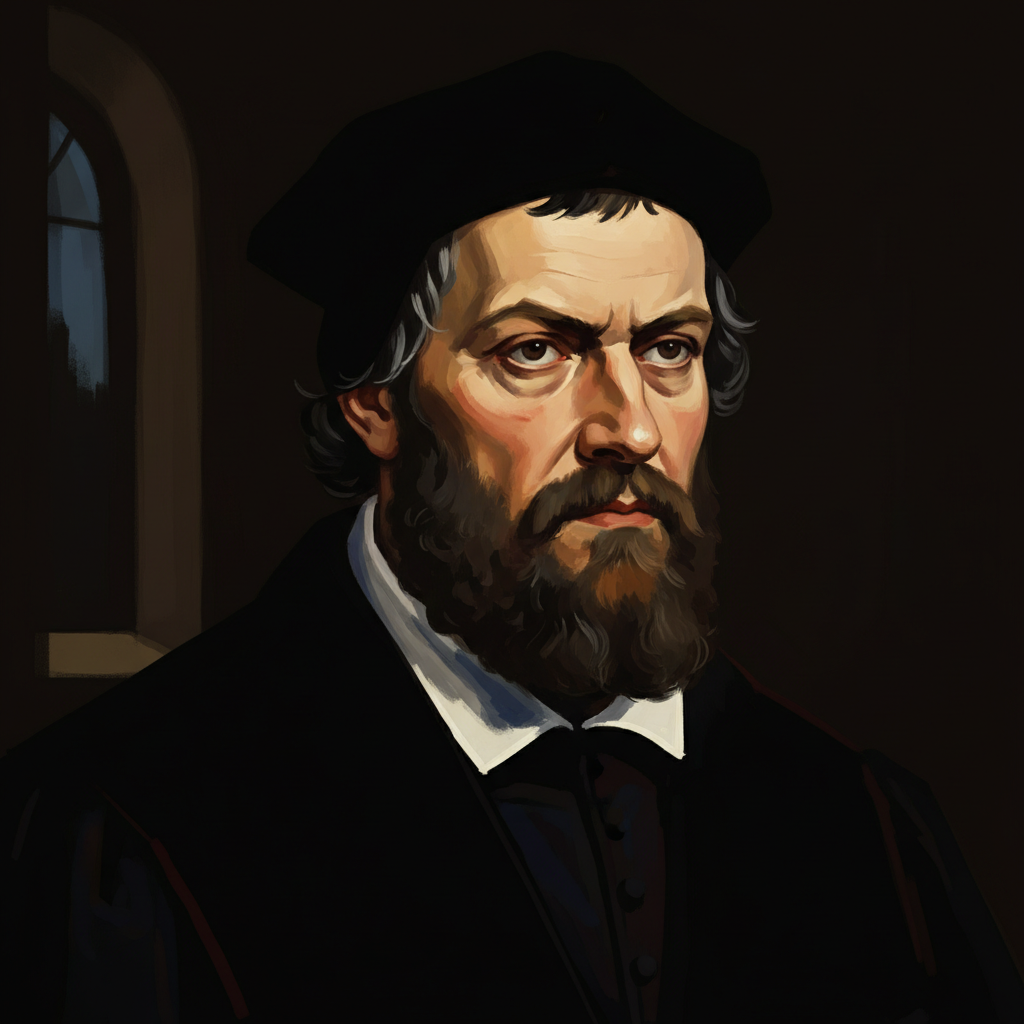
Martin Luther — "I am but a man prone to let himself be swept off his feet by society, drunkennes…"
I am but a man prone to let himself be swept off his feet by society, drunkenness, and the movements of the flesh.
I am but a man prone to let himself be swept off his feet by society, drunkenness, and the movements of the flesh.
Click any product to generate a realistic preview. Up to 3 at a time.
* Initial load can take up to 90 seconds — revising the preview in another color is nearly instant.
"I have not invented a new doctrine, but have only restored the old one."
"The world is a great book, of which they who never stir from home read only one page."
"Those who despise these, or treat them with contempt, are worthy of purchasing, adoring, and praising the pope's excrement as balsam."
"I never learned anything by being told, but only by doing."
"If you want to change the world, pick up your pen."
German theologian whose 95 Theses (1517) launched the Protestant Reformation and broke the Catholic Church's monopoly on Western Christianity. Closely associated with Philipp Melanchthon (Lutheran systematizer) and John Calvin (later Reformer who built on Luther's break). For an intellectual contrast, see Pope Leo X, Renaissance pope (1513-1521) — Leo X's indulgence sales triggered Luther's break and Leo excommunicated him in 1521 — Luther's entire Reformation is structured as a direct answer to the indulgence-funded Vatican Leo represented.
Found in 1 providers: gemini
1 source checked
Luther openly admits he is an ordinary human who struggles with common temptations: being influenced by the crowd, drinking too much, and sexual desire. Rather than claiming moral superiority, he confesses that he gets pulled along by social pressure and physical appetites like anyone else. It is a candid acknowledgment that willpower alone cannot always resist these pulls, and that self-awareness about one's weaknesses is more honest than pretending to be above them.
Luther, an Augustinian monk turned reformer, built his theology around human sinfulness and salvation by grace alone, not personal merit. He was famously blunt, enjoyed beer at his Wittenberg table talks, married former nun Katharina von Bora, and wrote frankly about bodily urges. This admission fits his core conviction that even the devout remain 'simul justus et peccator'—simultaneously righteous and sinner—making confession of weakness, not pretended holiness, the mark of genuine faith.
In early-modern Europe (1500s), the Catholic Church demanded outward piety, clerical celibacy, and purchased indulgences for sin. Luther's 1517 Ninety-Five Theses ignited the Reformation, shattering religious unity amid peasant revolts, printing-press pamphlet wars, and brutal sectarian conflict. Public figures were expected to project saintly discipline, so a prominent theologian openly naming drunkenness and fleshly weakness was radical—mirroring Luther's broader attack on hypocritical religiosity and his insistence that grace, not performed perfection, saves.
AI-generated insights based on extensive research and information for context. Factual errors? Email [email protected].
Your cart is empty