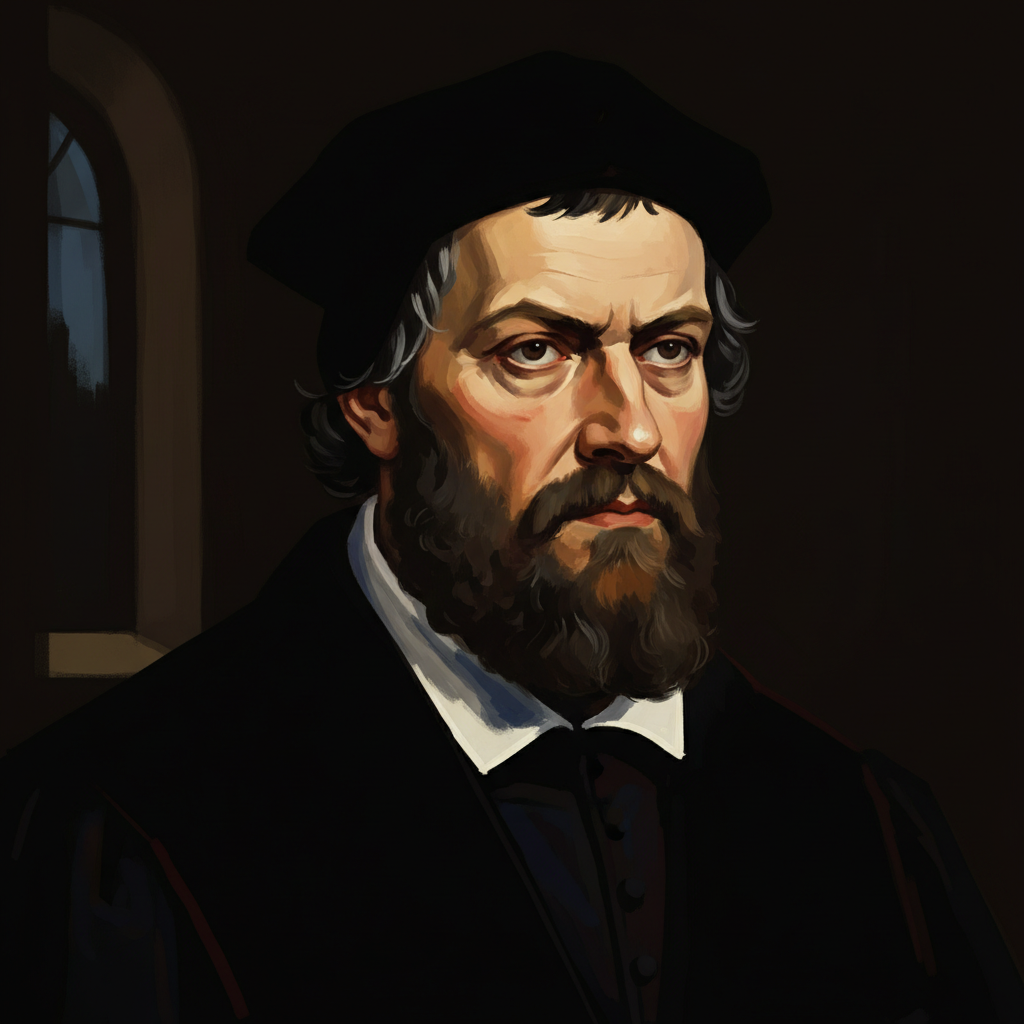
Martin Luther — "I have not invented a new doctrine, but have only restored the old one."
I have not invented a new doctrine, but have only restored the old one.
I have not invented a new doctrine, but have only restored the old one.
Click any product to generate a realistic preview. Up to 3 at a time.
* Initial load can take up to 90 seconds — revising the preview in another color is nearly instant.
"The assembly of his greased and religious crew in praying was altogether like the croaking of frogs, which edified nothing at all."
"Secondly, their homes also should be razed and destroyed. For they pursue the same aims in them as in their synagogues. Instead they might be lodged under a roof or in a barn, like the gypsies, in ord…"
"When I am assailed by temptation, I find it good to eat, drink, and be merry, so that I may not be alone with the devil."
"A man who has no wife is only half a man."
"The soul can do without anything except the Word of God, without which there is no help for it at all."
German theologian whose 95 Theses (1517) launched the Protestant Reformation and broke the Catholic Church's monopoly on Western Christianity. Closely associated with Philipp Melanchthon (Lutheran systematizer) and John Calvin (later Reformer who built on Luther's break). For an intellectual contrast, see Pope Leo X, Renaissance pope (1513-1521) — Leo X's indulgence sales triggered Luther's break and Leo excommunicated him in 1521 — Luther's entire Reformation is structured as a direct answer to the indulgence-funded Vatican Leo represented.
Found in 1 providers: grok
1 source checked
Luther claims he isn't making up new religious ideas; he's simply bringing back teachings that existed originally but got buried or distorted over time. He positions himself as a restorer rather than an innovator, arguing that what seems radical is actually a return to authentic roots. True reform, in his view, means recovering something lost, not inventing something novel.
Luther spent his career insisting the Reformation was a return to scripture and early church teaching, not rebellion. As an Augustinian monk and theology professor, he grounded his Ninety-Five Theses and doctrine of justification by faith in Paul's epistles and Augustine. This statement captures his self-image: a biblical scholar recovering gospel truth from medieval accretions, not a heretic inventing novelties.
In early 16th-century Europe, the Catholic Church dominated spiritual and political life, and indulgence sales funded St. Peter's Basilica. Humanist scholars were returning to original Greek and Hebrew sources, fueling demands for reform. Accusations of heresy carried lethal consequences, so framing reform as restoration of ancient Christianity gave Luther theological cover and rhetorical power against charges that he was fracturing Christendom with dangerous innovations.
AI-generated insights based on extensive research and information for context. Factual errors? Email [email protected].
Your cart is empty