Laozi — "When nothing is done, nothing is left undone."
When nothing is done, nothing is left undone.
When nothing is done, nothing is left undone.
Click any product to generate a realistic preview. Up to 3 at a time.
* Initial load can take up to 90 seconds — revising the preview in another color is nearly instant.
"The sage embraces the One and becomes the model of the world. He does not display himself, therefore he shines. He does not assert himself, therefore he is distinguished. He does not boast, therefore …"
"The whole world knows that the good is good, and this is how evil arises. The whole world knows that the beautiful is beautiful, and this is how ugliness arises."
"The sage puts his person last, and it comes first. He treats his person as an outsider, and it is preserved."
"Water is fluid, soft, and yielding. But water will wear away rock, which is rigid and cannot yield. As a rule, whatever is fluid, soft, and yielding will overcome whatever is rigid and hard. This is a…"
"The greatest flaw is to desire more."
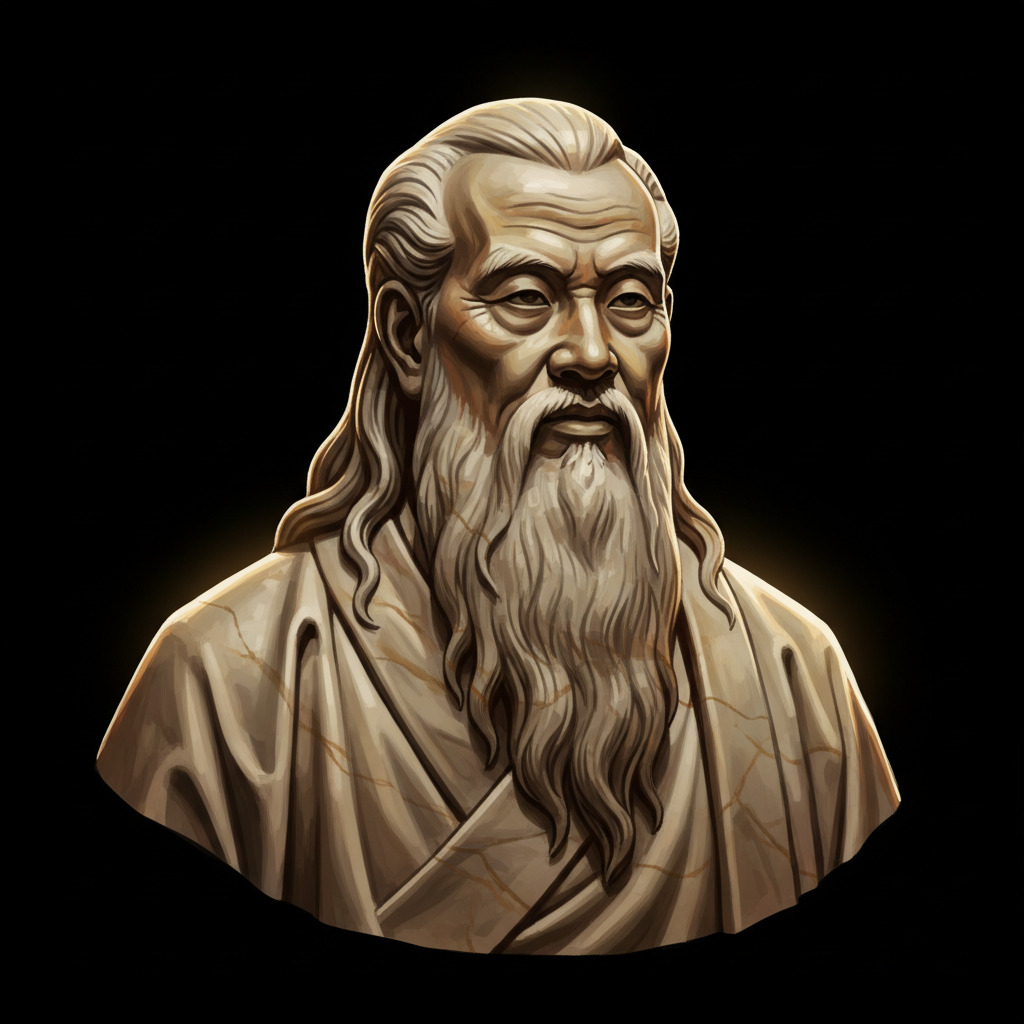
Reputed founder of Taoism and author of the Tao Te Ching, whose wu wei (effortless action) shaped East Asian philosophy. Closely associated with Zhuangzi (later Taoist who extended Laozi's framework). For an intellectual contrast, see Confucius, near-contemporary Chinese sage of social ritual and duty — Confucius systematized social order through ritual and hierarchy; Laozi argued that all such systems were the disease, not the cure — the two founding poles of Chinese moral philosophy.
Found in 1 providers: gemini
1 source checked
Acting without force or interference often produces better results than constant effort. When you stop pushing against the natural flow of things, events unfold as they should. This is the principle of wu wei, or effortless action. It does not mean literal inactivity, but rather aligning with circumstances instead of imposing your will. Problems solve themselves when you stop overmanaging, and necessary work still gets accomplished.
Laozi built Taoism around wu wei, the idea that the wisest path is non-forcing action aligned with the Dao, the natural order. Traditionally an archivist in the Zhou court, he observed rulers exhaust themselves and their states through ambition and control. He reportedly left civilization disillusioned with political meddling. This saying distills his core teaching: restraint, humility, and surrender to natural rhythms accomplish more than striving, which is why he became the patriarch of Chinese mystical philosophy.
Laozi lived during the late Zhou dynasty, likely the 6th century BCE, as feudal authority crumbled and states drifted toward the Warring States bloodshed. Rulers piled on laws, taxes, and military campaigns, yet chaos deepened. Rival schools like Confucianism prescribed more ritual and hierarchy as the cure. Taoism offered the opposite diagnosis: meddling itself was the disease. In an age of exhausting ambition and constant warfare, advocating stillness and non-interference was a radical political critique, not just personal advice.
AI-generated insights based on extensive research and information for context. Factual errors? Email [email protected].
Your cart is empty