Laozi — "Act without doing; work without effort."
Act without doing; work without effort.
Act without doing; work without effort.
Click any product to generate a realistic preview. Up to 3 at a time.
* Initial load can take up to 90 seconds — revising the preview in another color is nearly instant.
"The difficult is done easily; the easy is done with difficulty."
"Doing nothing is better than being busy doing nothing."
"He who knows that enough is enough will always have enough."
"One who is too insistent on his own views finds few who agree with him."
"Govern a great nation as you would cook a small fish. (Do not overdo it.)"
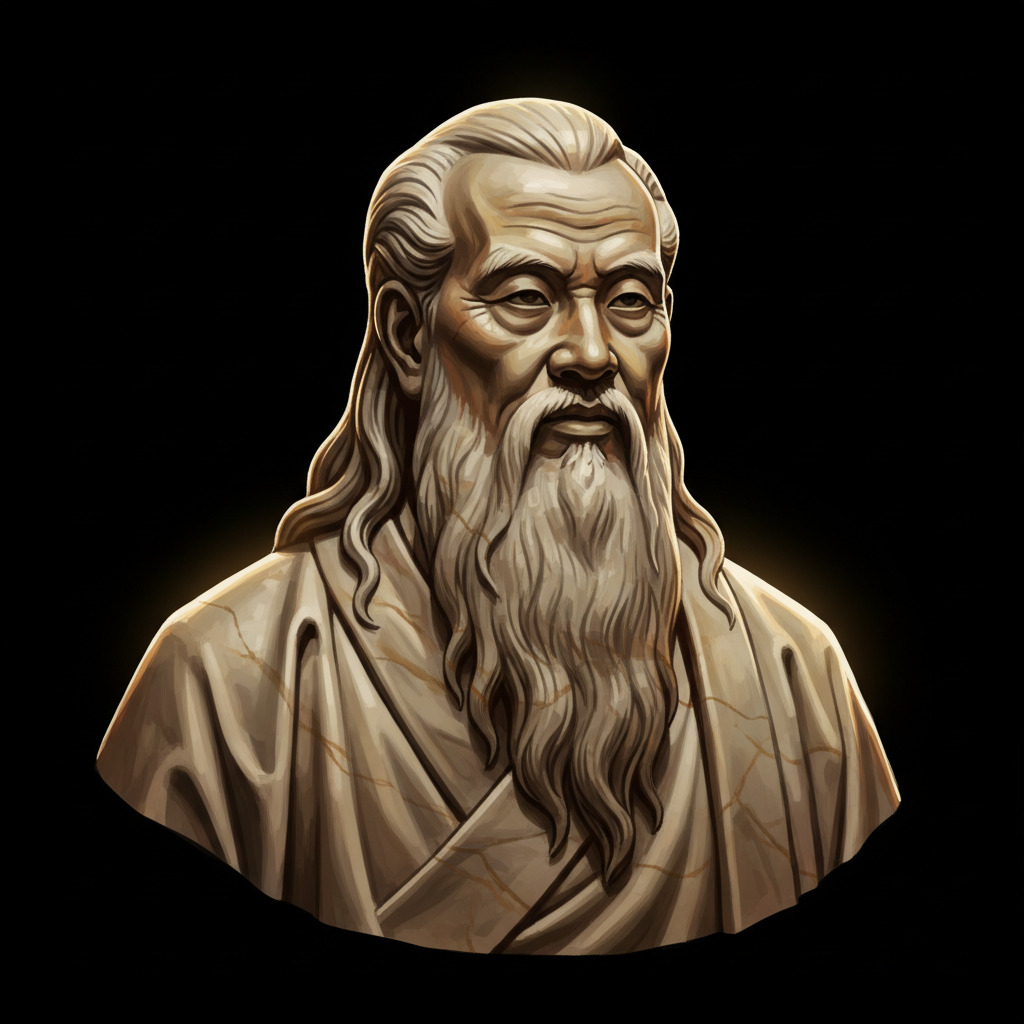
Reputed founder of Taoism and author of the Tao Te Ching, whose wu wei (effortless action) shaped East Asian philosophy. Closely associated with Zhuangzi (later Taoist who extended Laozi's framework). For an intellectual contrast, see Confucius, near-contemporary Chinese sage of social ritual and duty — Confucius systematized social order through ritual and hierarchy; Laozi argued that all such systems were the disease, not the cure — the two founding poles of Chinese moral philosophy.
Found in 1 providers: gemini
1 source checked
True effectiveness comes from aligning with the natural flow of situations rather than forcing outcomes through strain. When you stop pushing against reality and respond to what each moment actually requires, tasks get accomplished without the exhaustion of willpower. It is the difference between swimming with a current and fighting it. Productivity without burnout happens when action emerges from awareness instead of anxiety, leaving no friction between intention and result.
Laozi served as an archivist in the Zhou royal court, observing bureaucratic striving before withdrawing from public life. His core concept of wu wei, effortless action, sits at the heart of the Tao Te Ching he reputedly wrote before leaving civilization westward. Legend says he departed because forced governance had corrupted natural order. This saying distills his conviction that sages accomplish more by yielding than by imposing, a belief shaped by watching ambitious officials destroy themselves.
Laozi lived during the late Zhou dynasty, around the 6th century BCE, as feudal order fractured into the Warring States period. Rival kingdoms raised armies, ministers schemed, and Confucian scholars pushed rigorous social rituals as the cure. Against this backdrop of aggressive intervention and moral engineering, Laozi's counsel of non-forcing was radical. It offered an alternative to both military conquest and elaborate bureaucracy, proposing that harmony returns when rulers and individuals stop manipulating outcomes.
AI-generated insights based on extensive research and information for context. Factual errors? Email [email protected].
Your cart is empty