Laozi — "The sage's Way is to act and not to contend."
The sage's Way is to act and not to contend.
The sage's Way is to act and not to contend.
Click any product to generate a realistic preview. Up to 3 at a time.
* Initial load can take up to 90 seconds — revising the preview in another color is nearly instant.
"To know that you do not know is the best. To think you know when you do not is a disease."
"All things in the world come from being. And being comes from non-being."
"The more prohibitions there are, the poorer the people become. The more sharp weapons the people have, the more troubled the state becomes. The more cunning and skill man possesses, the more peculiar …"
"The gentlest thing in the world can ride through the hardest thing in the world."
"He who values himself more than the world can be entrusted with the world. He who loves himself more than the world can be charged with the world."
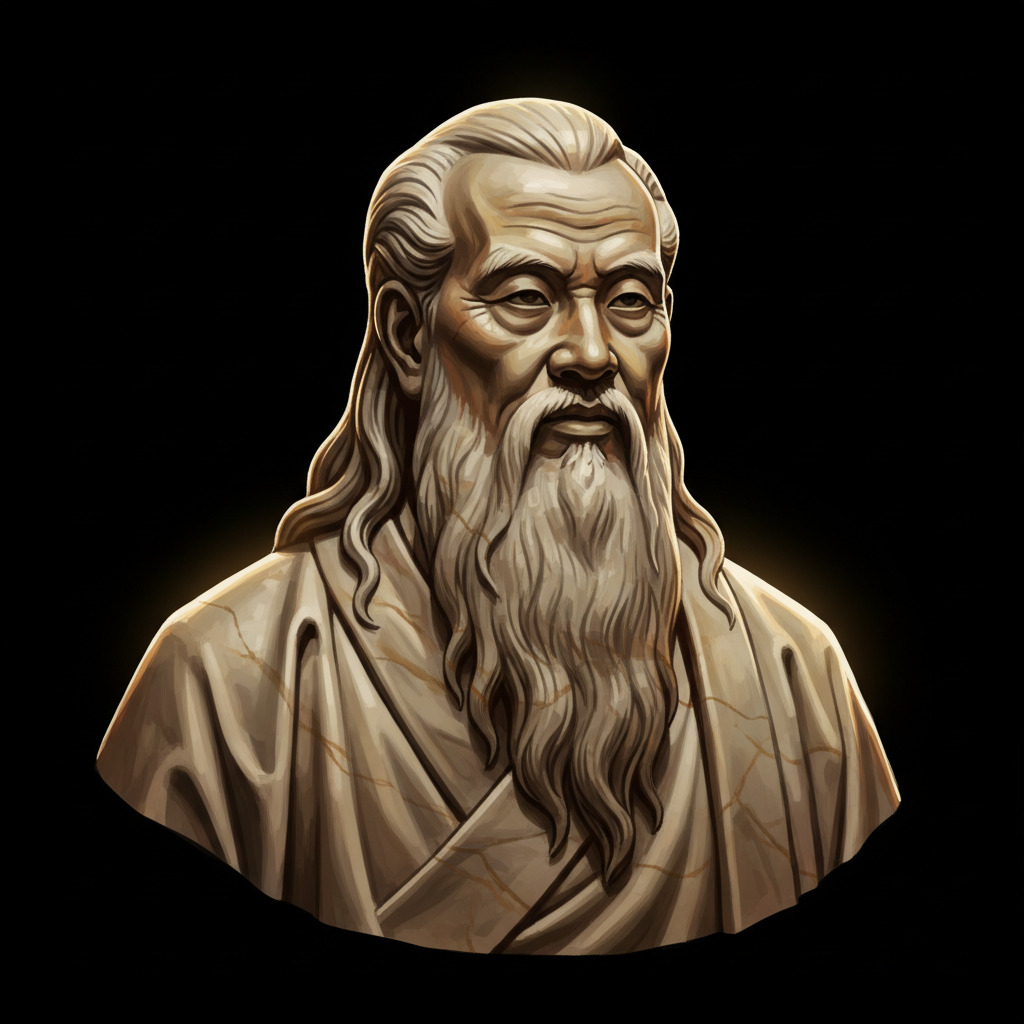
Reputed founder of Taoism and author of the Tao Te Ching, whose wu wei (effortless action) shaped East Asian philosophy. Closely associated with Zhuangzi (later Taoist who extended Laozi's framework). For an intellectual contrast, see Confucius, near-contemporary Chinese sage of social ritual and duty — Confucius systematized social order through ritual and hierarchy; Laozi argued that all such systems were the disease, not the cure — the two founding poles of Chinese moral philosophy.
Found in 1 providers: gemini
1 source checked
A wise person focuses on doing their work effectively rather than competing, arguing, or fighting for recognition. They take action when needed, but they do not push against others, seek credit, or try to win. By refusing to engage in rivalry, they avoid the friction and exhaustion that come from constant struggle, and their efforts tend to succeed more naturally because nothing stands in opposition to them.
Laozi, the traditional founder of Taoism, taught wu wei, meaning effortless action aligned with the natural flow of things. Legend holds he served as an archivist in the Zhou royal court before withdrawing from public life, disillusioned with political ambition. This saying captures his core conviction: real power comes not from dominance or striving, but from yielding, simplicity, and acting without ego, mirroring how water shapes stone without forcing.
Laozi lived during China's late Zhou dynasty, around the 6th century BCE, as central authority was fracturing into the bloody Warring States period. Rival lords, scheming ministers, and endless military campaigns defined daily politics, and Confucian scholars competed for court influence through ritual and hierarchy. Against this culture of ambition and contention, Laozi's teaching offered a radical alternative: withdraw from the rat race, act humbly, and let outcomes unfold without forcing them.
AI-generated insights based on extensive research and information for context. Factual errors? Email [email protected].
Your cart is empty