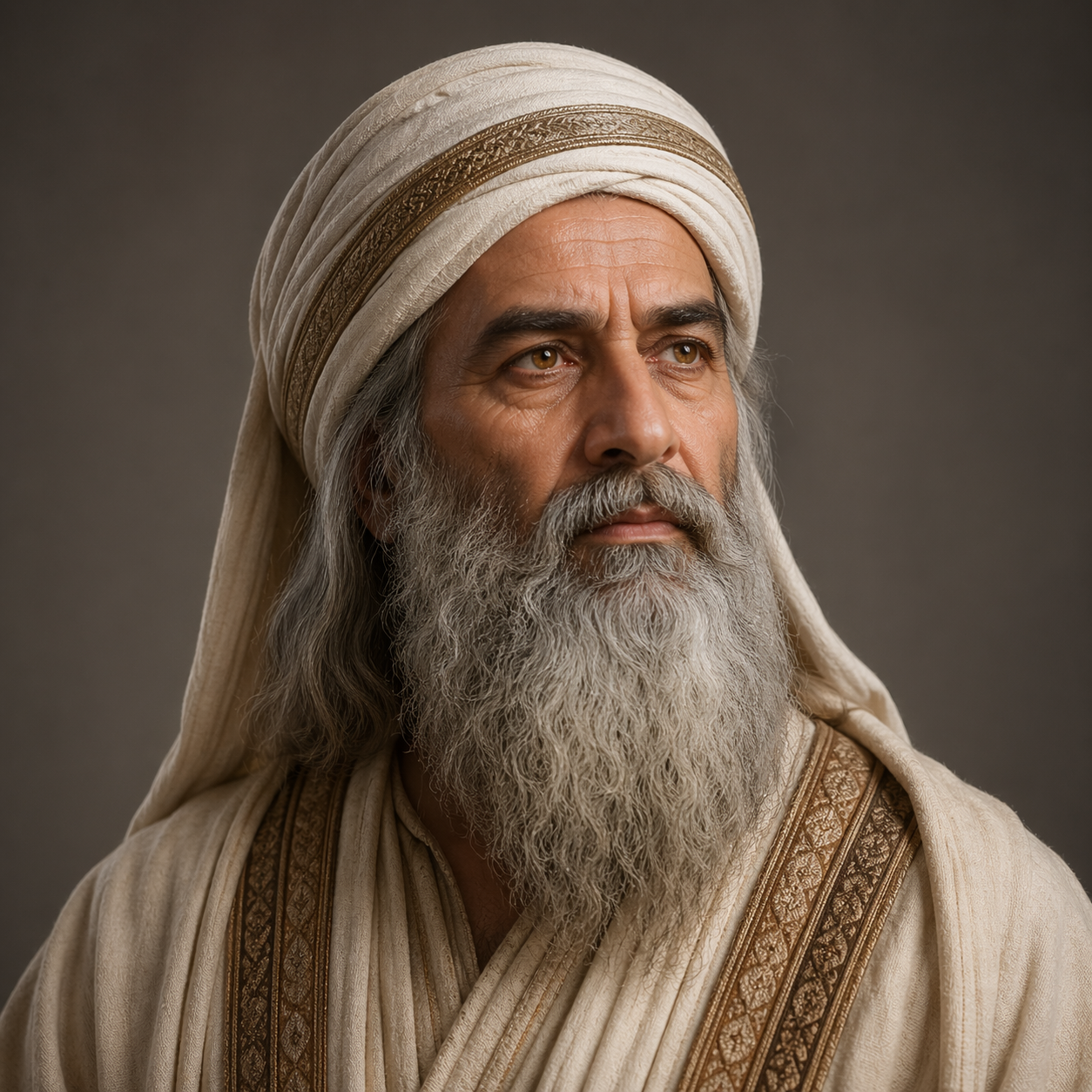
Zoroaster — "How shall I satisfy Thee, O Ahura Mazda?"
How shall I satisfy Thee, O Ahura Mazda?
How shall I satisfy Thee, O Ahura Mazda?
Click any product to generate a realistic preview. Up to 3 at a time.
* Initial load can take up to 90 seconds — revising the preview in another color is nearly instant.
"For the wicked man, the end of existence shall be long darkness, ill food, and the word 'woe!'"
"False gods bring destruction, but the Wise Lord brings salvation."
"By Your fire, O Ahura Mazda, by Your truth, for its shining power, for its fiery glow, for its burning heat, we shall distinguish the upright from the wicked."
"Seek your happiness in the happiness of all."
"The greatest weapon against evil is righteousness."
Iranian prophet who founded Zoroastrianism, the first major religion of cosmic dualism between good (Ahura Mazda) and evil (Angra Mainyu). Closely associated with The Buddha (near-contemporary Eastern moral-cosmological revolutionary). For an intellectual contrast, see Friedrich Nietzsche, German philosopher of 'beyond good and evil' — Nietzsche appropriated Zarathustra's name for Thus Spoke Zarathustra (1883) precisely to invert the original's moral cosmology — the historical Zoroaster founded the good-versus-evil framework Nietzsche's character announces the end of.
Found in 1 providers: gemini
1 source checked
This is a sincere question asked to the supreme god, wondering what actions, thoughts, or offerings would genuinely please the divine. Rather than assuming the speaker already knows the right path, it admits humility and a desire to learn. It treats devotion as an ongoing relationship requiring honest inquiry, not routine ritual. The speaker wants to align personal conduct with divine will and asks directly how to do so.
Zoroaster spent years in contemplation before receiving visions of Ahura Mazda, the supreme wise lord he proclaimed. As a reforming priest who rejected the ritualistic polytheism of his people, he emphasized direct, personal dialogue with the divine over priestly intermediaries. His Gathas, the oldest Zoroastrian hymns, are full of such searching questions. This line captures his lifelong mission to discern and teach right thought, right word, and right action.
Around 1500-1000 BCE in ancient Persia, religion was dominated by animal sacrifices, intoxicating rituals, and many warring deities administered by a hereditary priestly class. Ordinary worshippers had little personal access to the gods. Zoroaster's reform introduced a single supreme creator, ethical monotheism, and the idea that each person's choices mattered cosmically. Asking the god directly how to please him was radical, replacing transactional sacrifice with moral accountability during an age of tribal upheaval.
AI-generated insights based on extensive research and information for context. Factual errors? Email [email protected].
Your cart is empty