Martin Luther — "A Christian is a perfectly free lord of all, subject to none. A Christian is a p…"
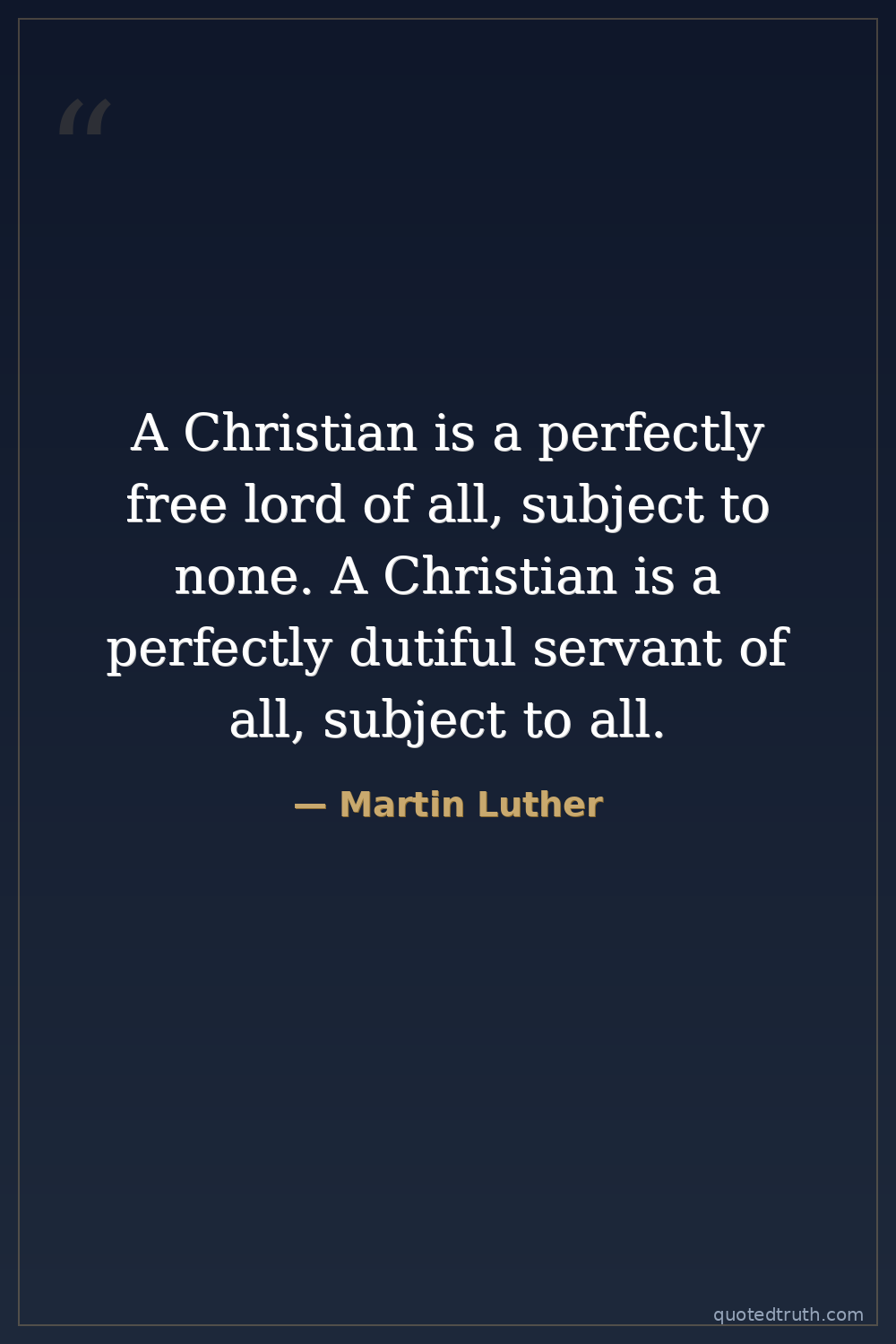
A Christian is a perfectly free lord of all, subject to none. A Christian is a perfectly dutiful servant of all, subject to all.
A Christian is a perfectly free lord of all, subject to none. A Christian is a perfectly dutiful servant of all, subject to all.
Click any product to generate a realistic preview. Up to 3 at a time.
* Initial load can take up to 90 seconds — revising the preview in another color is nearly instant.
"I would rather have my tongue cut out than retract a single syllable."
"Next to the Word of God, the noble art of music is the greatest treasure in the world. It controls our thoughts, minds, hearts, and spirits."
"The word and work of God is quite clear, namely, that women were made to be either wives or prostitutes."
"The best way to preach is to get down to the level of the people."
"He who does not understand the devil, does not understand God."
German theologian whose 95 Theses (1517) launched the Protestant Reformation and broke the Catholic Church's monopoly on Western Christianity. Closely associated with Philipp Melanchthon (Lutheran systematizer) and John Calvin (later Reformer who built on Luther's break). For an intellectual contrast, see Pope Leo X, Renaissance pope (1513-1521) — Leo X's indulgence sales triggered Luther's break and Leo excommunicated him in 1521 — Luther's entire Reformation is structured as a direct answer to the indulgence-funded Vatican Leo represented.
Found in 2 providers: gemini,grok
2 sources checked
True freedom and service aren't opposites—they coexist. Inner freedom comes from faith alone, not from rules or institutions, so no person or authority can claim dominion over your conscience. Yet that same freedom reorients you outward: loved by grace, you willingly serve everyone around you without obligation or reward. Autonomy before God produces voluntary responsibility toward neighbors, turning liberty into love rather than license.
This paradox sits at the heart of Luther's 1520 treatise 'On the Freedom of a Christian,' written months before his excommunication. A former Augustinian monk turned reformer, Luther had rejected the papal system of works, indulgences, and clerical hierarchy, arguing justification came by faith alone. Yet he remained deeply pastoral, insisting liberated believers owed selfless service to neighbors. The line captures his entire theology: conscience free from Rome, life bound to others.
The early 1500s saw Europe straining under a corrupt church selling indulgences to fund St. Peter's Basilica, while Gutenberg's press let dissenting ideas spread in weeks rather than generations. Peasants groaned under feudal dues, humanists questioned inherited authority, and Luther's 95 Theses (1517) detonated that tinderbox. In 1520, as the pope drafted his excommunication, Luther redefined Christian identity apart from sacramental control—a radical claim that reshaped politics, literacy, and individual conscience across the continent.
AI-generated insights based on extensive research and information for context. Factual errors? Email [email protected].
Your cart is empty