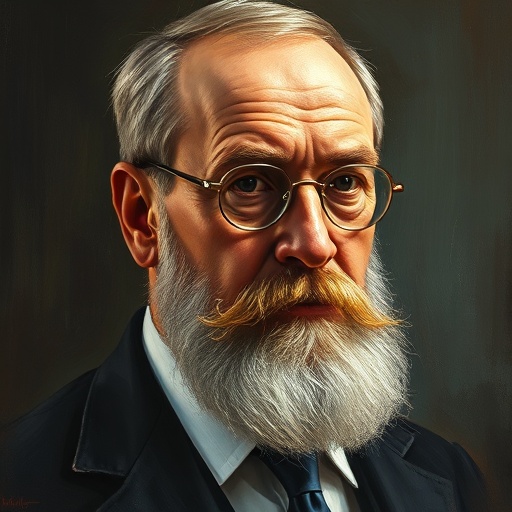
Robert Koch — "A doctor must be able to do two things: see microscopically and think logically."
A doctor must be able to do two things: see microscopically and think logically.
A doctor must be able to do two things: see microscopically and think logically.
Click any product to generate a realistic preview. Up to 3 at a time.
* Initial load can take up to 90 seconds — revising the preview in another color is nearly instant.
"The discovery of the cause of a disease is only the first step towards its eradication."
"The discovery of the cholera bacillus was a very exciting moment in my career."
"I have devoted my life to the study of bacteria, and I have found it to be a most rewarding pursuit."
"The progress of medicine depends on rigorous scientific inquiry."
"The public needs to be educated about the importance of preventing the spread of germs."
Found in 1 providers: deepseek
1 source checked
A good doctor needs two complementary skills: sharp observational precision—seeing fine details others miss—and rigorous analytical reasoning to make sense of those details. Neither alone is enough. Close observation without clear thinking produces confusion; clear thinking without close observation produces speculation. Together, they form the foundation of reliable medical diagnosis and scientific discovery.
Koch embodied this ideal personally. His TB breakthrough in 1882 required painstaking microscopic work—staining and isolating Mycobacterium tuberculosis—combined with the logical discipline of his four postulates, which established a rigorous framework proving specific microbes cause specific diseases. He was simultaneously a craftsman of the microscope and a systematic logical thinker.
Koch worked in the 1870s–1900s, when germ theory was displacing miasma theory. Medicine was transitioning from intuition-based practice to laboratory science. Microscopy had become accessible but was often misused; logical frameworks for causation were still being developed. Koch's insistence on both skills helped professionalize bacteriology and set standards that transformed medicine into a rigorous empirical discipline.
AI-generated insights based on extensive research and information for context. Factual errors? Email [email protected].
Your cart is empty