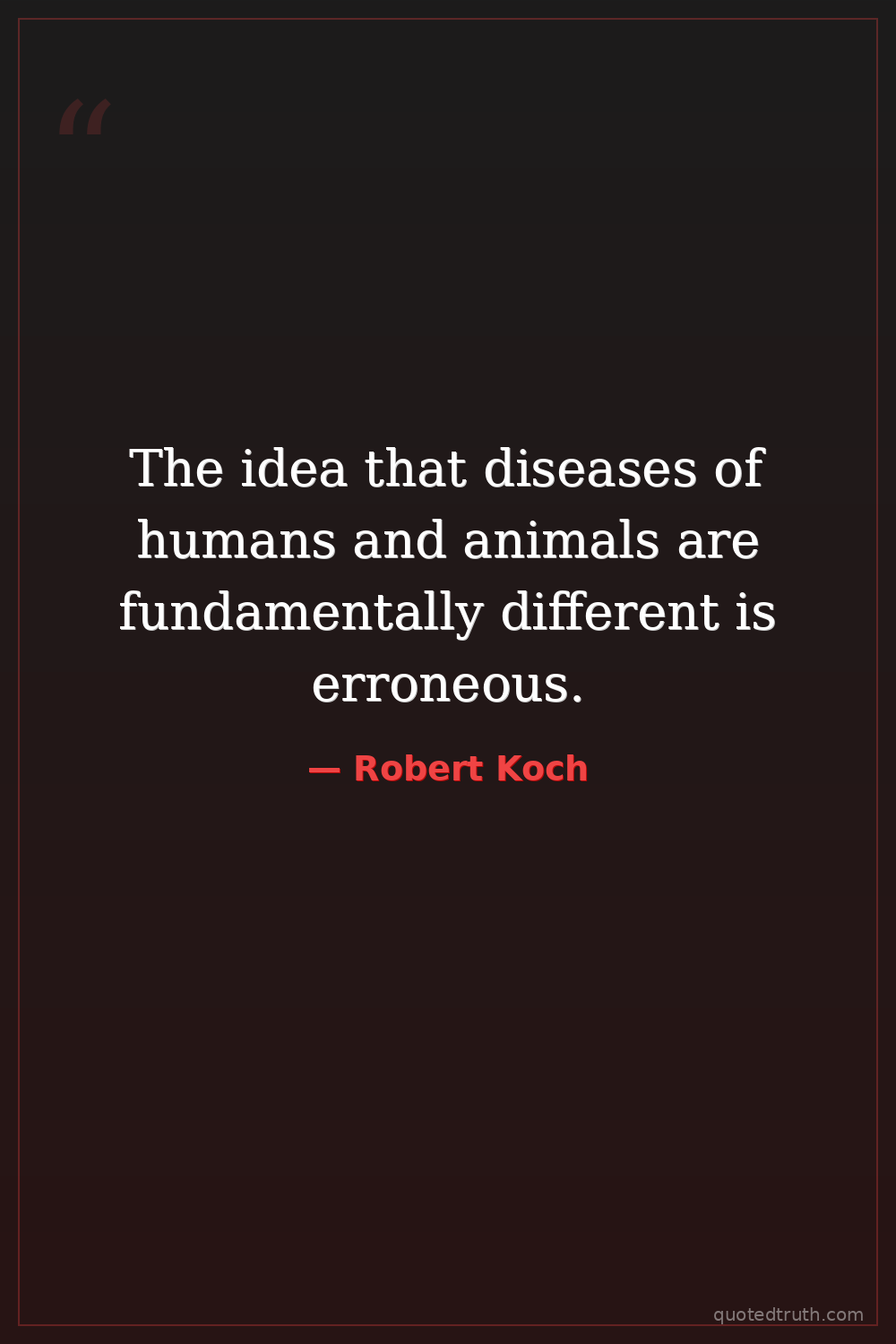
Robert Koch — "The idea that diseases of humans and animals are fundamentally different is erro…"
The idea that diseases of humans and animals are fundamentally different is erroneous.
The idea that diseases of humans and animals are fundamentally different is erroneous.
Click any product to generate a realistic preview. Up to 3 at a time.
* Initial load can take up to 90 seconds — revising the preview in another color is nearly instant.
"My experiments on anthrax were some of the most challenging of my career."
"The public needs to be educated about the importance of preventing the spread of germs."
"The fight against infectious diseases is a global concern."
"A doctor must be able to do two things: see microscopically and think logically."
"A disease is not an entity, but a process."
Found in 1 providers: deepseek
1 source checked
Pathogens don't recognize species boundaries — a bacterium or virus that sickens livestock operates by the same biological principles when it infects a human. The machinery of infection, immune response, and disease progression is shared across mammals and other animals. Treating human medicine and veterinary medicine as wholly separate disciplines leads to blind spots. Understanding disease in one species directly informs understanding disease in another.
Koch proved this through practice, not just theory. His foundational postulates required inducing disease in healthy animals to confirm microbial causation in humans — blurring the species line by design. He first demonstrated germ theory on anthrax, a disease killing both sheep and people via identical bacteria. His tuberculosis research forced direct comparison of bovine and human TB strains. His entire scientific method assumed shared biology across species.
In the 1870s–1900s, human medicine and veterinary medicine were entirely separate professions with no formal collaboration. Anthrax regularly wiped out European livestock herds and killed farmers handling them. Cholera, plague, and typhoid ravaged cities. Germ theory was still contested. Koch's era saw the first systematic recognition that cattle, sheep, pigs, and people could share identical infectious agents — a radical departure from the dominant view that animal and human illness had distinct, unrelated causes.
AI-generated insights based on extensive research and information for context. Factual errors? Email [email protected].
Your cart is empty