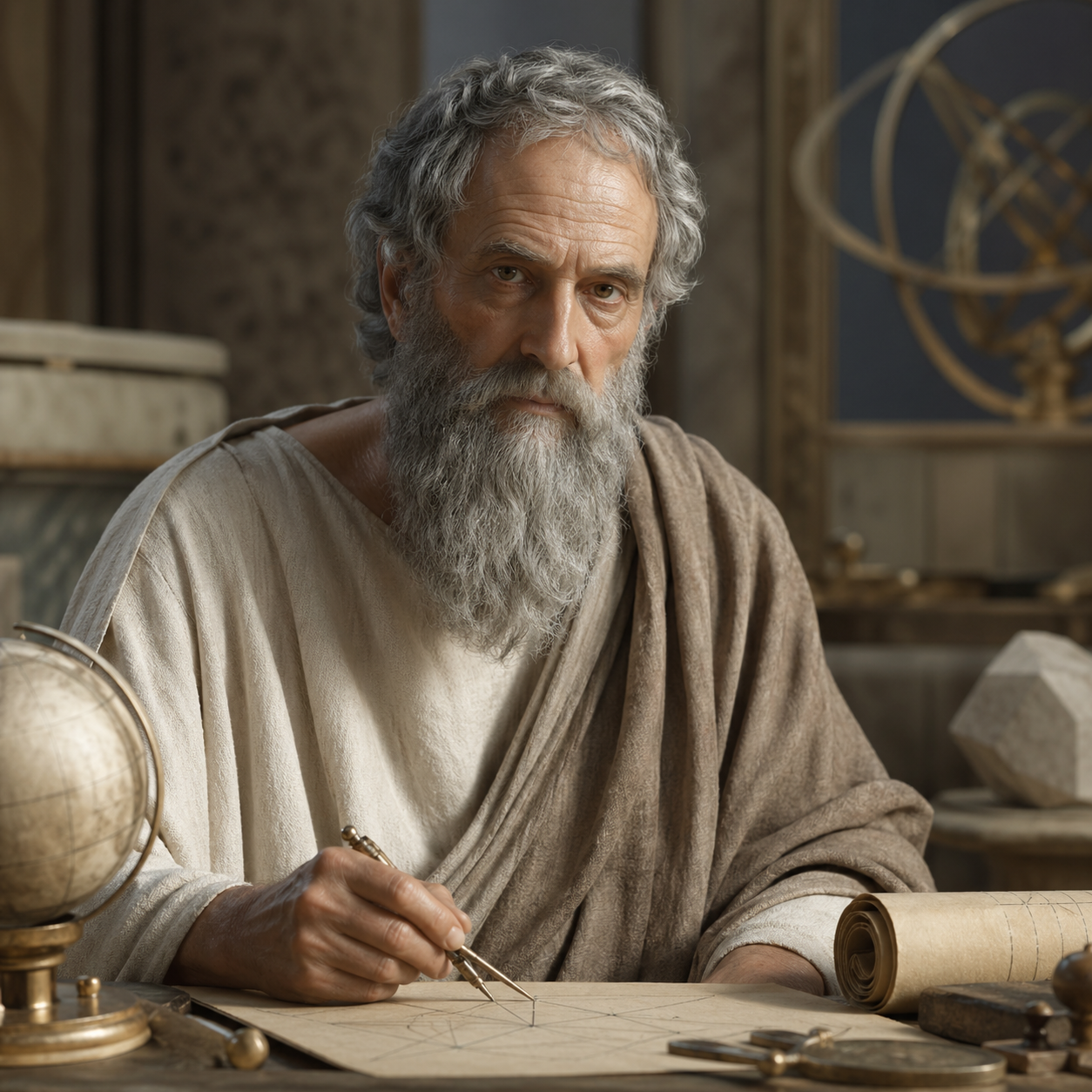
Euclid — "A point is that which has no part."
A point is that which has no part.
A point is that which has no part.
Click any product to generate a realistic preview. Up to 3 at a time.
* Initial load can take up to 90 seconds — revising the preview in another color is nearly instant.
"Of trilateral figures, an equilateral triangle is that which has its three sides equal, an isosceles triangle that which has two of its sides alone equal, and a scalene triangle that which has its thr…"
"Proof by contradiction is a powerful tool."
"A plane surface is a surface which lies evenly with the straight lines on itself."
"If a straight line be cut into two equal parts and also into two unequal parts, the rectangle contained by the unequal parts together with the square on the line between the points of section is equal…"
"Rectilinear figures are those which are contained by straight lines, trilateral figures being those contained by three, quadrilateral those contained by four, and multilateral those contained by more …"
Found in 3 providers: grok,deepseek,gemini
3 sources checked
The simplest possible building block of all geometry — a location with no size, no length, no width, no depth. It exists only as a position. Because it has no parts, it cannot be divided or measured. Everything in geometry — lines, shapes, solids — is ultimately built from points. This definition insists that complex structures must begin with something irreducibly simple and precise.
Euclid opened his Elements — the most studied mathematical text in history — with this as Definition 1, Book I. His genius was methodological: begin with undeniable first principles and derive all geometry through pure logic. This sentence encapsulates his life's work — rigorous, austere, building vast complexity from atomic simplicity. When King Ptolemy asked for a shortcut to geometry, Euclid reportedly replied there is no royal road.
Around 300 BCE, Alexandria had become the intellectual capital of the Hellenistic world under Ptolemy I. Greek thinkers were systematizing all knowledge — philosophy, medicine, astronomy, mathematics — and the Library of Alexandria was being assembled. Euclid codified centuries of scattered Greek geometric discoveries into one logical system. Systematic proof-based reasoning was a Greek cultural innovation, replacing earlier intuitive or mystical approaches to understanding space and number.
AI-generated insights based on extensive research and information for context. Factual errors? Email [email protected].
Your cart is empty