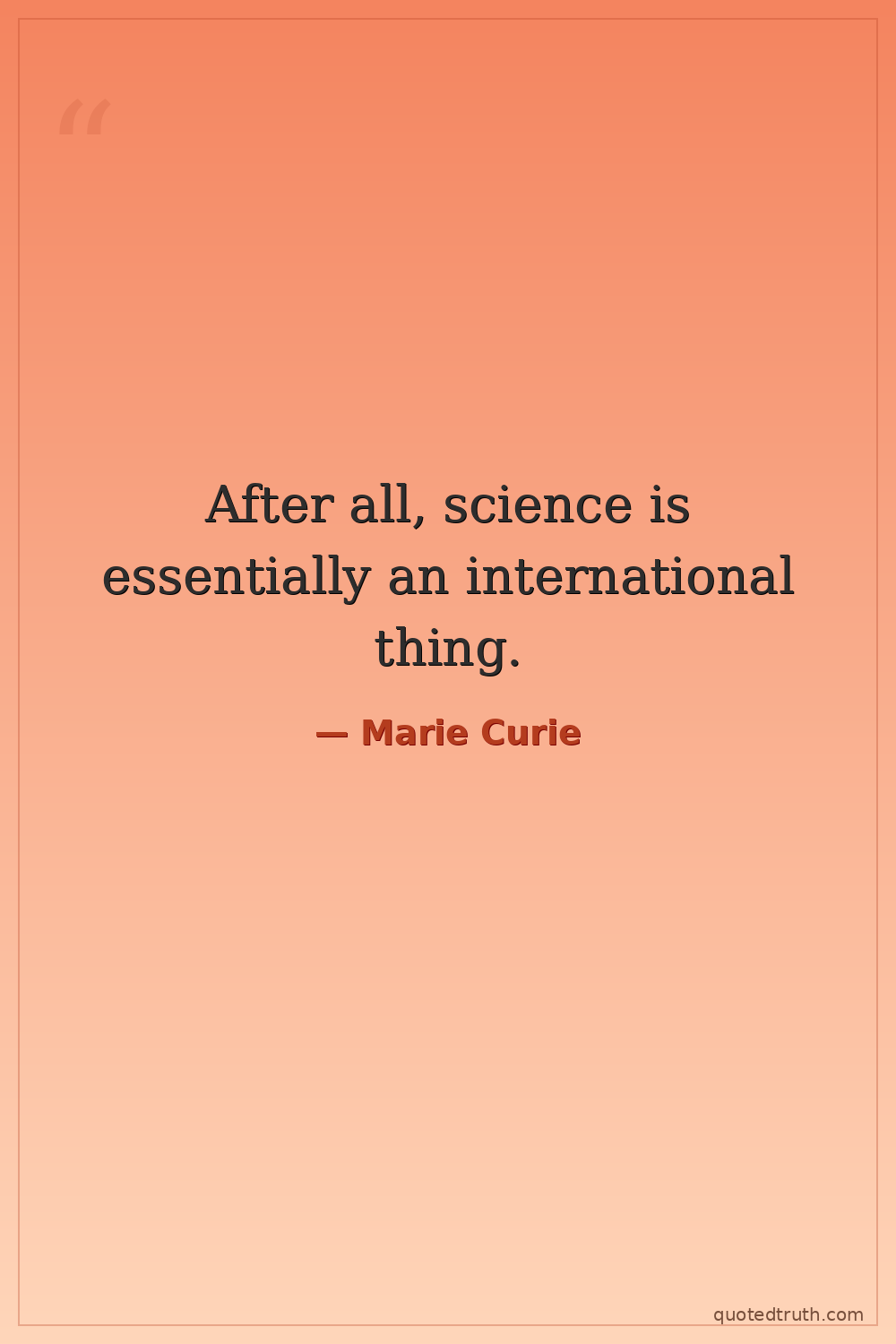
Marie Curie — "After all, science is essentially an international thing."
After all, science is essentially an international thing.
After all, science is essentially an international thing.
Click any product to generate a realistic preview. Up to 3 at a time.
* Initial load can take up to 90 seconds — revising the preview in another color is nearly instant.
"I have always believed that science has the power to change the world for the better. I have always believed that science has the power to improve the lives of all people. And I am proud of it."
"I never saw myself as a woman in science. I saw myself as a scientist. And I am proud of it."
"I am one of those who think like Nobel, that humanity will draw more good than evil from new discoveries."
"There are sadistic scientists who hurry to hunt down errors instead of establishing the truth."
"I have tried to preserve the memory of Pierre Curie and to perpetuate the work which was the object of his life."
Found in 1 providers: grok
1 source checked
Scientific knowledge does not belong to any single country. Discoveries, methods, and data cross borders freely because nature works the same everywhere. Researchers build on each other's findings regardless of nationality, and progress depends on sharing results openly across languages and political lines. Treating science as a national possession slows everyone down, while cooperation accelerates understanding for all humanity.
Curie lived this belief. Born Polish, she studied and worked in France, collaborated with British, German, and American scientists, and refused to patent radium so researchers worldwide could use it freely. She toured the United States to raise funds for her Paris lab and founded the Radium Institute in Warsaw, deliberately linking her adopted and native countries through research rather than guarding discoveries for national glory.
Curie worked while European nationalism hardened into the rivalries that produced World War I, which she served by driving mobile X-ray units to the front. Afterward, governments increasingly tied science to military and economic power, and laboratories competed for prestige. Her insistence on international scientific community pushed against that tide, aligning with early League of Nations efforts at intellectual cooperation, where she served on the Committee on Intellectual Cooperation.
AI-generated insights based on extensive research and information for context. Factual errors? Email [email protected].
Your cart is empty