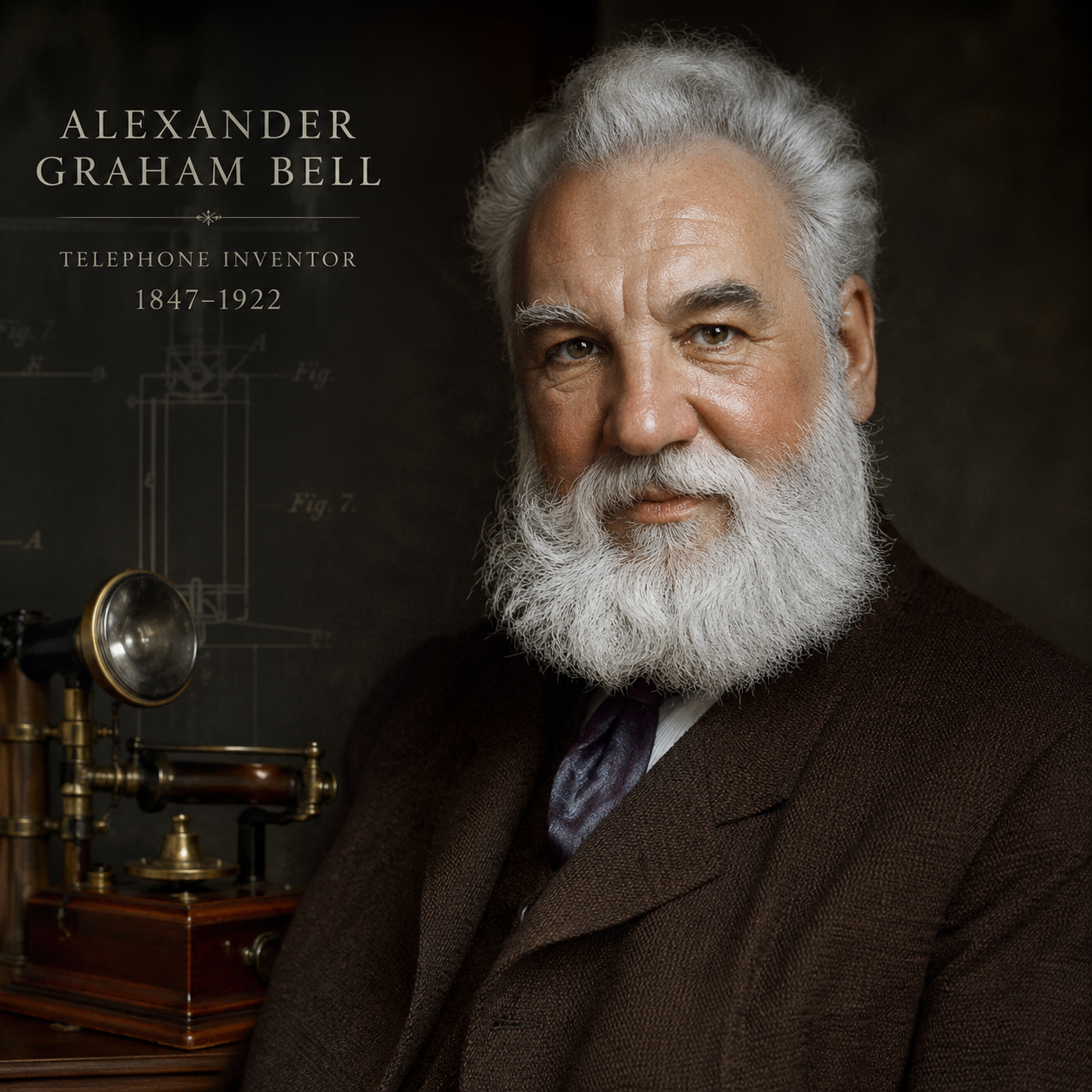
Alexander Graham Bell — "All really big discoveries are the results of thought."
All really big discoveries are the results of thought.
All really big discoveries are the results of thought.
Click any product to generate a realistic preview. Up to 3 at a time.
* Initial load can take up to 90 seconds — revising the preview in another color is nearly instant.
"Leave the beaten track occasionally and dive into the woods. Every time you do so you will be certain to find something that you have never seen before."
"The greatest minds are capable of the greatest vices as well as of the greatest virtues."
"We are all too much inclined, I think, to put off until tomorrow the things that we ought to do today."
"If it is not necessary, it is obviously not advisable, that deaf children should acquire, and use, as their ordinary and habitual means of communication — their vernacular in fact — a language that is…"
"I have always been a great believer in luck, and I find that the harder I work, the more I have of it."
From an address to the graduating class of the Friends' School, Washington D.C.
Date: 1914
PhilosophicalFound in 1 providers: gemini
1 source checked
Major breakthroughs don't happen by accident or pure luck — they require concentrated, sustained mental effort. The insight behind a discovery is the payoff of rigorous thinking done beforehand. This pushes back against the idea that innovation is purely hands-on tinkering. Before you can build something transformative, you must first understand the problem deeply enough in your mind to see the solution clearly.
Bell spent years studying acoustics and speech before inventing the telephone in 1876. Trained in his father's phonetics research and motivated by his deaf mother and wife, he approached invention intellectually — understanding sound-wave transmission theoretically before building hardware. His notebooks show systematic reasoning, not trial-and-error. He held over 18 patents across aviation, hydrofoils, and optical telecommunications, each rooted in deep theoretical inquiry rather than stumbled-upon discovery.
Bell's era — the Second Industrial Revolution of the 1860s–1900s — featured competing visions of invention: Edison's famous trial-and-error model versus rigorous scientific-theoretical approaches. Darwin had recently transformed biology through systematic reasoning. Universities were establishing formal research programs. Society debated whether genius was instinct or intellect. Bell's quote champions disciplined thought at a moment when the romantic myth of the lone tinkerer was clashing with the rise of structured scientific inquiry.
AI-generated insights based on extensive research and information for context. Factual errors? Email [email protected].
Your cart is empty