Laozi — "If a nation is to be great, it must be like a great river, it must flow freely i…"
If a nation is to be great, it must be like a great river, it must flow freely in every direction.
If a nation is to be great, it must be like a great river, it must flow freely in every direction.
Click any product to generate a realistic preview. Up to 3 at a time.
* Initial load can take up to 90 seconds — revising the preview in another color is nearly instant.
"If you are depressed you are living in the past. If you are anxious you are living in the future. If you are at peace you are living in the present."
"The sage rules by emptying their minds and filling their bellies, by weakening their wills and strengthening their bones."
"To know that you do not know is the best. To think you know when you do not is a disease."
"The value of teaching without words and accomplishing without action is understood by few in the world."
"Abandon sageliness and discard wisdom, and the people will benefit a hundredfold. Abandon benevolence and discard righteousness, and the people will return to filial piety and paternal love. Abandon s…"
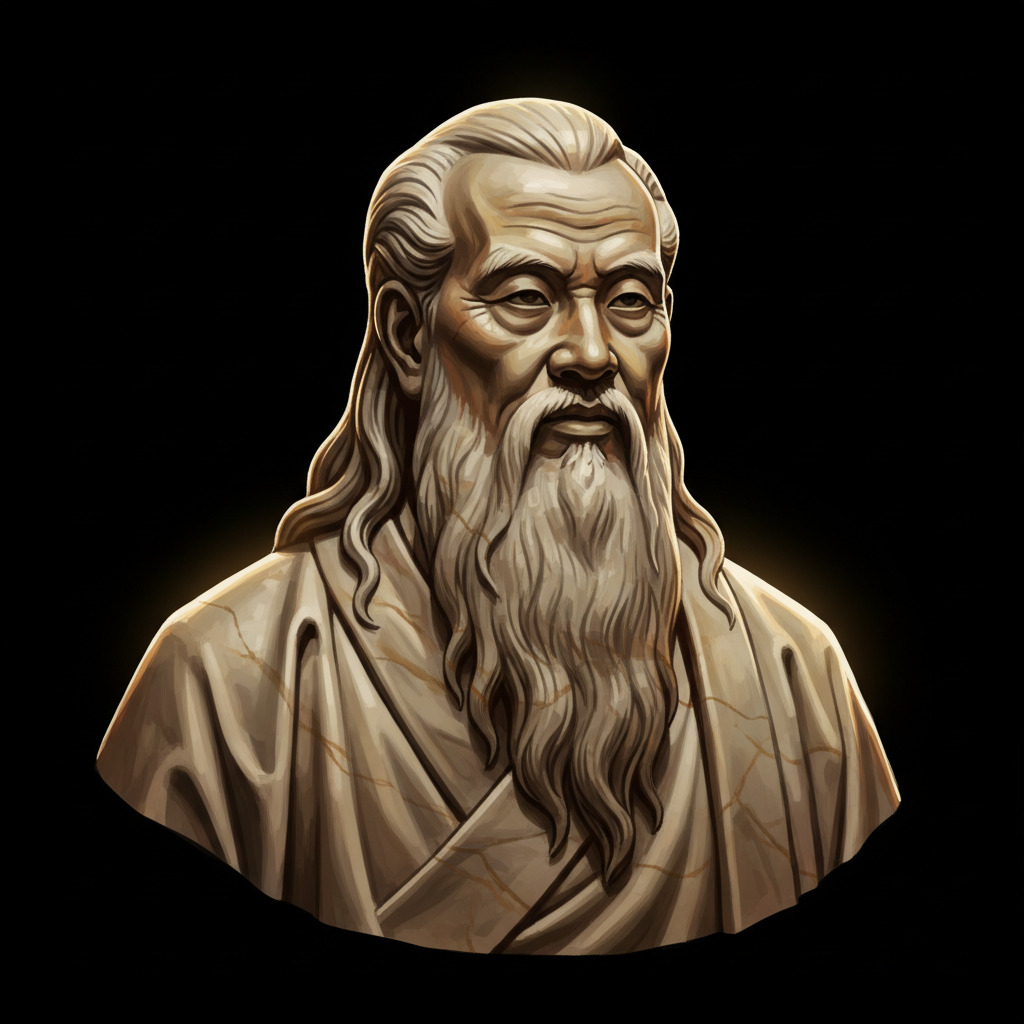
Reputed founder of Taoism and author of the Tao Te Ching, whose wu wei (effortless action) shaped East Asian philosophy. Closely associated with Zhuangzi (later Taoist who extended Laozi's framework). For an intellectual contrast, see Confucius, near-contemporary Chinese sage of social ritual and duty — Confucius systematized social order through ritual and hierarchy; Laozi argued that all such systems were the disease, not the cure — the two founding poles of Chinese moral philosophy.
Found in 1 providers: grok
1 source checked
A strong nation works like a large river: it doesn't force itself through one narrow channel but spreads outward, adapting to the terrain and reaching everywhere naturally. Greatness comes from openness, flexibility, and the ability to move with circumstances rather than against them. A country that stays rigid, closed off, or fixated on one direction will stagnate, while one that remains fluid and accommodating carries life and influence across its whole territory.
Laozi built Taoism around water as the supreme model of power, teaching that the softest thing overcomes the hardest and that the sage rules by yielding rather than dominating. As a court archivist steeped in ancient records, he watched rigid regimes collapse and distilled his observations into the Dao De Jing. Comparing a great nation to a flowing river fits his signature method of deriving political wisdom directly from the effortless behavior of the natural world.
Laozi lived during the late Zhou decline, as the Warring States era approached and rival kingdoms hardened borders, massed armies, and enforced brittle legalist controls. Against this backdrop of coercive, narrow statecraft, his river image offered a radical alternative: real strength came from openness to trade, ideas, and people flowing across regions. It countered the militarized tunnel vision of his age with a vision of expansive, adaptive governance.
AI-generated insights based on extensive research and information for context. Factual errors? Email [email protected].
Your cart is empty