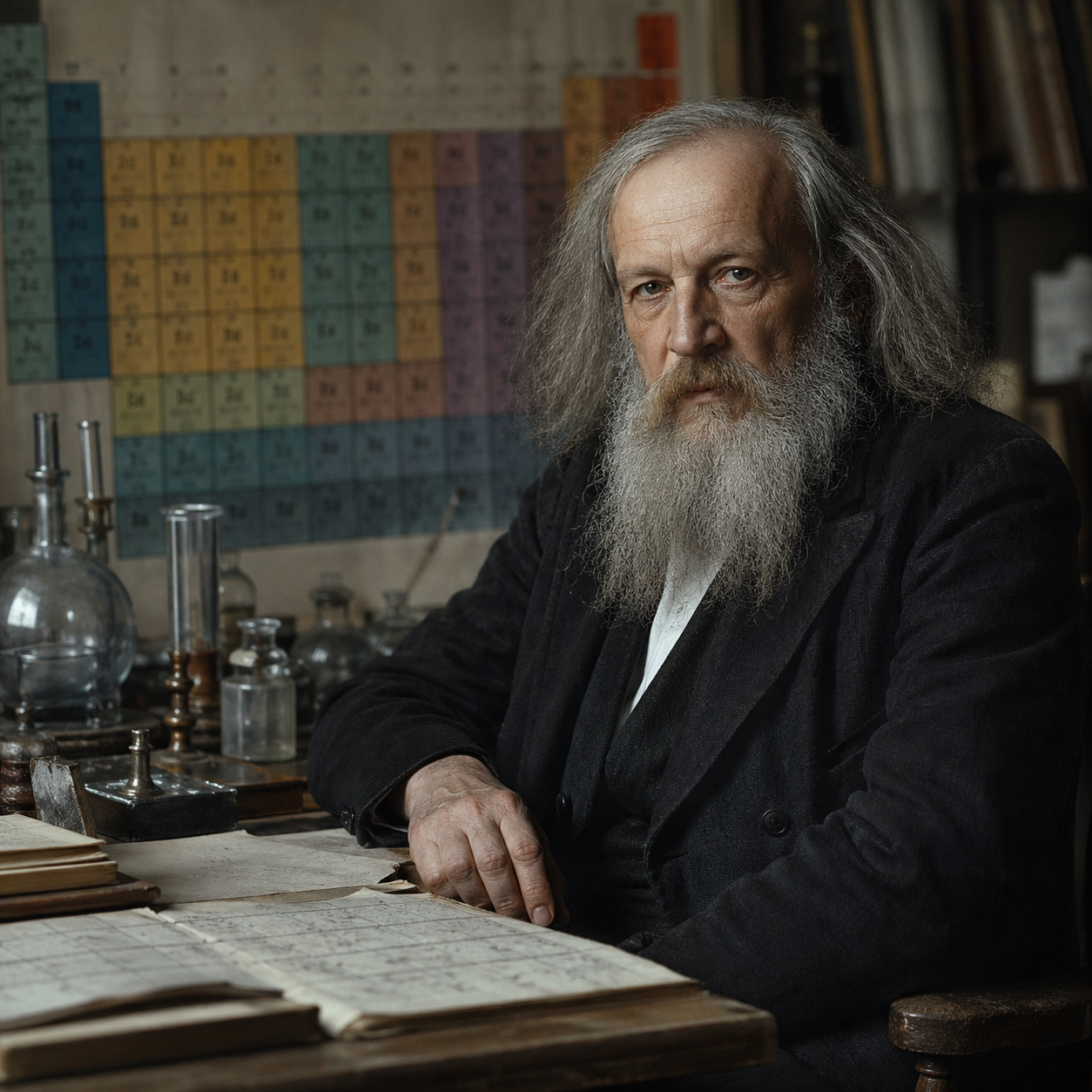
Dmitri Mendeleev — "Atomic weight belongs not to coal or diamond but carbon."
Atomic weight belongs not to coal or diamond but carbon.
Atomic weight belongs not to coal or diamond but carbon.
Click any product to generate a realistic preview. Up to 3 at a time.
* Initial load can take up to 90 seconds — revising the preview in another color is nearly instant.
"The weight of the atom is not the only criterion; there are other considerations."
"It is the function of science to discover the existence of a general reign of order in nature and to find the causes governing this order. And this refers in equal measure to the relations of man - so…"
"A well-made theory is like a good overcoat; Eloquent words are like a beautiful tie."
"I saw in a dream a table where all the elements fell into place as required."
"It is useful in this sense to make a clear distinction between the conception of an element as a separate homogenous substance and as a material but invisible part of a compound."
Announcing his discovery, distinguishing between a simple substance and the abstract element.
Date: 1869
PhilosophicalFound in 1 providers: gemini
1 source checked
A substance's fundamental identity lies in its underlying element, not its outward form. Coal and diamond look and behave completely differently, but both are pure carbon and share the same atomic weight. The physical appearance, hardness, or value of a material tells you nothing essential about what it actually is at the atomic level. True chemical identity is defined by the element itself, not by the shape it happens to take.
Mendeleev built the periodic table by recognizing that atomic weight, not superficial properties, was the organizing principle of matter. He spent years comparing elements and arranging them by weight, discovering repeating patterns that let him predict undiscovered elements. This quote captures his central insight: surface appearances deceive, but atomic weight reveals the truth. It reflects his deep conviction that chemistry must be grounded in measurable atomic quantities rather than observable traits.
Mendeleev published his periodic table in 1869, during a period when chemists were rapidly discovering new elements and struggling to classify them. Debates raged over atomic weights versus equivalent weights, and allotropes like coal and diamond confused classification systems. The Karlsruhe Congress of 1860 had just standardized atomic weight measurements, giving Mendeleev the reliable data he needed. His generation finally had the tools to see past physical form to atomic essence.
AI-generated insights based on extensive research and information for context. Factual errors? Email [email protected].
Your cart is empty