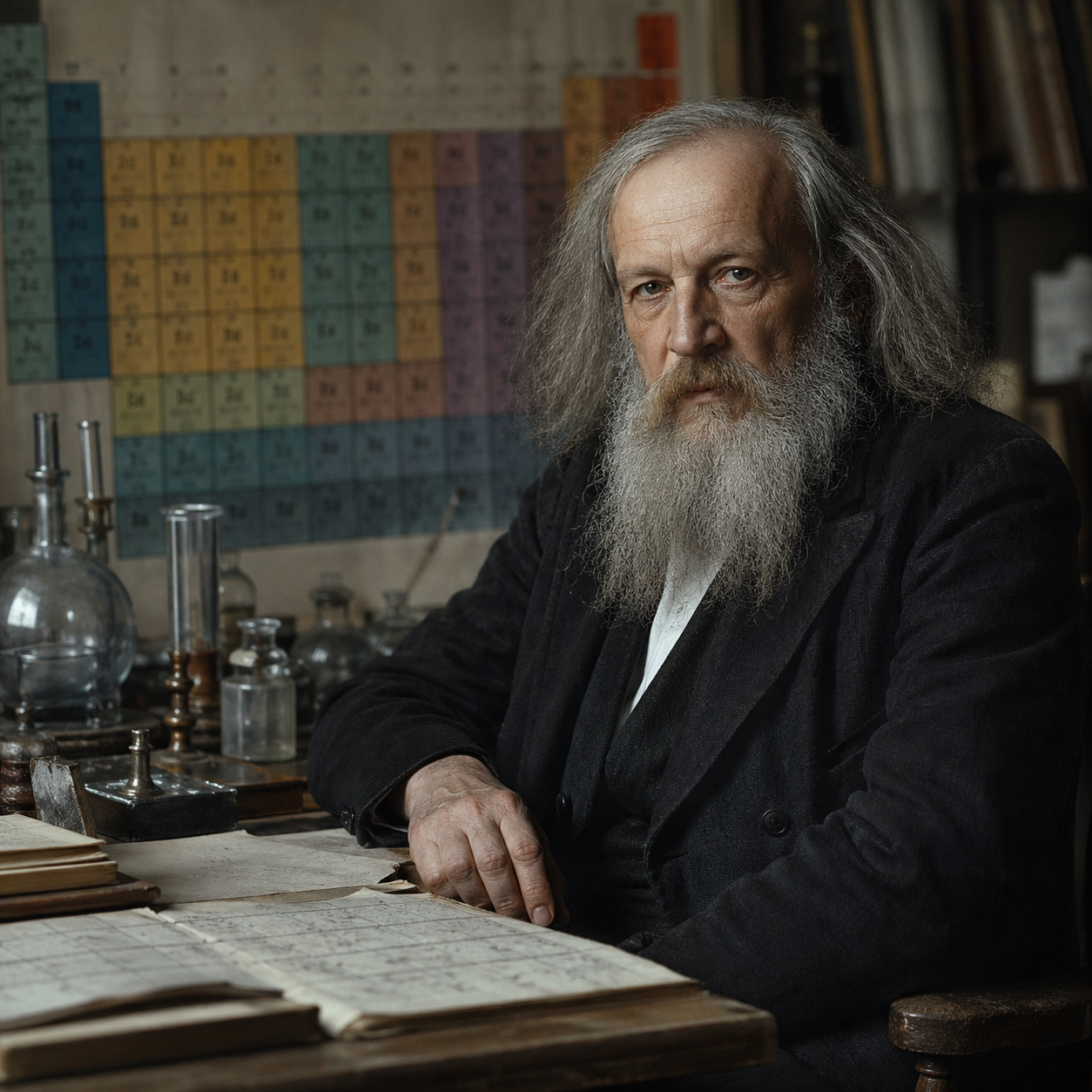
Dmitri Mendeleev — "Without knowledge, without work, there is no hope for humanity."
Without knowledge, without work, there is no hope for humanity.
Without knowledge, without work, there is no hope for humanity.
Click any product to generate a realistic preview. Up to 3 at a time.
* Initial load can take up to 90 seconds — revising the preview in another color is nearly instant.
"To tell the truth, I never thought of myself as a genius; I just worked hard."
"My table will serve as an instrument for discovering new facts and for correcting old ones."
"I saw in a dream a table where all the elements fell into place as required. Awakening, I immediately wrote it down on a piece of paper, only in one place did a correction later seem necessary."
"My father was a director of the local gymnasium, and my mother was a woman of strong character and great intelligence."
"It is useful in this sense to make a clear distinction between the conception of an element as a separate homogenous substance and as a material but invisible part of a compound."
Found in 1 providers: grok
1 source checked
Humanity cannot progress or survive on wishful thinking alone. Real hope depends on two things working together: understanding the world through learning, and putting in the effort to act on that understanding. Ignorance leaves you powerless, and knowledge without action changes nothing. Only the combination of educated minds and diligent labor creates a future worth believing in. Pure optimism without substance is empty.
Mendeleev built the periodic table through exactly this fusion of knowledge and labor, spending years cataloging elements and their properties before arranging them into a predictive system. He championed science education in Russia, advocated for industrial development, and studied petroleum, agriculture, and metrology to serve practical needs. Born a poor Siberian schoolteacher's son, he rose through relentless study and work, embodying the belief that disciplined inquiry paired with effort is what lifts people and nations.
Mendeleev lived 1834-1907, when Russia was an agrarian empire struggling to industrialize against Western Europe. Serfdom ended in 1861, universities expanded, and chemistry was transforming from alchemy's shadow into systematic science. The Industrial Revolution demanded trained scientists and engineers, while Russian intellectuals debated whether progress came through Western rationalism or Slavic tradition. Mendeleev's insistence on knowledge-plus-work reflected a nation racing to modernize through education and productive labor rather than inherited privilege.
AI-generated insights based on extensive research and information for context. Factual errors? Email [email protected].
Your cart is empty