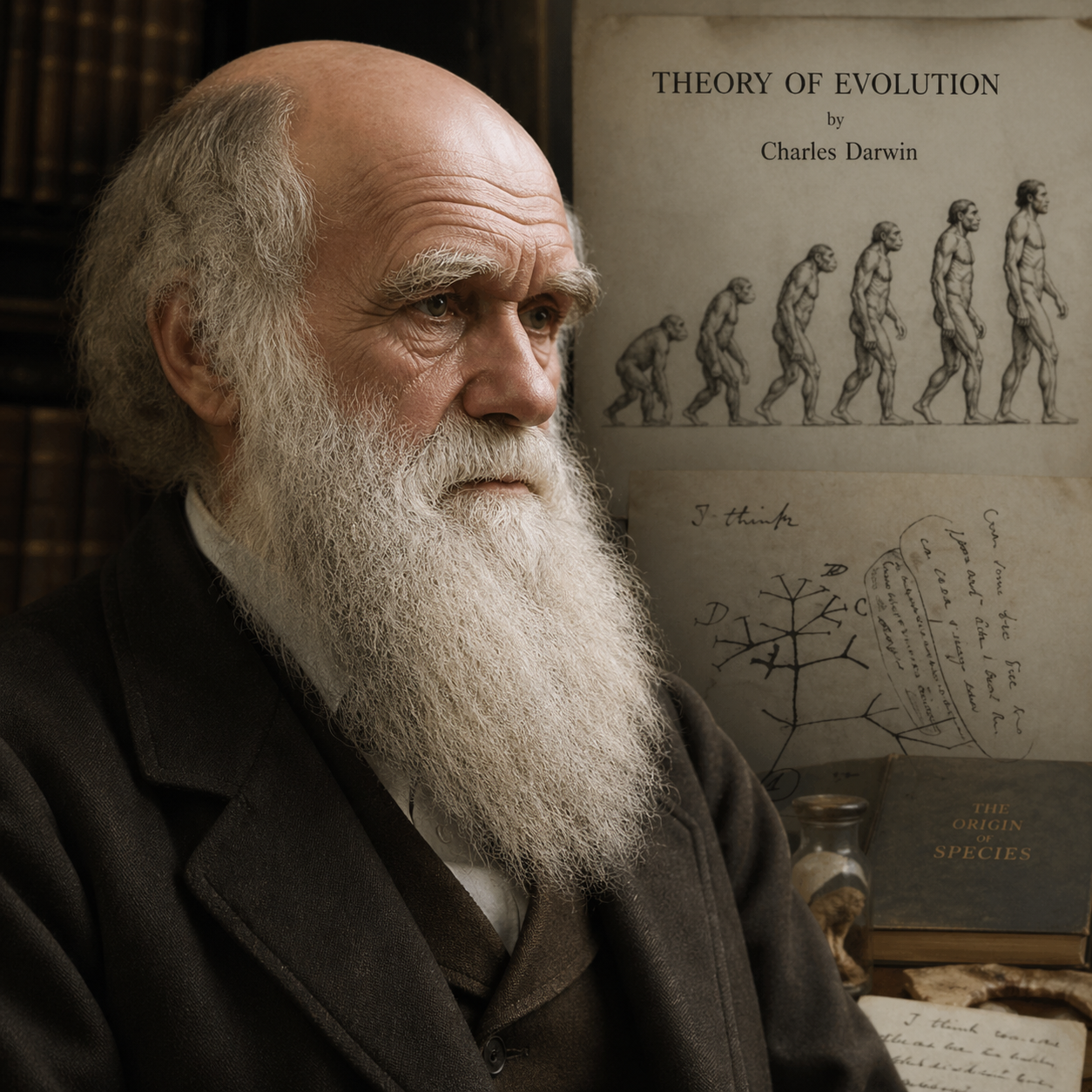
Charles Darwin — "Blushing is the most peculiar and most human of all expressions."
Blushing is the most peculiar and most human of all expressions.
Blushing is the most peculiar and most human of all expressions.
Click any product to generate a realistic preview. Up to 3 at a time.
* Initial load can take up to 90 seconds — revising the preview in another color is nearly instant.
"The very existence of our senses, our reason, and our intellect, is a proof that these faculties were given us for some purpose."
"I am almost convinced that species are not (it is like confessing a murder) immutable."
"In the long history of humankind (and animal kind, too) those who learned to collaborate and improvise most effectively have prevailed."
"I have always felt a strong feeling of gratitude to those who have helped me in my work."
"Thus, from the war of nature, from famine and death, the most exalted object which we are capable of conceiving, namely, the production of the higher animals, directly follows."
British naturalist whose On the Origin of Species (1859) established evolution by natural selection — the unifying theory of modern biology. Closely associated with Thomas Henry Huxley (his 'bulldog' public defender) and Alfred Russel Wallace (independent co-discoverer of natural selection). For an intellectual contrast, see William Paley, Anglican theologian and Natural Theology author (1743-1805) — Origin of Species is structurally a 400-page reply to Paley — Darwin admired Paley's watchmaker-argument as an undergraduate at Cambridge and then spent 20 years building the empirical machinery to displace him. The cleanest 'design argument vs natural selection' founding rebuttal in science.
The standard scholarly entry points to Charles Darwin's work: Janet Browne (Harvard, history of science) — Charles Darwin: Voyaging (1995) and The Power of Place (2002); Adrian Desmond (UCL, biographer) — Darwin: The Life of a Tormented Evolutionist (1991, with James Moore). These are the works graduate seminars cite when teaching Charles Darwin.
Found in 1 providers: gemini
1 source checked
Blushing stands apart from every other human expression because it cannot be faked or controlled — it reveals inner emotional states like shame, embarrassment, and self-consciousness involuntarily. Unlike a smile or frown, blushing is entirely social and self-referential, triggered by awareness of how others perceive us. It signals that we care deeply about social judgment, making it uniquely tied to human consciousness and moral feeling.
Darwin devoted an entire chapter of 'The Expression of the Emotions in Man and Animals' (1872) to blushing, calling it uniquely human — no animal blushes from shame. This fascinated him because his evolutionary framework sought continuities between species, yet blushing represented a sharp discontinuity. It connected to his broader interest in how emotions evolved and how self-consciousness emerged as a distinctly human trait.
Darwin published his emotions work in 1872, when Victorian society was intensely preoccupied with social propriety, respectability, and the moral significance of bodily responses. Physiology was emerging as a serious science, and debates raged about what distinguished humans from animals after his 1859 Origin of Species. Blushing symbolized the intersection of biology and morality that defined the era's intellectual tensions.
AI-generated insights based on extensive research and information for context. Factual errors? Email [email protected].
Your cart is empty