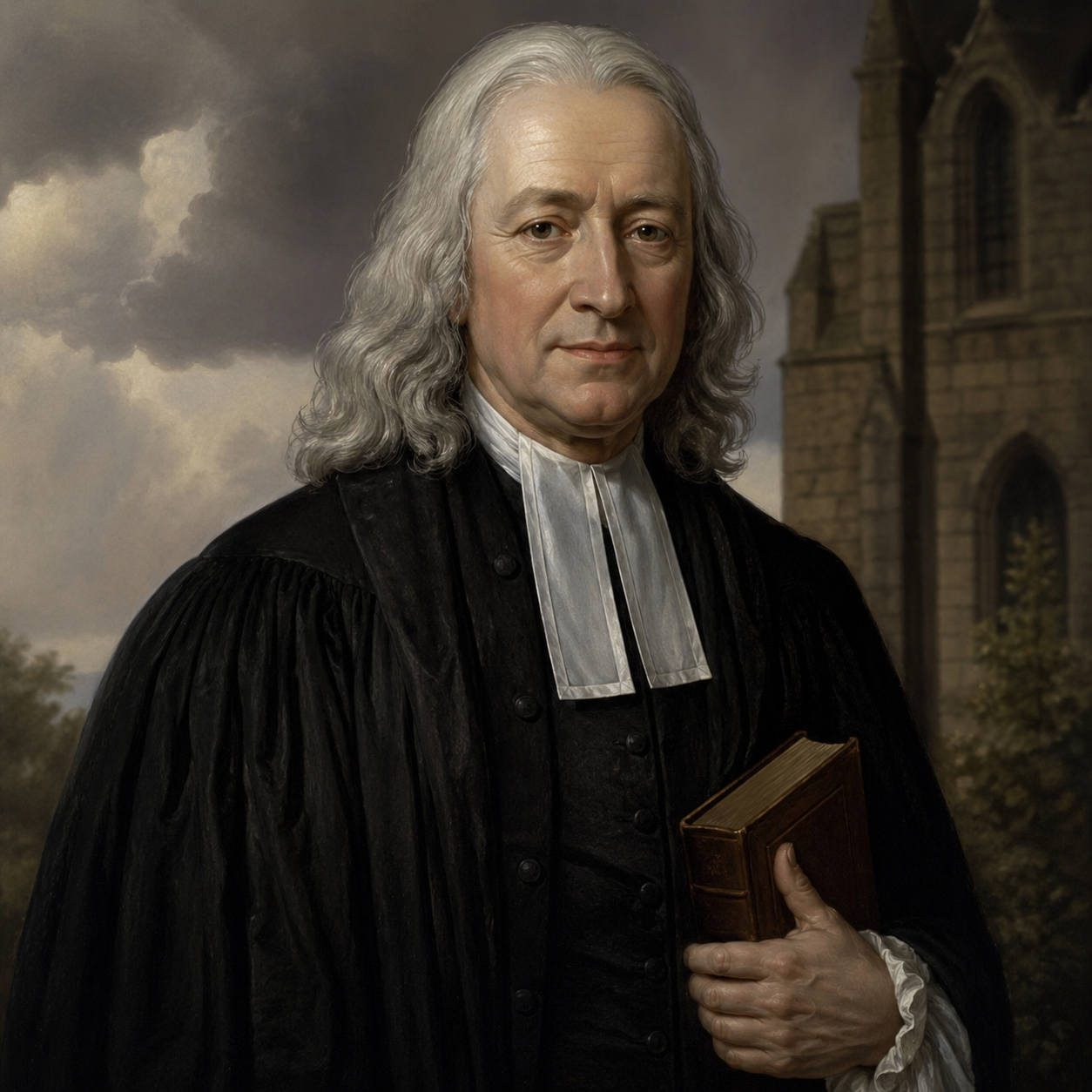
John Wesley — "Catch on fire with enthusiasm and people will come for miles to watch you burn."
Catch on fire with enthusiasm and people will come for miles to watch you burn.
Catch on fire with enthusiasm and people will come for miles to watch you burn.
Click any product to generate a realistic preview. Up to 3 at a time.
* Initial load can take up to 90 seconds — revising the preview in another color is nearly instant.
"I have often thought, that if I were to choose a language to speak, it should be Greek."
"I have often wondered that the generality of Christians should be so cold and indifferent in their religion."
"Though I am an old man, I am but a little child; for I am just beginning to learn the alphabet of salvation."
"I have often thought, that if I were to choose a place of abode, it should be in a country where there were no rich people."
"I offered Christ to the Negroes in Antigua. I offered him to the slaves. I offered him to the very dregs of the people."
English Anglican cleric and founder of Methodism, whose open-air preaching and class-meeting structure created the largest 18th-century evangelical revival. Closely associated with Charles Wesley (his hymn-writing brother) and George Whitefield (early co-revivalist, later doctrinal opponent). For an intellectual contrast, see George Whitefield, Calvinist evangelical revivalist — Whitefield's predestinarian Calvinism vs Wesley's free-grace Arminian theology split the early Methodist movement permanently in the 1739-41 break. The founding evangelical Calvinist-Arminian schism — the two parallel evangelical traditions American Christianity descends from.
Found in 1 providers: deepseek
1 source checked
Genuine passion is magnetic. When you commit to something with real, visible enthusiasm, you don't need to advertise or persuade — people are naturally drawn to watch, join, and participate. Authentic fire is rare enough that it becomes a spectacle worth traveling to witness. The quote urges total commitment over halfhearted effort, promising that intensity itself becomes the most powerful form of attraction and influence.
Wesley rode over 250,000 miles on horseback preaching across Britain, delivering 40,000+ sermons outdoors to crowds that gathered spontaneously. His electrifying open-air revivals drew thousands in fields and town squares. Methodism spread not through institutional power but through Wesley's relentless personal fervor. He rose at 4am daily, prayed fervently, and lived austerely — his visible total commitment was itself the engine of the movement's extraordinary growth.
18th-century Britain was undergoing Industrial Revolution upheaval — masses displaced from rural communities into urban poverty, largely abandoned by the established Church of England which served the gentry. Wesley preached to miners, factory workers, and the dispossessed when churches barred him. In an era without mass media, enthusiasm spread person-to-person; a genuinely passionate preacher in a field was the most powerful communications technology available, and Wesley weaponized this completely.
AI-generated insights based on extensive research and information for context. Factual errors? Email [email protected].
Your cart is empty