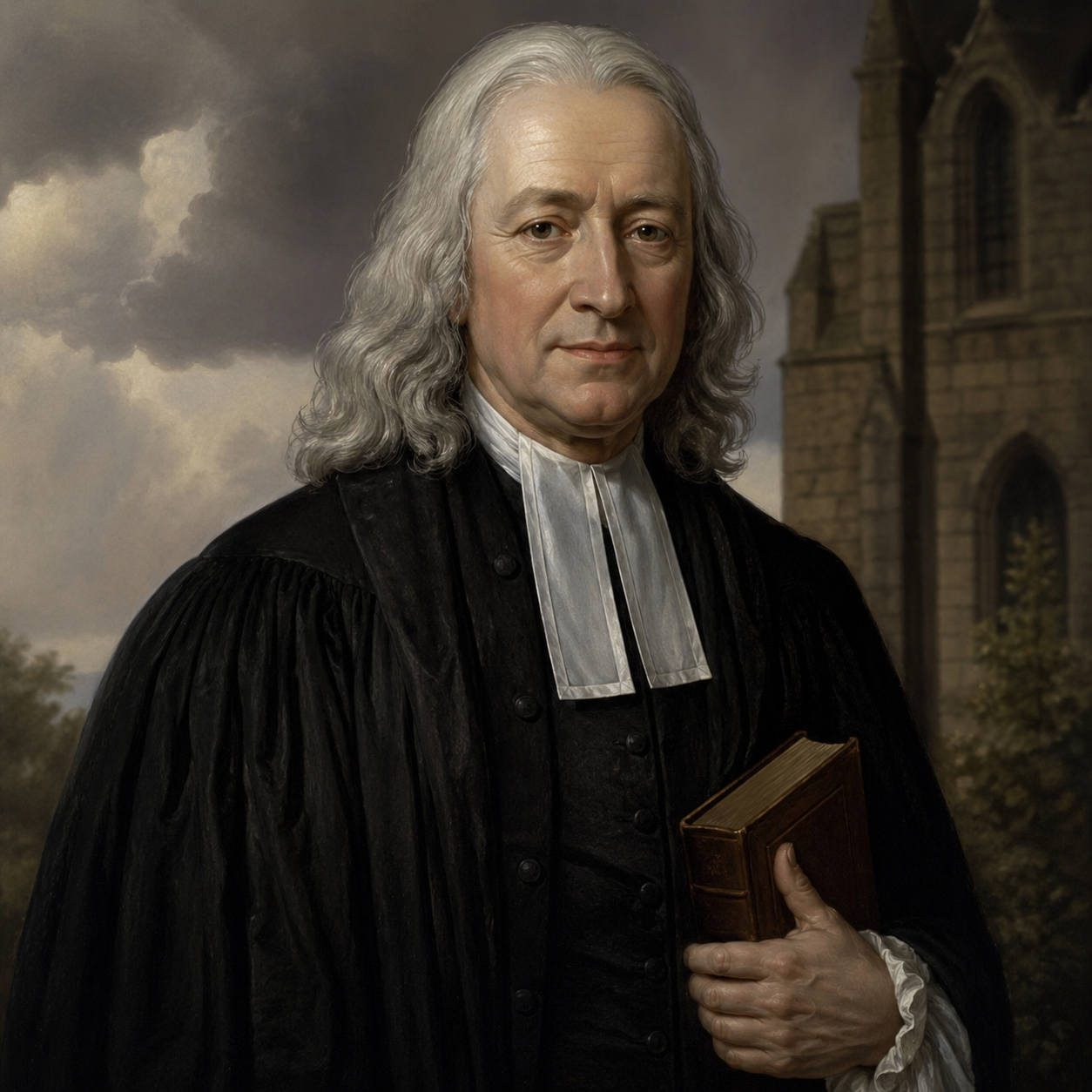
John Wesley — "I desire to have but one thing in view, to please God."
I desire to have but one thing in view, to please God.
I desire to have but one thing in view, to please God.
Click any product to generate a realistic preview. Up to 3 at a time.
* Initial load can take up to 90 seconds — revising the preview in another color is nearly instant.
"My hair is much whiter than it was a year ago; but my eyes are not much dimmer, nor my natural strength much abated."
"By Methodists, I mean such as profess to pursue a Christian life by Scriptural rules and methods."
"I had rather have a thousand common people to hear me, than a thousand fine gentlemen."
"I have often thought, that if I were to choose a text to preach from, it should be 'God is love.'"
"I am no more afraid of the devil than I am of a fly."
English Anglican cleric and founder of Methodism, whose open-air preaching and class-meeting structure created the largest 18th-century evangelical revival. Closely associated with Charles Wesley (his hymn-writing brother) and George Whitefield (early co-revivalist, later doctrinal opponent). For an intellectual contrast, see George Whitefield, Calvinist evangelical revivalist — Whitefield's predestinarian Calvinism vs Wesley's free-grace Arminian theology split the early Methodist movement permanently in the 1739-41 break. The founding evangelical Calvinist-Arminian schism — the two parallel evangelical traditions American Christianity descends from.
Found in 1 providers: grok
1 source checked
A declaration of singular, undivided purpose: everything else—reputation, wealth, comfort, social approval—becomes secondary or irrelevant. The speaker wants one organizing principle for all decisions and actions. In modern terms, it's radical simplicity of motivation: strip away competing desires and ambitions until only one thing remains as your north star, letting that single aim govern how you spend time, energy, and attention.
Wesley lived this literally. He rode 250,000 miles on horseback, preached 40,000 sermons, woke at 4am daily, gave away nearly all his income, and faced mob violence rather than soften his message. He founded Methodism not for institutional glory but from methodical spiritual discipline. This quote reflects the inner engine behind that extraordinary output—a man genuinely uninterested in personal gain, measuring every action against one criterion.
18th-century England was convulsed by industrialization, urban poverty, and a Church of England grown comfortable and distant from ordinary people. Wesley's era saw gin epidemics, child labor, and spiritual neglect of the working class. Against this backdrop, declaring singular devotion to pleasing God—not pleasing bishops, aristocrats, or polite society—was countercultural and costly. It justified preaching in fields when churches shut their doors to him.
AI-generated insights based on extensive research and information for context. Factual errors? Email [email protected].
Your cart is empty