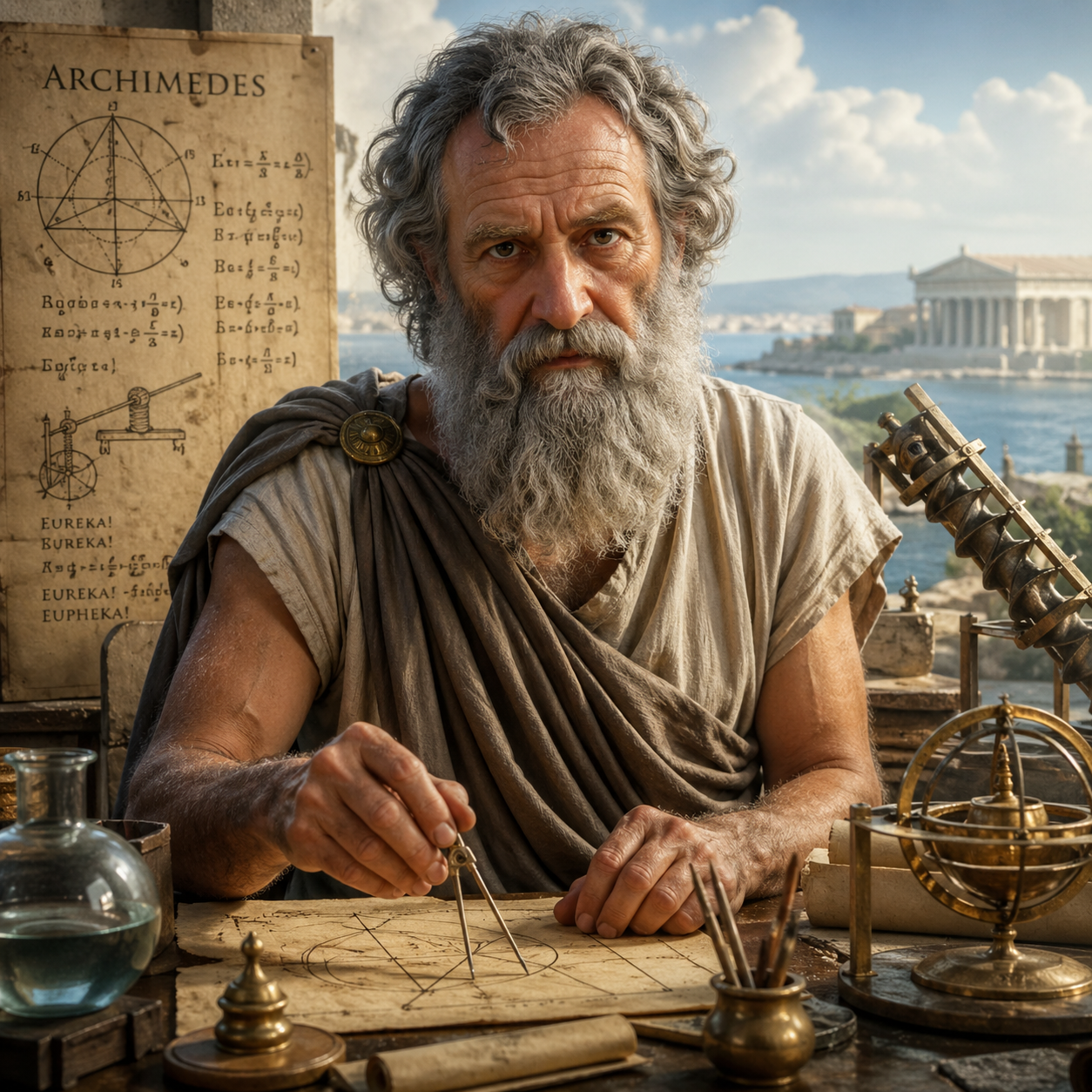
Archimedes — "Take the case of a cube and a sphere, and see which is the more beautiful body."
Take the case of a cube and a sphere, and see which is the more beautiful body.
Take the case of a cube and a sphere, and see which is the more beautiful body.
Click any product to generate a realistic preview. Up to 3 at a time.
* Initial load can take up to 90 seconds — revising the preview in another color is nearly instant.
"Every solid body immersed in a fluid is buoyed up by a force equal to the weight of the fluid displaced by the body."
"Mathematics reveals its secrets only to those who approach it with pure love, for its own beauty."
"The value of pi is more than 3 10/71 and less than 3 1/7."
"The shortest distance between two points is a straight line."
"Do not disturb my circles!"
Found in 1 providers: grok
1 source checked
The quote asks us to compare a cube — flat, angular, regular — against a sphere — smooth, continuous, symmetrical — and decide which holds more beauty. It frames geometric form as an aesthetic question, not just a mathematical one. The implication is that beauty lives in shape itself, discoverable through reason and observation. It challenges readers to see mathematical objects not merely as abstractions but as things possessing real, perceptible elegance.
Archimedes was so devoted to the sphere that he requested his tombstone display a sphere inscribed inside a cylinder — his proof that the sphere holds exactly two-thirds the volume and surface area of that cylinder was his proudest achievement. He spent his career in Syracuse calculating curves, volumes, and surfaces. To him, the sphere represented geometric perfection: every point equidistant from center, no edges, no hierarchy of axes — pure, unified form.
Archimedes lived in the 3rd century BC, when Platonic philosophy held that geometric shapes were eternal, ideal truths — more real than physical objects. The sphere was considered the shape of the cosmos itself in Greek cosmology, as Plato argued in the Timaeus. Beauty and mathematics were not separate disciplines; proportion and form were the foundations of aesthetics. Asking which shape is more beautiful was a legitimate philosophical and scientific question in this tradition.
AI-generated insights based on extensive research and information for context. Factual errors? Email [email protected].
Your cart is empty