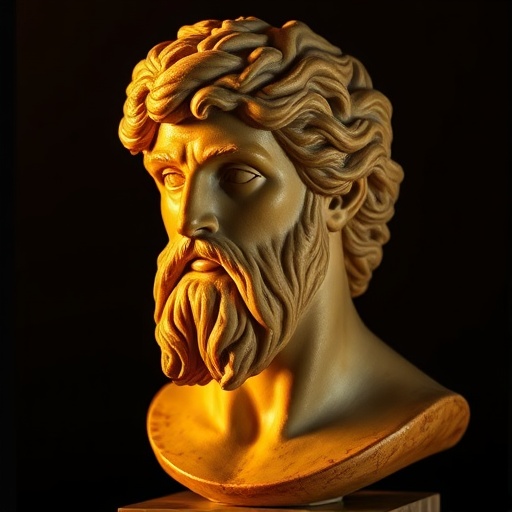
Pythagoras — "Do not stir the fire with a sword."
Do not stir the fire with a sword.
Do not stir the fire with a sword.
Click any product to generate a realistic preview. Up to 3 at a time.
* Initial load can take up to 90 seconds — revising the preview in another color is nearly instant.
"It is only necessary to make war with five things; with the maladies of the body, the ignorances of the mind, with the passions of the body, with the seditions of the city and the discords of families…"
"It is better to be silent than to utter words that are not true."
"Eat not fish whose tails are black."
"Let no one persuade you by word or deed to do or say whatever is not best for you."
"You should make great things, not promising great things."
Greek philosopher and mathematician whose school in Croton combined geometry (the Pythagorean theorem), number-mysticism, and a religious-vegetarian way of life. Closely associated with Thales of Miletus (earlier pre-Socratic and the first philosopher). For an intellectual contrast, see Heraclitus, pre-Socratic Greek philosopher of flux — Heraclitus called Pythagoras 'the chief of swindlers' — among the founding insults of the philosophical-rivalry tradition. Their 'all is flux' vs 'all is number' poles still organize the philosophy of mathematics today (Platonist vs anti-realist).
One of the 'symbols' or maxims attributed to Pythagoras, often interpreted allegorically.
Date: c. 570 – c. 495 BC
ShockingFound in 1 providers: grok
1 source checked
Don't provoke or escalate a situation that is already heated or dangerous. Fire represents anger, passion, or volatile conflict; the sword represents sharp words, aggression, or force. Poking fire with a blade only spreads the flames. The lesson: when emotions are running high, applying confrontation makes everything worse. Restraint and calm are the correct tools. Recognizing when to step back — not when to push harder — is genuine wisdom.
Pythagoras founded a tightly governed philosophical brotherhood at Croton with hundreds of symbolic behavioral rules called acusmata, of which this is one. He believed the cosmos operated on mathematical harmony, and he extended that principle to human conduct — self-mastery, balance, and order in all things. His community prized measured behavior over impulse. This precept directly mirrors his core teaching: that disciplined restraint, like a precise ratio, produces harmony, while aggression destroys it.
In 6th-century BCE Greece, the sword was a lived daily reality, not a metaphor — honor disputes between citizens, factional violence in city-states, and military culture made impulsive aggression genuinely common and socially glorified. Pythagoras's own community at Croton was eventually burned down by political enemies. Philosophers of this era were actively pushing back against the dominant warrior ethos, arguing that reason and self-control, not force, defined a truly ordered life and a stable society.
AI-generated insights based on extensive research and information for context. Factual errors? Email [email protected].
Your cart is empty