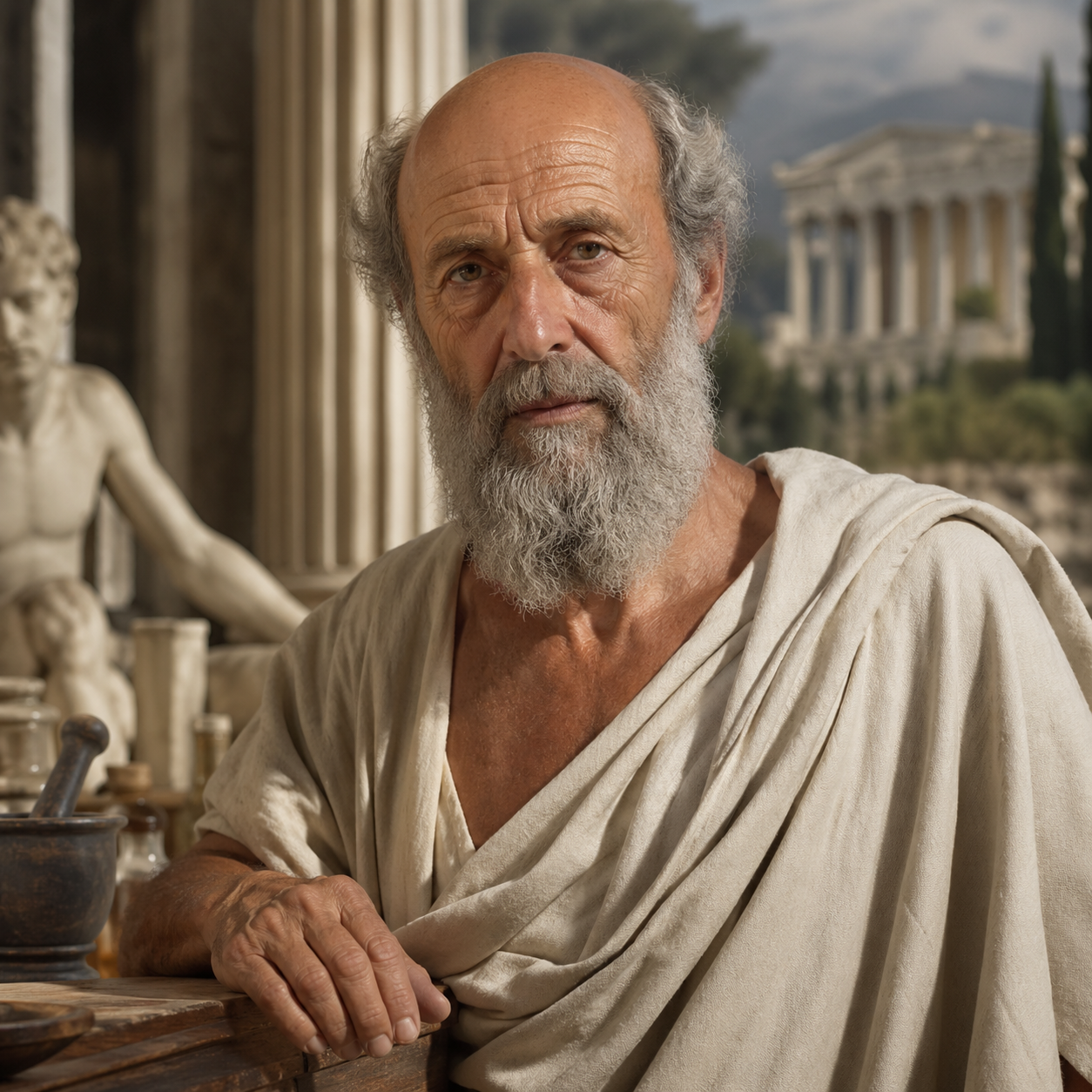
Hippocrates — "Everything in excess is opposed to nature."
Everything in excess is opposed to nature.
Everything in excess is opposed to nature.
Click any product to generate a realistic preview. Up to 3 at a time.
* Initial load can take up to 90 seconds — revising the preview in another color is nearly instant.
"The physician must not only be prepared to do what is right himself, but also to make the patient, the attendants, and externals cooperate."
"The physician must be able to tell the future."
"That which is used - develops. That which is not used wastes away."
"Some patients, though conscious that their condition is perilous, recover their health simply through their contentment with the goodness of the physician."
"Those by nature overweight, die earlier than the slim."
Found in 2 providers: grok,gemini
2 sources checked
When anything goes beyond what the body or nature needs — food, rest, exertion, medicine — it works against the body's inherent balance rather than supporting it. Nature tends toward equilibrium; excess tips that equilibrium into disorder. The principle is practical: overeating harms as much as starvation, overexertion as much as inactivity. Balance is not a middle ground chosen arbitrarily but the state nature defaults to when undisturbed.
Hippocrates built Greek medicine on humoral theory — health as balance among blood, phlegm, and two biles. Excess or deficiency in any humor caused disease. He prescribed diet, exercise, and lifestyle adjustments before drugs, because restoring natural proportion was the cure. His Hippocratic Corpus repeatedly returns to moderation in eating and physical regimen. This quote is essentially the philosophical foundation for everything he practiced and taught.
In 5th-century BCE Greece, medicine was separating from religious ritual — Asclepius temples still competed with rational physicians. Greek philosophy independently arrived at the golden mean concept. Wealthy Athenians feasted heavily on wine and meat; athletic training pushed bodies to extremes. Hippocrates argued, against priestly mysticism and physical excess alike, that nature itself imposes limits — a radical empirical claim in a world that blamed disease on divine punishment.
AI-generated insights based on extensive research and information for context. Factual errors? Email [email protected].
Your cart is empty