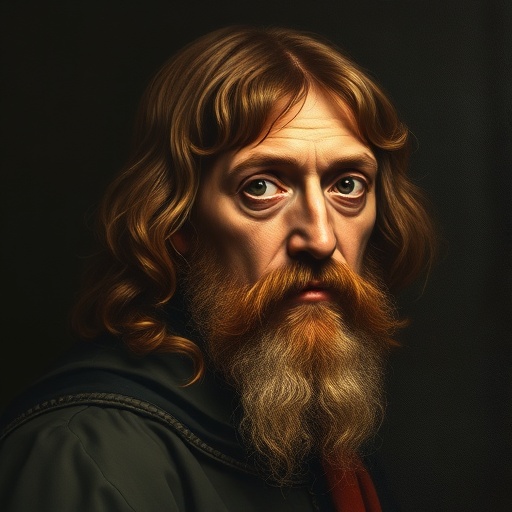
Nicolaus Copernicus — "For the world is spherical, and is bounded by a spherical surface."
For the world is spherical, and is bounded by a spherical surface.
For the world is spherical, and is bounded by a spherical surface.
Click any product to generate a realistic preview. Up to 3 at a time.
* Initial load can take up to 90 seconds — revising the preview in another color is nearly instant.
"The order of the planets is as follows: Saturn, Jupiter, Mars, Earth, Venus, Mercury, and in the middle of all, the Sun."
"For I have found that the motions of the planets are more regular and orderly if the Earth is assumed to move."
"And so, in the first book, I describe the earth's general position and its various motions, and then I pass to the other planets, showing how their motions are related to the earth's."
"Perhaps there will be babblers who, although completely ignorant of mathematics, nevertheless dare to pass judgment on these things, and because of some passage in Holy Scripture, want to distort my b…"
"For the motions of the planets are so much more orderly and harmonious if they are referred to the sun as the center."
Found in 1 providers: grok
1 source checked
The Earth and cosmos are round, enclosed within curved boundaries. This asserts the geometric truth of spherical form as foundational to understanding the universe's structure — not flat, not irregular, but perfectly spherical, a claim with profound implications for navigation, astronomy, and humanity's conception of its place in space.
Copernicus spent decades at Frombork Cathedral meticulously observing celestial bodies. His 1543 De Revolutionibus Orbium Coelestium placed the Sun at the center of a spherical universe. Affirming Earth's spherical nature was prerequisite to his heliocentric model — you cannot have orbiting spheres without accepting spherical geometry as cosmic truth.
In the early 1500s, medieval cosmology still blended Ptolemaic astronomy with Church doctrine. While scholars accepted Earth's sphericity theoretically, Columbus's 1492 voyage had recently made it viscerally real. Copernicus wrote amid Renaissance humanism's revival of Greek geometry, when asserting mathematical order over religious cosmology was intellectually bold and potentially dangerous.
AI-generated insights based on extensive research and information for context. Factual errors? Email [email protected].
Your cart is empty