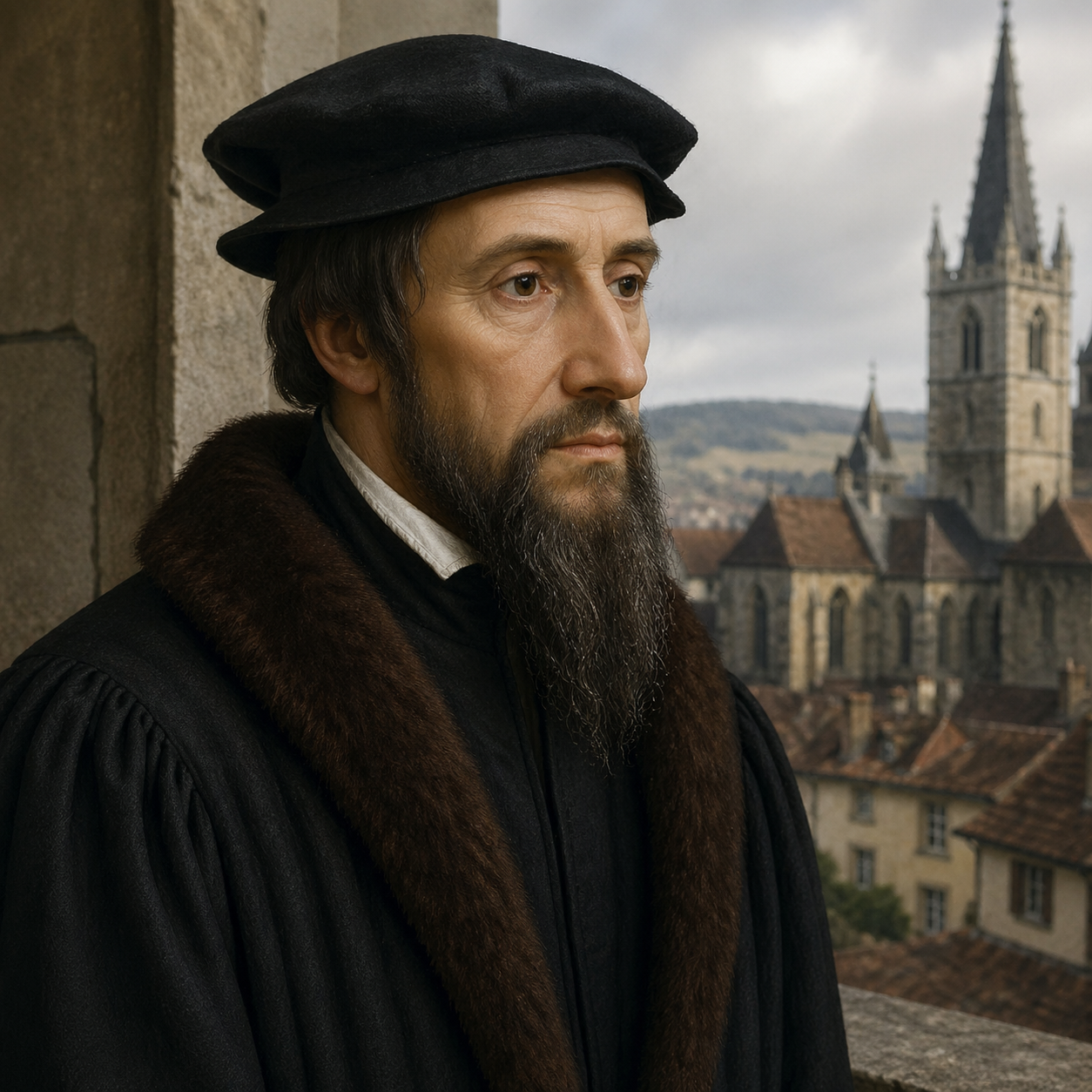
John Calvin — "God always remains true to himself."
God always remains true to himself.
God always remains true to himself.
Click any product to generate a realistic preview. Up to 3 at a time.
* Initial load can take up to 90 seconds — revising the preview in another color is nearly instant.
"God works in the hearts of men to incline their wills as he pleases."
"God's providence extends to all things, even to the least of them."
"Though the will of God is the highest rule of justice, and all that he wills is to be held for righteous, yet he has not deemed it sufficient for us to acquiesce in his bare will, but has added reason…"
"For we must not think that it is an arbitrary will in God that is the cause of election, but that he wills justly and without fault."
"The proper knowledge of God is when we know him to be our Father."
French theologian whose Institutes of the Christian Religion (1536) systematized Protestant Reformed doctrine, including predestination. Closely associated with Martin Luther (Reformation founder, Calvin's predecessor). For an intellectual contrast, see Jacobus Arminius, Dutch Reformed theologian (1560-1609) — Arminius's rejection of strict double-predestination founded Arminianism — the theological tradition modern Methodism, most evangelicalism, and Pentecostalism descend from. The Calvinist-Arminian debate has divided Protestantism for 400 years.
Found in 1 providers: grok
1 source checked
This quote asserts divine immutability and consistency — that God's nature, promises, and character never change or contradict themselves. Believers can rely on God's word and covenants because he is not capricious or arbitrary. His justice, mercy, and sovereignty operate according to an unchanging essence, making him a trustworthy foundation for faith rather than a shifting force subject to human interpretation or circumstance.
Calvin built his entire theological system — the Institutes of the Christian Religion — on God's sovereign, unchanging nature. His doctrine of predestination rested on eternal, unalterable divine decrees. As Geneva's reformer, Calvin insisted Scripture reliably reveals God precisely because God cannot contradict himself. His covenant theology similarly depended on God's absolute fidelity to his own character across redemptive history, making immutability a cornerstone of Reformed doctrine.
The Protestant Reformation fractured Western Christendom in the 16th century, raising urgent questions about authority, Scripture, and God's reliability. Against Catholic claims of evolving tradition and papal mediation, reformers anchored theology in Scripture's unchanging divine author. Religious wars, political upheaval, and theological fragmentation across Europe made an immutable God existentially urgent — ordinary believers desperately needed certainty that divine promises held firm amid institutional collapse and doctrinal chaos.
AI-generated insights based on extensive research and information for context. Factual errors? Email [email protected].
Your cart is empty