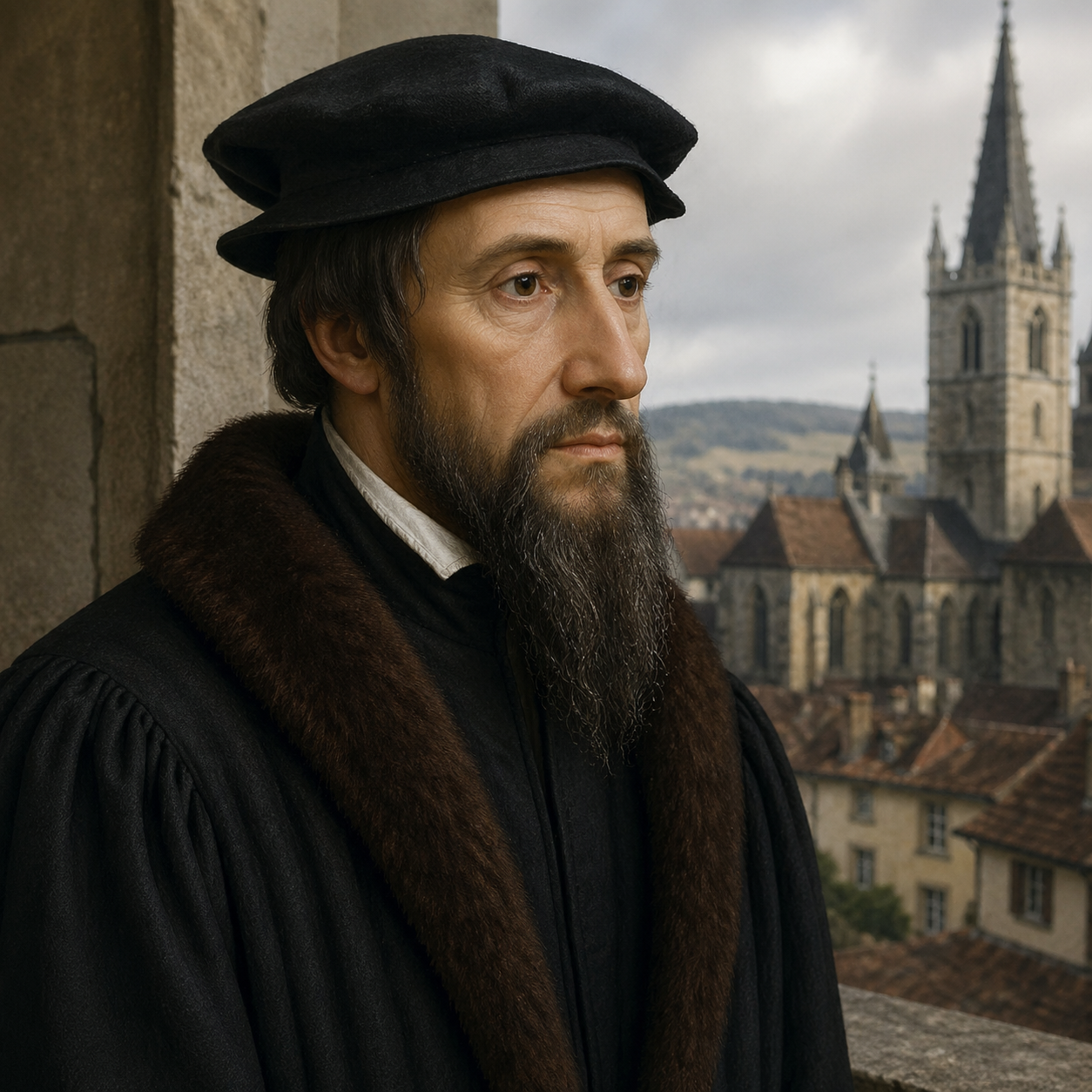
John Calvin — "God works in the hearts of men to incline their wills as he pleases."
God works in the hearts of men to incline their wills as he pleases.
God works in the hearts of men to incline their wills as he pleases.
Click any product to generate a realistic preview. Up to 3 at a time.
* Initial load can take up to 90 seconds — revising the preview in another color is nearly instant.
"Our hearts are so prone to idolatry that we cannot but be continually forging new gods for ourselves."
"We frankly confess that God has ordained to death those whom he has not deemed worthy of life."
"Without faith, it is impossible to please God."
"The elect alone are endued with the knowledge of God, and the illumination of the Holy Spirit."
"The Christian life is a perpetual exercise of repentance."
French theologian whose Institutes of the Christian Religion (1536) systematized Protestant Reformed doctrine, including predestination. Closely associated with Martin Luther (Reformation founder, Calvin's predecessor). For an intellectual contrast, see Jacobus Arminius, Dutch Reformed theologian (1560-1609) — Arminius's rejection of strict double-predestination founded Arminianism — the theological tradition modern Methodism, most evangelicalism, and Pentecostalism descend from. The Calvinist-Arminian debate has divided Protestantism for 400 years.
Found in 1 providers: grok
1 source checked
Divine sovereignty extends into human psychology itself — God actively moves and directs human desires, not just external events. Free will exists, but operates only within whatever direction God inclines it. Nothing humans choose falls outside God's orchestration. This is the core of Reformed theology's doctrine of irresistible grace: when God determines to bring someone to a decision or belief, that inner inclination cannot ultimately be refused or overridden by human preference.
Calvin's entire theology pivoted on God's absolute sovereignty. His masterwork, Institutes of the Christian Religion, systematically argued for predestination and irresistible grace. Running Geneva as a Reformed city-state, he believed his own reforming work was God directing history through human hearts. This quote captures one of the five points later codified as Calvinism — that God's saving grace operates internally and irresistibly, not as an offer humans independently accept or reject.
The Protestant Reformation shattered Western Christendom's unity over exactly this question. Catholic teaching emphasized human cooperation with grace and genuine free will in salvation. Calvin's Geneva (1540s–1560s) radicalized the break, asserting God's absolute predetermination. The Council of Trent (1545–1563) simultaneously defended Catholic free-will doctrine. For persecuted Reformed believers across France, the Netherlands, and Scotland, Calvin's insistence that God controls human hearts offered profound assurance — their faith was God's sovereign gift, not their own fragile choice.
AI-generated insights based on extensive research and information for context. Factual errors? Email [email protected].
Your cart is empty