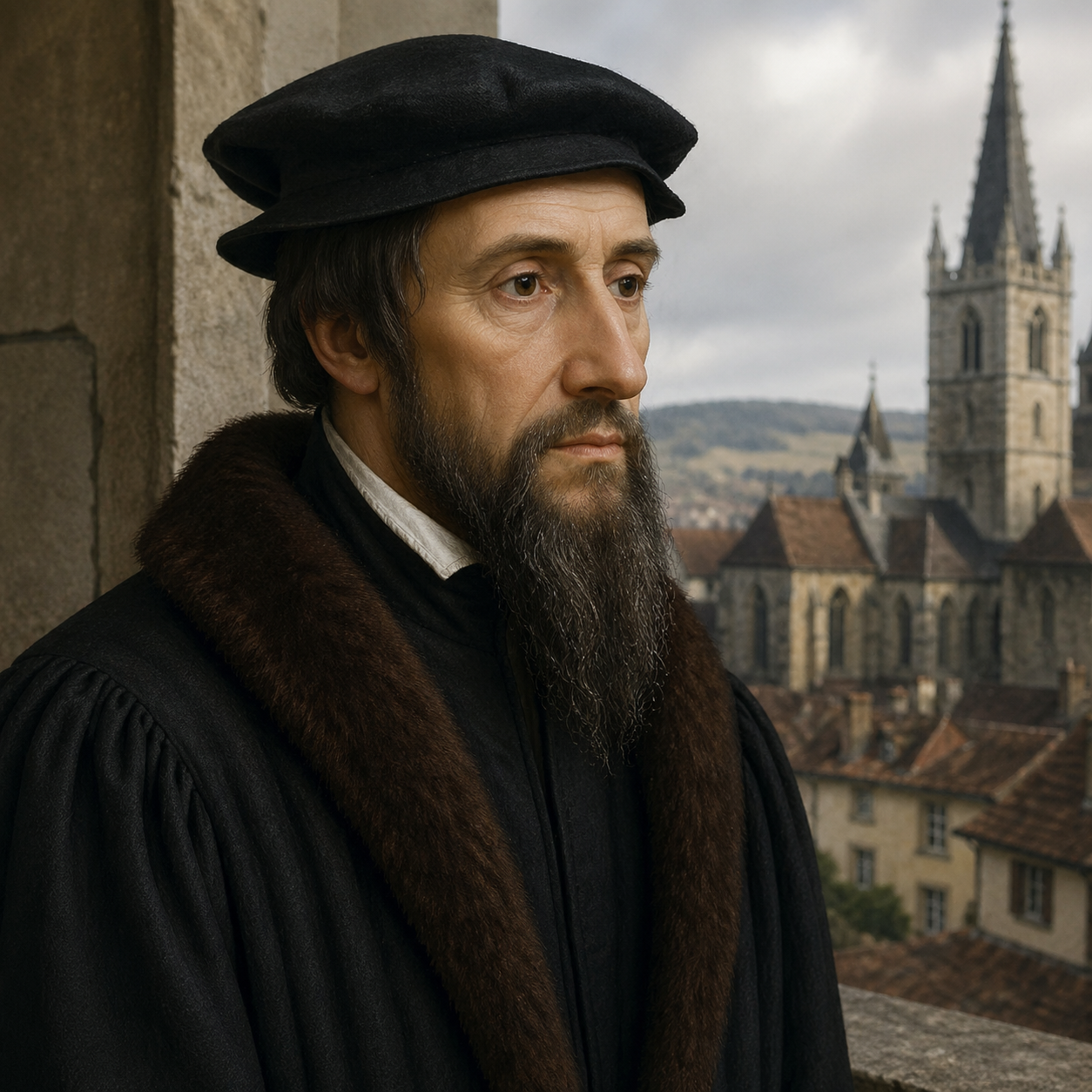
John Calvin — "God blinds the minds of the reprobate, and hardens their hearts, that they may n…"
God blinds the minds of the reprobate, and hardens their hearts, that they may not believe.
God blinds the minds of the reprobate, and hardens their hearts, that they may not believe.
Click any product to generate a realistic preview. Up to 3 at a time.
* Initial load can take up to 90 seconds — revising the preview in another color is nearly instant.
"The whole life of a Christian should be a meditation on death."
"The church is the mother of all the godly."
"We frankly confess that God has ordained to death those whom he has not deemed worthy of life."
"However many blessings we expect from God, His infinite liberality will always exceed all our wishes and our thoughts."
"The reprobate are not able to believe, because God does not give them the gift of faith."
French theologian whose Institutes of the Christian Religion (1536) systematized Protestant Reformed doctrine, including predestination. Closely associated with Martin Luther (Reformation founder, Calvin's predecessor). For an intellectual contrast, see Jacobus Arminius, Dutch Reformed theologian (1560-1609) — Arminius's rejection of strict double-predestination founded Arminianism — the theological tradition modern Methodism, most evangelicalism, and Pentecostalism descend from. The Calvinist-Arminian debate has divided Protestantism for 400 years.
Found in 1 providers: grok
1 source checked
This quote asserts that God actively causes spiritual blindness and hardened hearts in those destined for damnation—the 'reprobate'—ensuring they cannot come to faith. It is not passive permission but direct divine causation. Unbelief itself is part of God's sovereign design, not merely human failure. The reprobate do not simply choose to reject God; according to Calvin, God arranges that they are incapable of receiving him.
Double predestination—God electing some to salvation and actively reprobating others to damnation—was the theological core of Calvin's Institutes of the Christian Religion. Unlike Luther, who softened predestination's darker edges, Calvin pressed it to logical extremity. His austere governance of Geneva, his approval of Michael Servetus's execution for heresy, and his relentless systematic theology all flow from this conviction: God's absolute sovereignty extends even to who believes.
The 16th-century Reformation shattered Western Christendom over salvation's mechanics. Catholicism taught humans cooperate with grace through free will and sacraments; Calvin's predestination struck at that entirely. The Council of Trent (1545–1563) was simultaneously codifying Catholic resistance. Religious wars were igniting across Europe. Declaring God actively hardens unbelievers' hearts was theologically explosive—empowering the elect with certainty, drawing sharp anthropological battle lines between Reformed theology and Catholic teaching on human freedom.
AI-generated insights based on extensive research and information for context. Factual errors? Email [email protected].
Your cart is empty