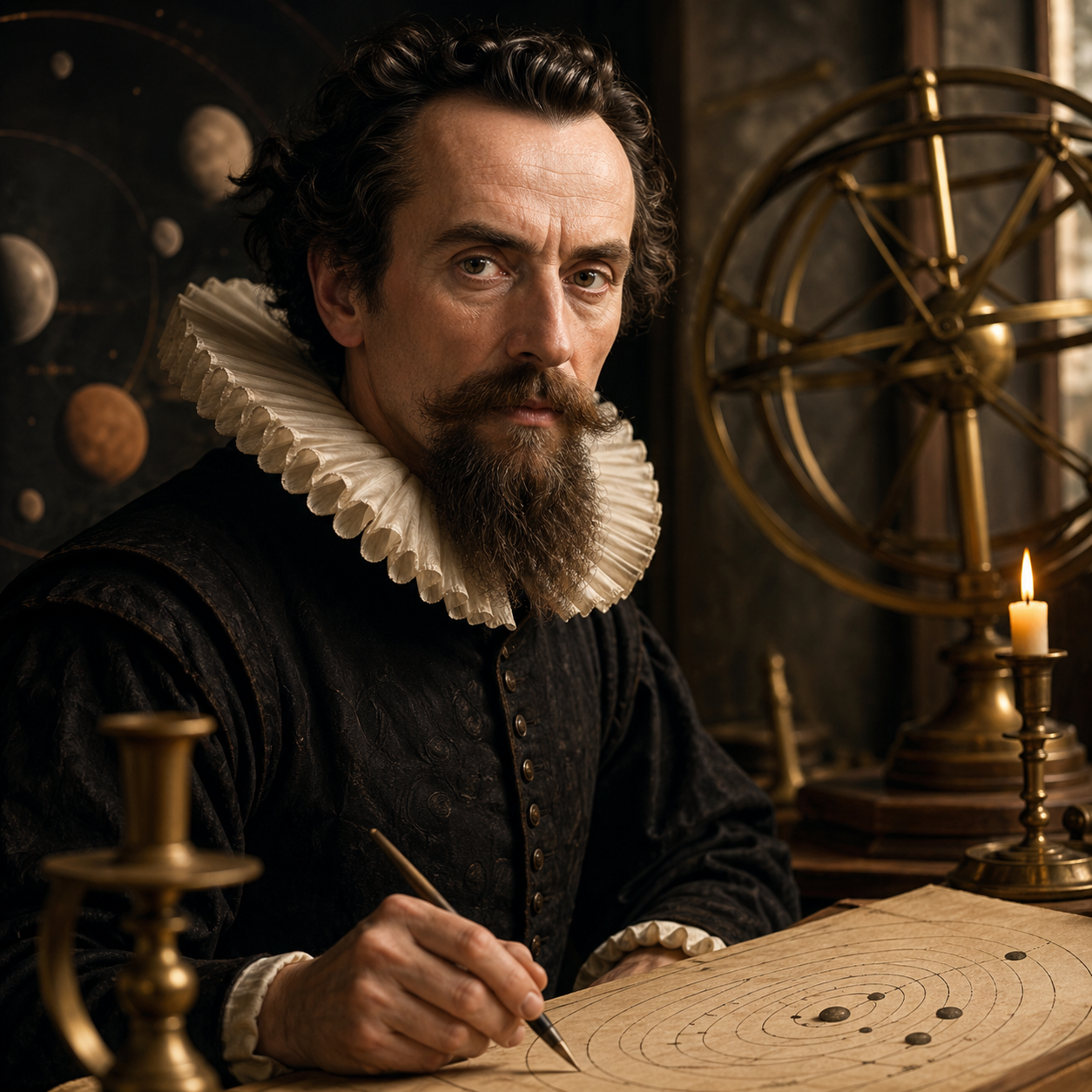
Johannes Kepler — "God himself is the first and greatest geometrician."
God himself is the first and greatest geometrician.
God himself is the first and greatest geometrician.
Click any product to generate a realistic preview. Up to 3 at a time.
* Initial load can take up to 90 seconds — revising the preview in another color is nearly instant.
"I have been a wanderer, but I have always found my way back to God."
"God gives every animal the means of saving its life—why object if he gives astrology to the astronomer?"
"I have sinned many times, but I have always repented."
"I have dedicated my life to the study of the heavens."
"I have been a father, and I have rejoiced in my children."
Found in 1 providers: grok
1 source checked
The universe has a mathematical structure at its core, and the divine mind works through geometry. Whoever designed reality thought in shapes, proportions, and precise measurements rather than arbitrary whims. To understand creation, you study its geometric patterns, because order and form are the fundamental language of existence itself, not decoration laid over something messier underneath.
Kepler spent decades fitting planetary orbits to geometric forms, first nesting Platonic solids inside planetary spheres in Mysterium Cosmographicum, then discovering elliptical orbits and his three laws of planetary motion. A devout Lutheran trained for ministry, he saw astronomy as reading God's mind through mathematics. This line captures his lifelong conviction that celestial harmony was literal divine geometry.
In the early modern period, the Copernican revolution was unsettling inherited cosmology, and natural philosophers worked under religious authorities who scrutinized any claim about the heavens. Kepler wrote amid the Thirty Years' War, Galileo's trials, and his own mother's witchcraft prosecution. Framing mathematics as divine let scientists pursue radical ideas while staying within Christian orthodoxy, legitimizing the new astronomy as worship rather than heresy.
AI-generated insights based on extensive research and information for context. Factual errors? Email [email protected].
Your cart is empty