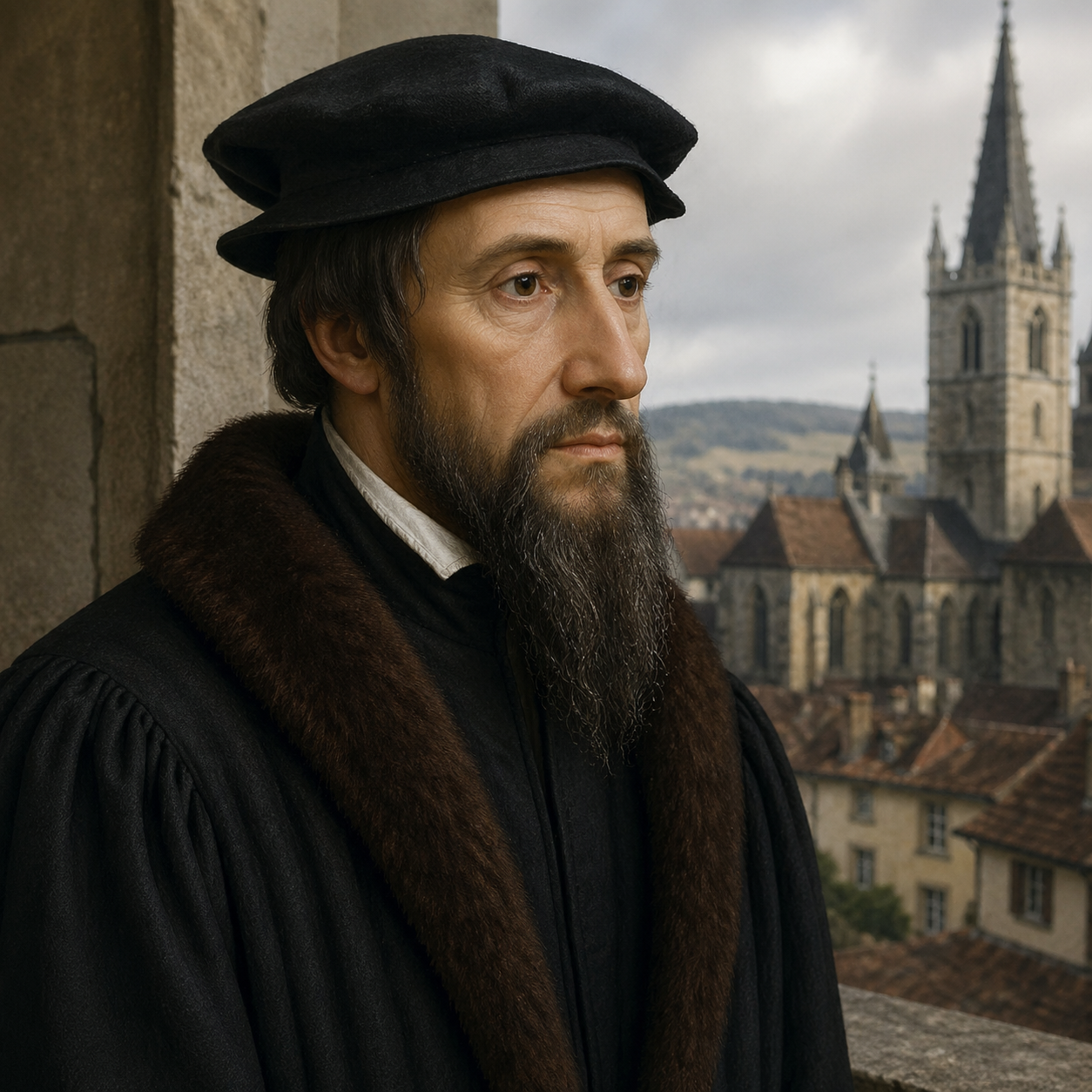
John Calvin — "God's glory is the end of all things."
God's glory is the end of all things.
God's glory is the end of all things.
Click any product to generate a realistic preview. Up to 3 at a time.
* Initial load can take up to 90 seconds — revising the preview in another color is nearly instant.
"He who has God for his father has the church for his mother."
"Ignorance of predestination is a great evil, because it deprives us of the knowledge of God's glory."
"Let that ethical philosophy therefore of free-will be far from a Christian mind."
"God will not suffer that one of his children should be lost."
"The reprobate are left to their own wickedness, and are justly punished for it."
French theologian whose Institutes of the Christian Religion (1536) systematized Protestant Reformed doctrine, including predestination. Closely associated with Martin Luther (Reformation founder, Calvin's predecessor). For an intellectual contrast, see Jacobus Arminius, Dutch Reformed theologian (1560-1609) — Arminius's rejection of strict double-predestination founded Arminianism — the theological tradition modern Methodism, most evangelicalism, and Pentecostalism descend from. The Calvinist-Arminian debate has divided Protestantism for 400 years.
Found in 1 providers: grok
1 source checked
Everything that exists — creation, history, suffering, and redemption — ultimately serves one overriding purpose: to display God's greatness. Human happiness, earthly success, and even salvation itself are not the final goal; they are means to an end. That end is divine glory. In modern terms, the universe functions as a stage designed not primarily for human fulfillment, but to showcase something infinitely greater.
This is the theological heartbeat of Calvinism. Calvin built his entire system — predestination, total depravity, irresistible grace — around God's absolute sovereignty. His Institutes of the Christian Religion returns repeatedly to divine glory as theology's organizing principle. Governing Geneva's civic and religious life, he subordinated everything to God's honor. His personal motto, Soli Deo Gloria, was not rhetorical flourish — it was the structural foundation of his entire worldview.
Calvin wrote during the Protestant Reformation (16th century), when Europe was fracturing from Roman Catholic dominance. The Church had positioned its sacraments, priests, and pope as necessary channels to God, centering human institutions. By declaring God's glory the end of all things, Calvin swept away ecclesiastical intermediaries. Amid religious wars, the Council of Trent's counter-offensive, and competing state churches, this was a radical and politically dangerous theological declaration.
AI-generated insights based on extensive research and information for context. Factual errors? Email [email protected].
Your cart is empty