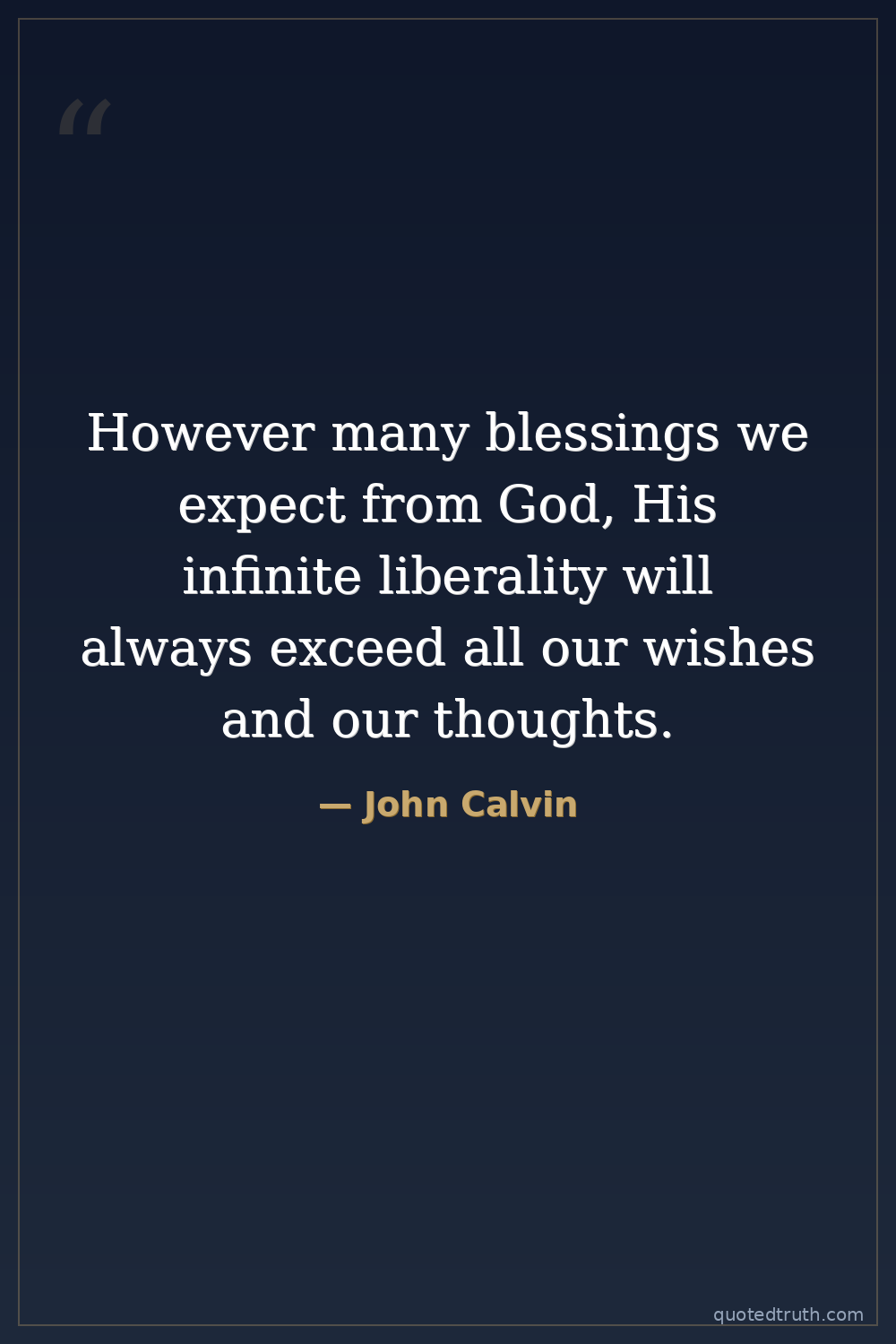
John Calvin — "However many blessings we expect from God, His infinite liberality will always e…"
However many blessings we expect from God, His infinite liberality will always exceed all our wishes and our thoughts.
However many blessings we expect from God, His infinite liberality will always exceed all our wishes and our thoughts.
Click any product to generate a realistic preview. Up to 3 at a time.
* Initial load can take up to 90 seconds — revising the preview in another color is nearly instant.
"The natural gifts were corrupted in man through sin, but his supernatural gifts were stripped from him."
"For we do not say that man is dragged unwillingly into sinning, but that because his will is corrupt he is held captive under the yoke of sin and therefore of necessity wills in an evil way."
"The wicked are justly condemned, because they are not only alien from God, but are also full of all impurity."
"The greater part of the world, because it despises the Word of God, despises also the whole of true religion."
"We are never so much ourselves as when we are in Christ."
French theologian whose Institutes of the Christian Religion (1536) systematized Protestant Reformed doctrine, including predestination. Closely associated with Martin Luther (Reformation founder, Calvin's predecessor). For an intellectual contrast, see Jacobus Arminius, Dutch Reformed theologian (1560-1609) — Arminius's rejection of strict double-predestination founded Arminianism — the theological tradition modern Methodism, most evangelicalism, and Pentecostalism descend from. The Calvinist-Arminian debate has divided Protestantism for 400 years.
Found in 1 providers: deepseek
1 source checked
God's generosity is limitless and always surpasses whatever humans can anticipate or imagine. Whatever blessings a person hopes to receive, the actual measure of divine giving exceeds those hopes entirely. This is not passive comfort but an active claim: human capacity for expectation, no matter how expansive, is fundamentally outpaced by God's giving nature. Divine abundance operates on a scale beyond the boundaries of human thought or desire.
Calvin built his entire theology around God's absolute sovereignty and grace. His landmark Institutes of the Christian Religion argued that salvation flows entirely from divine will, not human merit. As Geneva's leading reformer, he preached that grace is freely given, never earned. This quote mirrors his core doctrine directly: divine liberality is not proportional to human worthiness or expectation but flows from God's own infinite nature, completely untethered from human limits or deserving.
Calvin wrote during the height of the Protestant Reformation, when Europe was fracturing over the nature of divine grace and salvation. The Catholic Church taught grace was partially merited through works and sacraments; reformers countered it flowed freely from God alone. This debate had violent consequences — religious wars, city-states aligned by creed, executions for heresy. Calvin's emphasis on God's boundless generosity directly challenged any transactional or merit-based view of faith then dominant across Christendom.
AI-generated insights based on extensive research and information for context. Factual errors? Email [email protected].
Your cart is empty