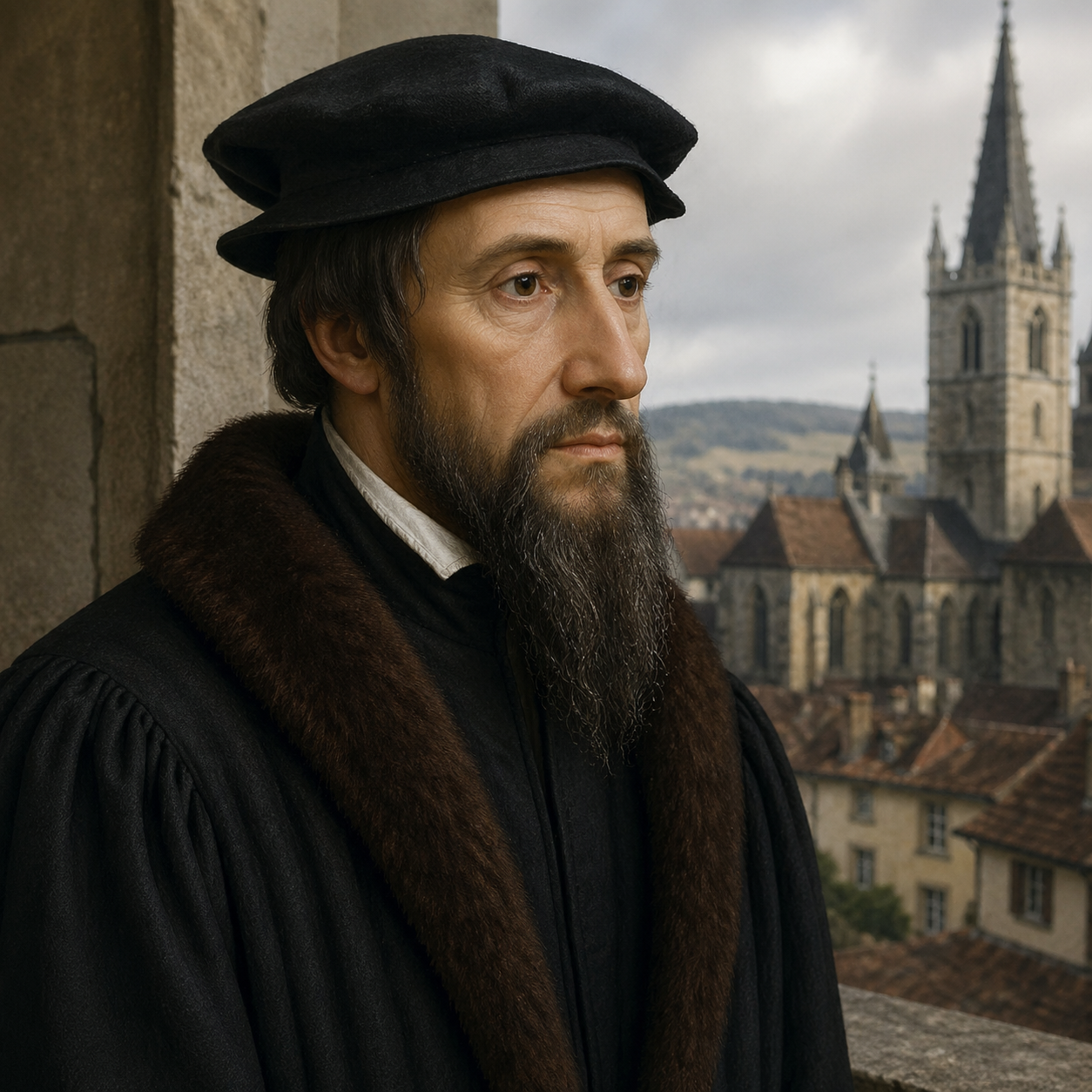
John Calvin — "We must live as if we were always in the presence of God."
We must live as if we were always in the presence of God.
We must live as if we were always in the presence of God.
Click any product to generate a realistic preview. Up to 3 at a time.
* Initial load can take up to 90 seconds — revising the preview in another color is nearly instant.
"God's sovereignty is absolute."
"Whence it is sufficiently plain that they are not chosen for their own merit, but because God has gratuitously chosen them."
"Our salvation depends on the free election of God."
"God's justice or righteousness is manifest as the reprobate receive the eternal punishment they deserve."
"Without knowledge of God, there is no true knowledge of self."
French theologian whose Institutes of the Christian Religion (1536) systematized Protestant Reformed doctrine, including predestination. Closely associated with Martin Luther (Reformation founder, Calvin's predecessor). For an intellectual contrast, see Jacobus Arminius, Dutch Reformed theologian (1560-1609) — Arminius's rejection of strict double-predestination founded Arminianism — the theological tradition modern Methodism, most evangelicalism, and Pentecostalism descend from. The Calvinist-Arminian debate has divided Protestantism for 400 years.
Found in 1 providers: grok
1 source checked
Every action, thought, and decision should be held to the same standard regardless of who is watching. True faith is not performance for an audience — it is an internal posture of constant accountability. Private behavior must match public piety. The quote rejects hypocrisy and compartmentalization, demanding that religion shape not just Sunday worship but business dealings, speech, relationships, and inner life every hour of every day.
Calvin structured Geneva as a living embodiment of this principle. His consistory courts monitored citizens' conduct — church attendance, business ethics, personal morality — because he believed God's sovereignty was total and inescapable. His Institutes of the Christian Religion argued that human life's entire purpose is glorifying God. Surviving exile, illness, and fierce opposition, Calvin himself lived with relentless discipline, treating every day as a stewardship account before an omniscient judge.
The 16th-century Reformation dismantled Catholicism's sacramental system — confession, penance, priestly absolution — that had structured moral accountability for centuries. Without those institutional checkpoints, Reformed Christians needed an internalized, continuous sense of divine presence. Calvin's Geneva operationalized this theologically: church and civil authority jointly enforced godly conduct. Religious wars across Europe also made personal piety politically loaded — whose God you served determined your allegiance, safety, and social standing.
AI-generated insights based on extensive research and information for context. Factual errors? Email [email protected].
Your cart is empty