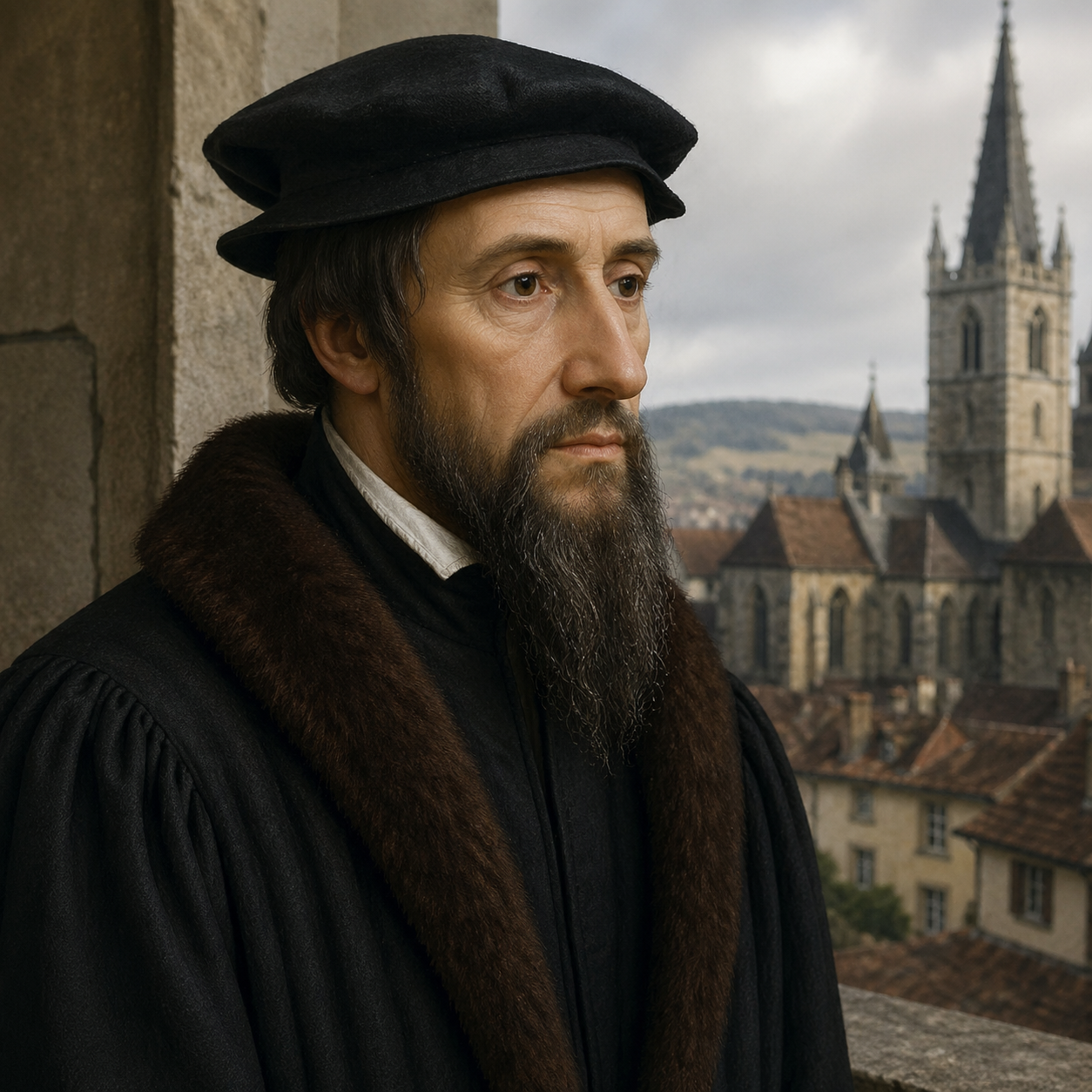
John Calvin — "God's ultimate discrimination rests solely on the freedom and sovereign will of …"
God's ultimate discrimination rests solely on the freedom and sovereign will of God.
God's ultimate discrimination rests solely on the freedom and sovereign will of God.
Click any product to generate a realistic preview. Up to 3 at a time.
* Initial load can take up to 90 seconds — revising the preview in another color is nearly instant.
"Without knowledge of God, there is no true knowledge of self."
"The will of God is the cause of all things, and there is no other cause."
"By predestination we mean the eternal decree of God, by which he has determined with himself whatever he wills to happen with regard to every man."
"He who has God for his father has the church for his mother."
"For the mind of man, when it has once been infected with this pest, is so utterly perverse that it is with difficulty restrained from framing for itself, after the example of the devil, some new and u…"
French theologian whose Institutes of the Christian Religion (1536) systematized Protestant Reformed doctrine, including predestination. Closely associated with Martin Luther (Reformation founder, Calvin's predecessor). For an intellectual contrast, see Jacobus Arminius, Dutch Reformed theologian (1560-1609) — Arminius's rejection of strict double-predestination founded Arminianism — the theological tradition modern Methodism, most evangelicalism, and Pentecostalism descend from. The Calvinist-Arminian debate has divided Protestantism for 400 years.
Found in 1 providers: gemini
1 source checked
God alone decides who receives salvation and who does not, based entirely on His own free, sovereign choice — not on anything humans deserve, earn, or foresee doing. This distinction between the saved and unsaved belongs to God exclusively. No human merit, effort, or prior faith initiates divine favor. The elect are chosen purely because God wills it, making salvation a matter of divine freedom rather than human qualification or worthiness.
This encapsulates Calvin's signature doctrine of double predestination, the theological core of his Institutes of the Christian Religion. He spent decades defending it in Geneva against critics like Jerome Bolsec. Calvin believed total human depravity made self-initiated salvation impossible. God's absolute sovereignty — not human will or works — determined election entirely. His governance of Geneva, his voluminous correspondence, and his entire Reformed theological system orbited this single unwavering conviction about divine freedom.
The 16th-century Reformation shattered the medieval Catholic synthesis, which taught humans cooperated with grace toward salvation. Erasmus and Luther had publicly debated free will in 1524–25. The Council of Trent was actively condemning Protestant doctrine. Europe fragmented along theological lines with political and military consequences attached to every position. Calvin's insistence on absolute divine sovereignty gave Reformed Protestantism its doctrinal backbone, directly shaping Dutch, Scottish, French Huguenot, and later English Puritan movements.
AI-generated insights based on extensive research and information for context. Factual errors? Email [email protected].
Your cart is empty