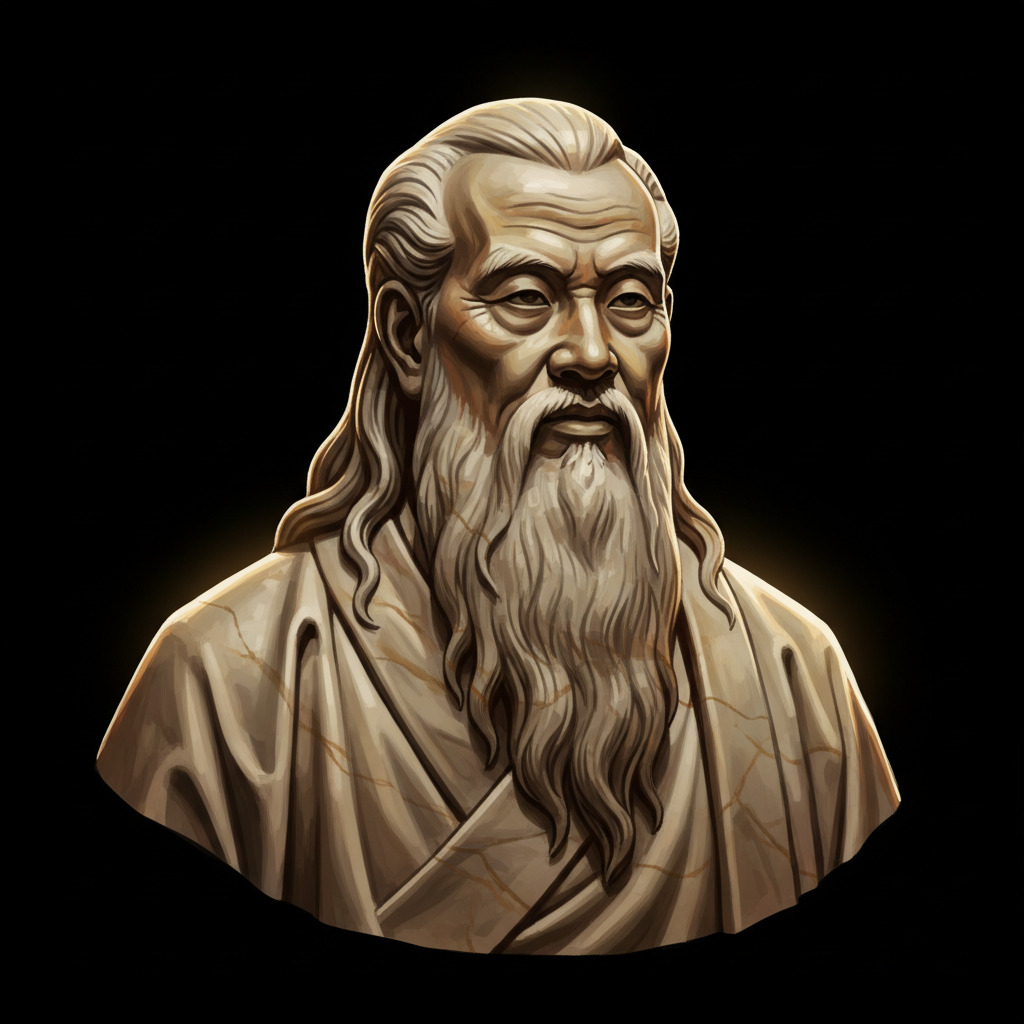
Laozi — "Great acts are made up of small deeds."
Great acts are made up of small deeds.
Great acts are made up of small deeds.
Click any product to generate a realistic preview. Up to 3 at a time.
* Initial load can take up to 90 seconds — revising the preview in another color is nearly instant.
"The higher the sun rises, the less shadow it casts."
"Let people return to making knots on ropes, instead of writing."
"The highest virtue does nothing. Yet, nothing needs to be done. The lowest virtue does everything. Yet, much remains to be done."
"The Sage manages affairs without doing anything, and spreads doctrines without speaking."
"The Tao never does anything, yet through it all things are done."
Reputed founder of Taoism and author of the Tao Te Ching, whose wu wei (effortless action) shaped East Asian philosophy. Closely associated with Zhuangzi (later Taoist who extended Laozi's framework). For an intellectual contrast, see Confucius, near-contemporary Chinese sage of social ritual and duty — Confucius systematized social order through ritual and hierarchy; Laozi argued that all such systems were the disease, not the cure — the two founding poles of Chinese moral philosophy.
Found in 1 providers: grok
1 source checked
Every significant achievement is built from countless minor actions performed consistently over time. Grand outcomes don't appear suddenly or through a single dramatic effort; they accumulate from ordinary steps taken each day. Whether building a structure, mastering a skill, or transforming a society, the result traces back to modest choices repeated with care. Focus on the small task in front of you, because that is what large accomplishments are actually made of.
Laozi taught wu wei, effortless action aligned with the natural flow of the Dao, and warned against forcing outcomes. The Tao Te Ching repeatedly frames greatness as emerging from humility and smallness: a journey of a thousand miles begins with a single step, and the tallest tree grows from a tiny sprout. As a reputed archivist in the Zhou court, he observed how patient accumulation, not grand gestures, sustained lasting order.
Laozi lived during the late Zhou dynasty, an age of fracturing feudal authority sliding toward the Warring States period. Rulers chased quick conquests, elaborate rituals, and ambitious reforms while ordinary life unraveled. Competing schools, Confucians, Legalists, Mohists, offered sweeping programs to fix society. Against that backdrop of grandiose ambition, Laozi's insistence that greatness grows from humble, incremental deeds was a pointed rebuke, urging rulers and sages alike toward restraint and patient cultivation.
AI-generated insights based on extensive research and information for context. Factual errors? Email [email protected].
Your cart is empty