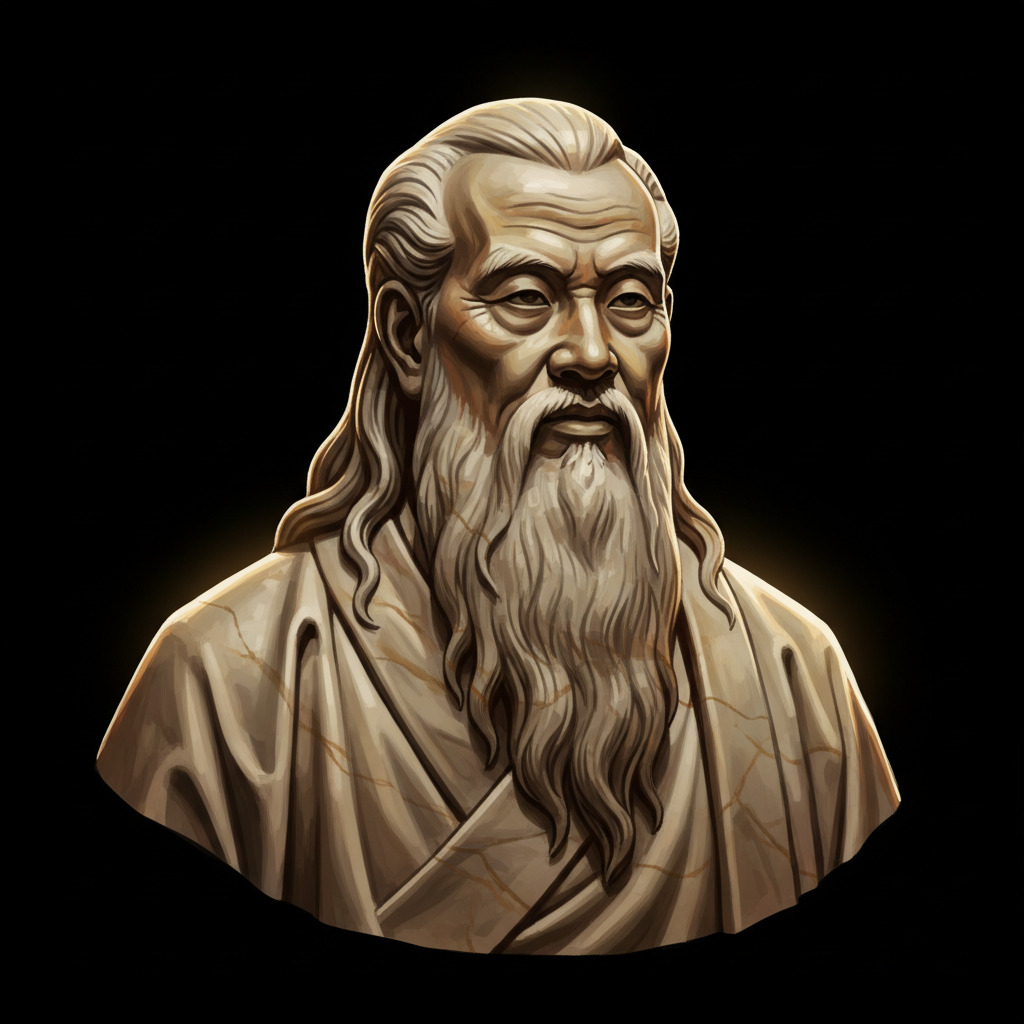
Laozi — "When I let go of what I am, I become what I might be."
When I let go of what I am, I become what I might be.
When I let go of what I am, I become what I might be.
Click any product to generate a realistic preview. Up to 3 at a time.
* Initial load can take up to 90 seconds — revising the preview in another color is nearly instant.
"When the great sage is born, the world is at peace."
"The sage embraces the One and becomes the model of the world. He does not display himself, therefore he shines. He does not assert himself, therefore he is distinguished. He does not boast, therefore …"
"He who knows does not speak. He who speaks does not know."
"The sage puts his own person last, and yet is found in the foremost place."
"The higher the sun rises, the less shadow it casts."
Reputed founder of Taoism and author of the Tao Te Ching, whose wu wei (effortless action) shaped East Asian philosophy. Closely associated with Zhuangzi (later Taoist who extended Laozi's framework). For an intellectual contrast, see Confucius, near-contemporary Chinese sage of social ritual and duty — Confucius systematized social order through ritual and hierarchy; Laozi argued that all such systems were the disease, not the cure — the two founding poles of Chinese moral philosophy.
Interpretation of Taoist philosophy, often attributed as a direct quote.
Date: 6th century BCE (approx)
WisdomFound in 1 providers: grok
1 source checked
Clinging to a fixed identity—your roles, labels, past achievements, or self-image—keeps you locked inside narrow boundaries. When you release that rigid definition of yourself, space opens up for growth, change, and potential you couldn't access before. Letting go isn't losing yourself; it's freeing yourself to become something larger. Growth requires surrendering the comfortable, known version of who you think you are.
Laozi built Taoism around wu wei (effortless action) and the idea that forcing outcomes blocks natural flow. Legend says he abandoned his post as a Zhou dynasty archivist, left society entirely, and only wrote the Tao Te Ching when a border guard insisted. That act embodies this saying—he let go of scholar, official, and teacher identities to become the wandering sage tradition remembers. Non-attachment to self was central to his philosophy.
Laozi lived during the turbulent late Zhou dynasty (around 6th century BCE), as centralized authority collapsed into the warring, ambitious states that produced the Hundred Schools of Thought. Confucians pushed rigid social roles, duties, and titles as the cure for chaos. Laozi's counter-message—release striving, release identity, align with the Tao—was radical pushback against a culture obsessed with rank, ritual, and becoming someone. Stability came from yielding, not grasping.
AI-generated insights based on extensive research and information for context. Factual errors? Email [email protected].
Your cart is empty