Isaac Newton — "He who thinks half-heartedly will not believe in God; but he who thinks seriousl…"
He who thinks half-heartedly will not believe in God; but he who thinks seriously will believe in God.
He who thinks half-heartedly will not believe in God; but he who thinks seriously will believe in God.
Click any product to generate a realistic preview. Up to 3 at a time.
* Initial load can take up to 90 seconds — revising the preview in another color is nearly instant.
"I have studied these things – you have not."
"The most beautiful order of the planets and comets could not have arisen without the design and dominion of an intelligent and powerful Being."
"Truth is ever to be found in simplicity, and not in the multiplicity and confusion of things."
"I feign no hypotheses."
"Plato is my friend, Aristotle is my friend, but my greatest friend is truth."
Found in 2 providers: gemini,grok
2 sources checked
Shallow or uncommitted thinking produces doubt about God, while deep, rigorous inquiry leads to belief. The quote argues that atheism or agnosticism stems from intellectual half-measures, not from careful examination. Truly serious thought — confronting the complexity, order, and structure of existence — naturally points toward a creator. Faith here is not a retreat from reason but its conclusion when reason is pursued with full honesty and effort.
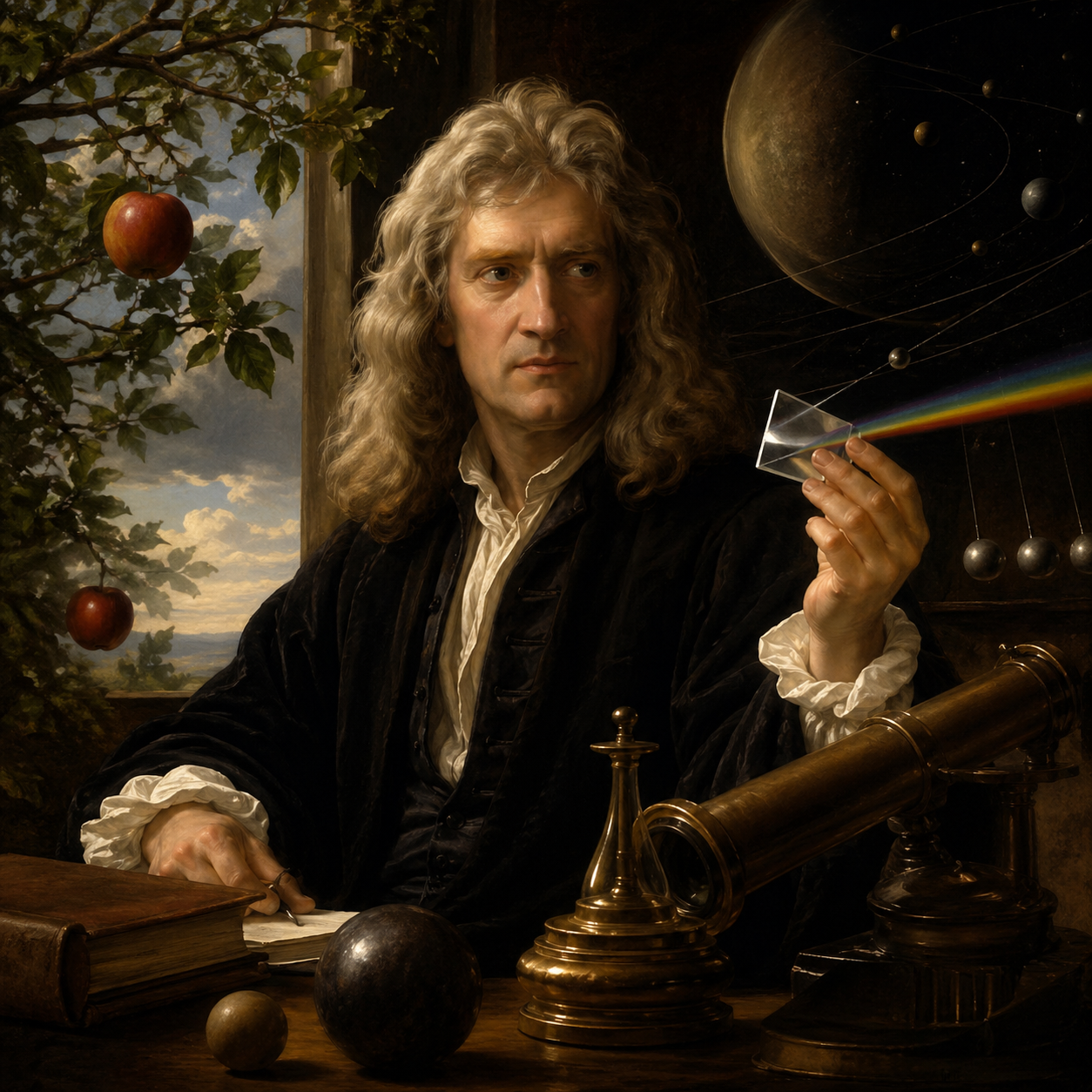
Newton wrote more on theology than on physics — his unpublished biblical manuscripts exceed his scientific output in volume. He saw gravity's elegant laws as evidence of God's rational design, stating explicitly in Principia that the solar system's ordered structure proved divine authorship. A devout if unorthodox Christian who rejected the Trinity, Newton experienced no conflict between scientific rigor and faith — each reinforced the other in his view.
Newton worked during the Scientific Revolution and early Enlightenment, when natural philosophy increasingly challenged Church authority. Deism — a belief in a distant, non-intervening creator — was gaining intellectual traction, and atheism, though socially dangerous, was becoming thinkable. The Royal Society formalized empirical inquiry as a discipline. Newton's quote directly counters the emerging assumption that scientific thinking erodes faith, insisting instead that rigorous intellectual pursuit confirms divine creation.
AI-generated insights based on extensive research and information for context. Factual errors? Email [email protected].
Your cart is empty