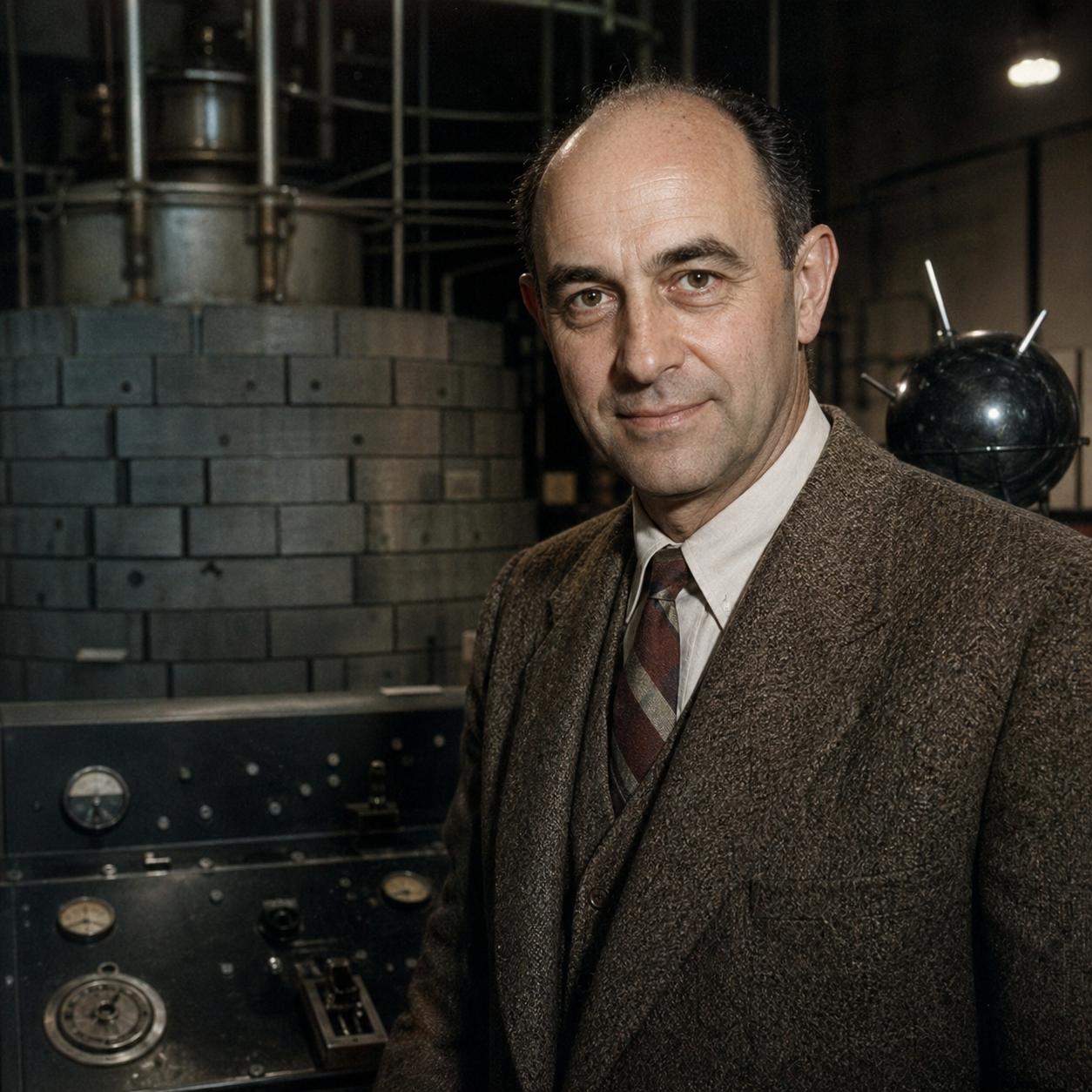
Enrico Fermi — "I am not a genius. I am just a curious person."
I am not a genius. I am just a curious person.
I am not a genius. I am just a curious person.
Click any product to generate a realistic preview. Up to 3 at a time.
* Initial load can take up to 90 seconds — revising the preview in another color is nearly instant.
"The only trouble is that the damn stuff is radioactive."
"The more you know, the more you realize you don't know."
"I have been very lucky in my life, because I have always been able to do what I love."
"The world is full of interesting things to do with neutrons."
"It is not good to try to stop knowledge from going forward. Ignorance is never better than knowledge."
Found in 1 providers: grok
1 source checked
Genuine achievement doesn't require exceptional inborn intelligence — it requires sustained curiosity, the drive to keep asking why and how. This quote challenges the myth that only rare, gifted minds can produce extraordinary results. It reframes success as a habit of questioning rather than a fixed trait. Anyone willing to stay genuinely interested in the world around them holds the same fundamental tool that drives discovery forward.
Fermi was uniquely both a theoretical and experimental physicist — extraordinarily rare. He invented Fermi estimation, using curiosity-driven back-of-envelope reasoning to approximate unknowable quantities. His Chicago Pile-1, the world's first nuclear reactor in 1942, emerged from relentlessly questioning how neutron chain reactions actually behave. Despite a Nobel Prize in 1938 and foundational contributions to atomic physics, colleagues remembered him as humble and endlessly inquisitive, never someone who attributed his breakthroughs to genius.
Fermi worked during a period when Einstein was a global celebrity and scientists were being mythologized as unreachable geniuses. The Manhattan Project elevated physicists to near-legendary status, placing them at the center of geopolitical power. Post-WWII atomic anxiety deepened this mystification. Fermi's statement quietly resists the cult of innate brilliance forming around him — made during an era when curiosity-driven science was literally reshaping civilization and raising profound moral questions about what scientists were responsible for.
AI-generated insights based on extensive research and information for context. Factual errors? Email [email protected].
Your cart is empty