Marie Curie — "I believe that every woman who has a scientific career should be able to combine…"
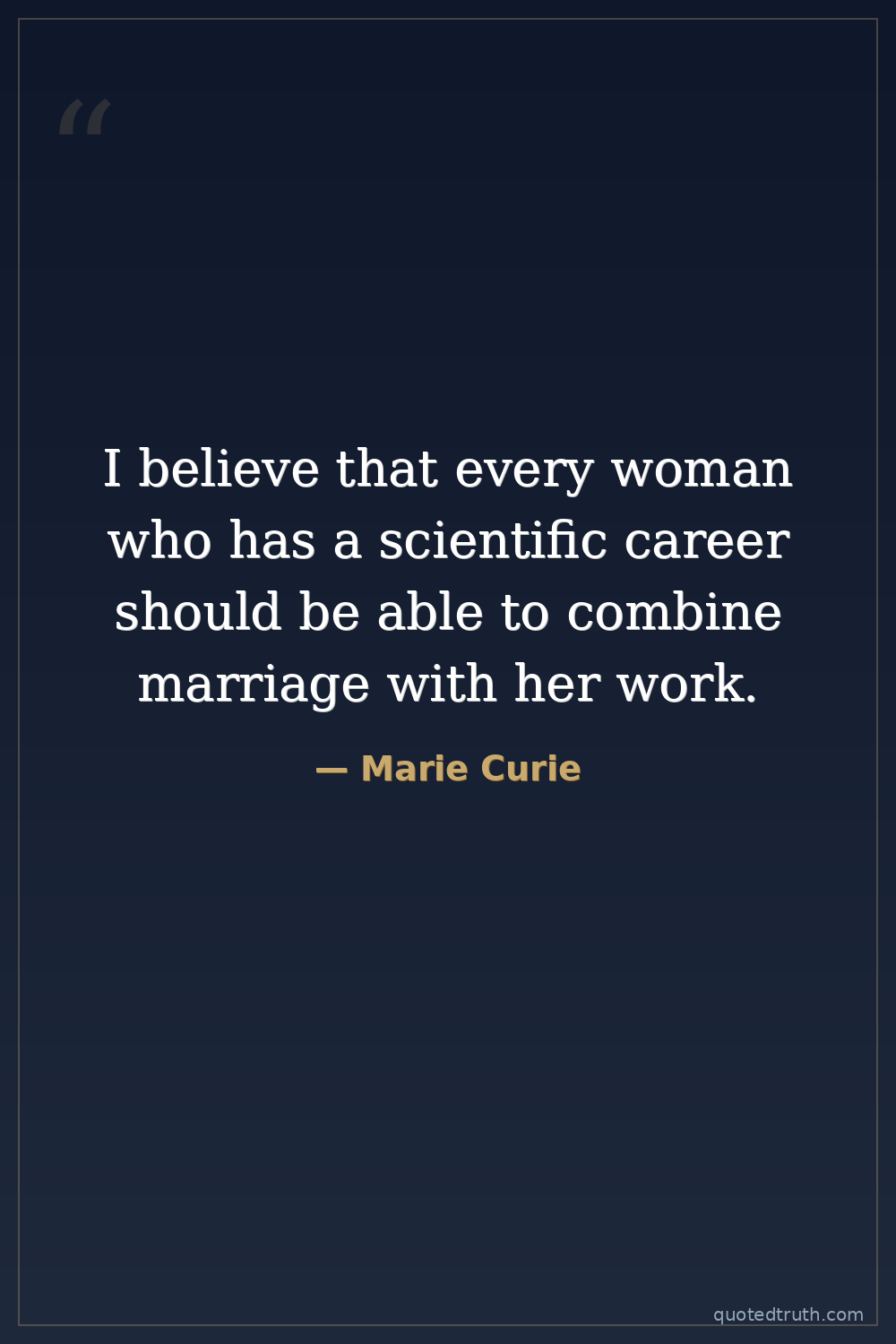
I believe that every woman who has a scientific career should be able to combine marriage with her work.
I believe that every woman who has a scientific career should be able to combine marriage with her work.
Click any product to generate a realistic preview. Up to 3 at a time.
* Initial load can take up to 90 seconds — revising the preview in another color is nearly instant.
"All my life through, the new sights of Nature made me rejoice like a child."
"I have frequently been questioned, especially by women, of how I could reconcile family life with a scientific career. Well, it has not been easy."
"My mind is entirely absorbed by my studies, and I consider it a great privilege to be able to devote myself to them."
"You cannot hope to build a better world without improving the individuals. To that end, each of us must work for his own improvement, and at the same time share a general responsibility for all humani…"
"I am not afraid of anything. I am only afraid of not being able to do my work. I am only afraid of not being able to discover new things."
Found in 1 providers: grok
1 source checked
Women pursuing scientific careers should not be forced to choose between professional ambition and married life. Both paths can coexist when a supportive partner and workable arrangements exist. The statement pushes back against the assumption that serious intellectual work is incompatible with being a wife, arguing instead that personal commitments and rigorous research can reinforce rather than cancel each other out for a woman who wants both.
Curie lived this directly. She married physicist Pierre Curie in 1895, and their partnership produced the discoveries of polonium and radium, earning them the 1903 Nobel Prize in Physics together. After Pierre died in 1906, she raised two daughters while running her lab and winning a second Nobel in Chemistry in 1911. Her career proved that marriage, motherhood, and frontier science were not mutually exclusive for a woman willing to carry all three.
In the late 19th and early 20th centuries, married women in Europe were typically expected to abandon paid or professional work, and universities like the Sorbonne admitted women only reluctantly. Most scientific institutions outright barred wives from laboratories or faculty posts. Curie spoke as the first woman to win a Nobel and the first to hold a Sorbonne professorship, at a moment when suffrage movements were challenging these norms and a handful of women were forcing science's doors open.
AI-generated insights based on extensive research and information for context. Factual errors? Email [email protected].
Your cart is empty