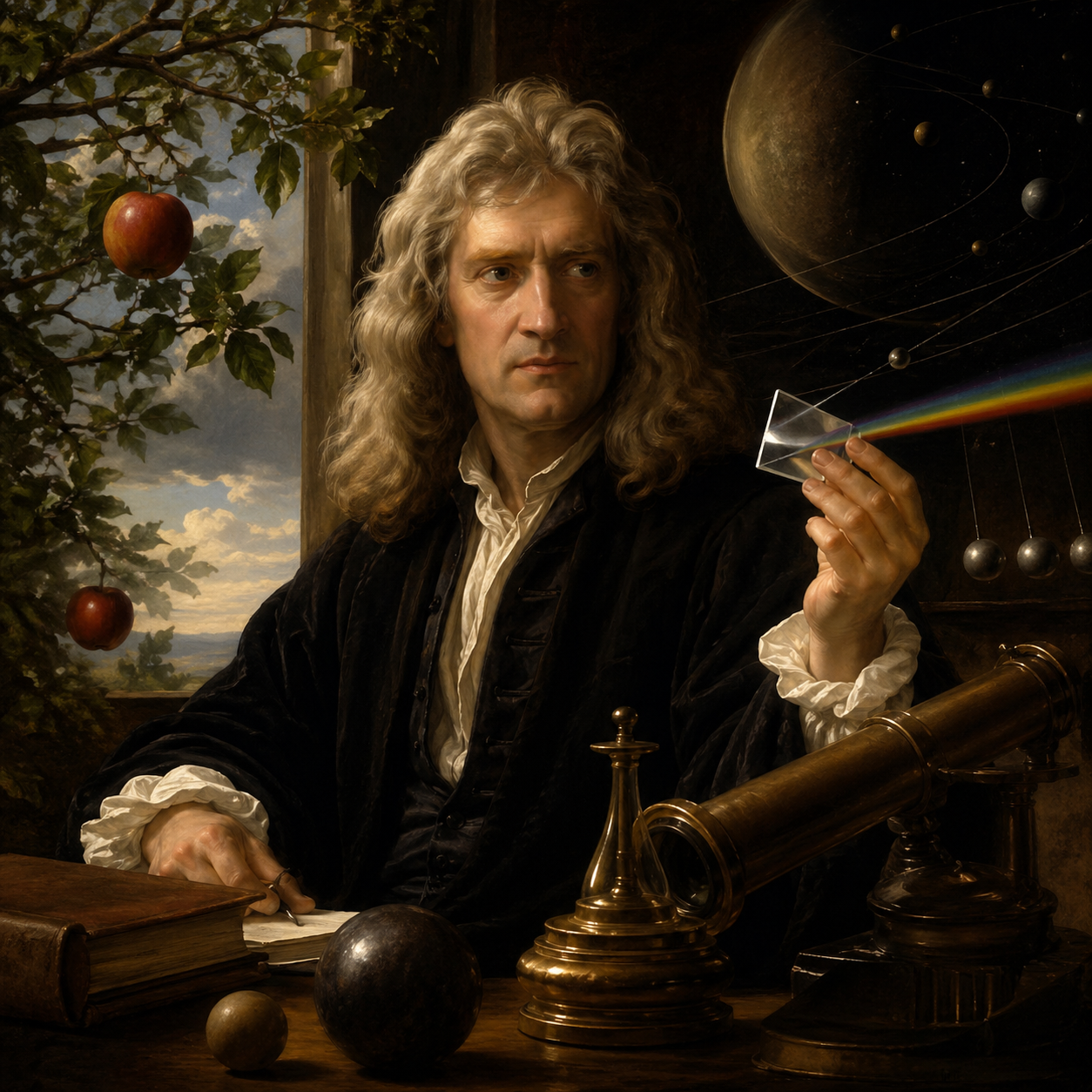
Isaac Newton — "I build my philosophy upon the shoulders of giants."
I build my philosophy upon the shoulders of giants.
I build my philosophy upon the shoulders of giants.
Click any product to generate a realistic preview. Up to 3 at a time.
* Initial load can take up to 90 seconds — revising the preview in another color is nearly instant.
"I was like a boy playing on the seashore."
"The power of gravity is of such a nature as to penetrate to the very centres of the sun and planets, without suffering the least diminution of its force."
"A man may imagine things that are false, but he can only understand things that are true, for if the things be false, the apprehension of them is not understanding."
"The particles of light are exceedingly small, and move with exceeding swiftness."
"The parts of all homogeneal hard bodies which fully touch one another, stick together with a very strong attraction."
Found in 1 providers: grok
1 source checked
No thinker works in isolation — every insight is built atop the accumulated knowledge of those who came before. True intellectual progress is collaborative across time: we inherit frameworks, disprove errors, and extend what previous minds discovered. Claiming sole originality is a delusion; acknowledging predecessors is both honest and strategically wise, since their prior work elevates your starting point far above ground level.
Newton's 1675 letter to rival Robert Hooke contained the actual phrase: 'If I have seen further, it is by standing on the shoulders of giants.' He synthesized Galileo's kinematics, Kepler's planetary laws, and Descartes' mathematics into the Principia (1687). Newton devoured prior literature obsessively and knew his universal gravitation was impossible without those foundations — making this rare humility unusually sincere from history's most celebrated physicist.
The Scientific Revolution (1543–1687) was a cascade of interdependent breakthroughs: Copernicus displaced Earth, Galileo measured motion, Kepler found orbital laws, and Newton unified them. The newly founded Royal Society (1660) formalized the practice of building publicly on shared findings. Print culture had made prior knowledge broadly accessible for the first time, making the metaphor of 'giants' practically literal — accumulated written science was an actual launchpad unavailable to ancient thinkers.
AI-generated insights based on extensive research and information for context. Factual errors? Email [email protected].
Your cart is empty