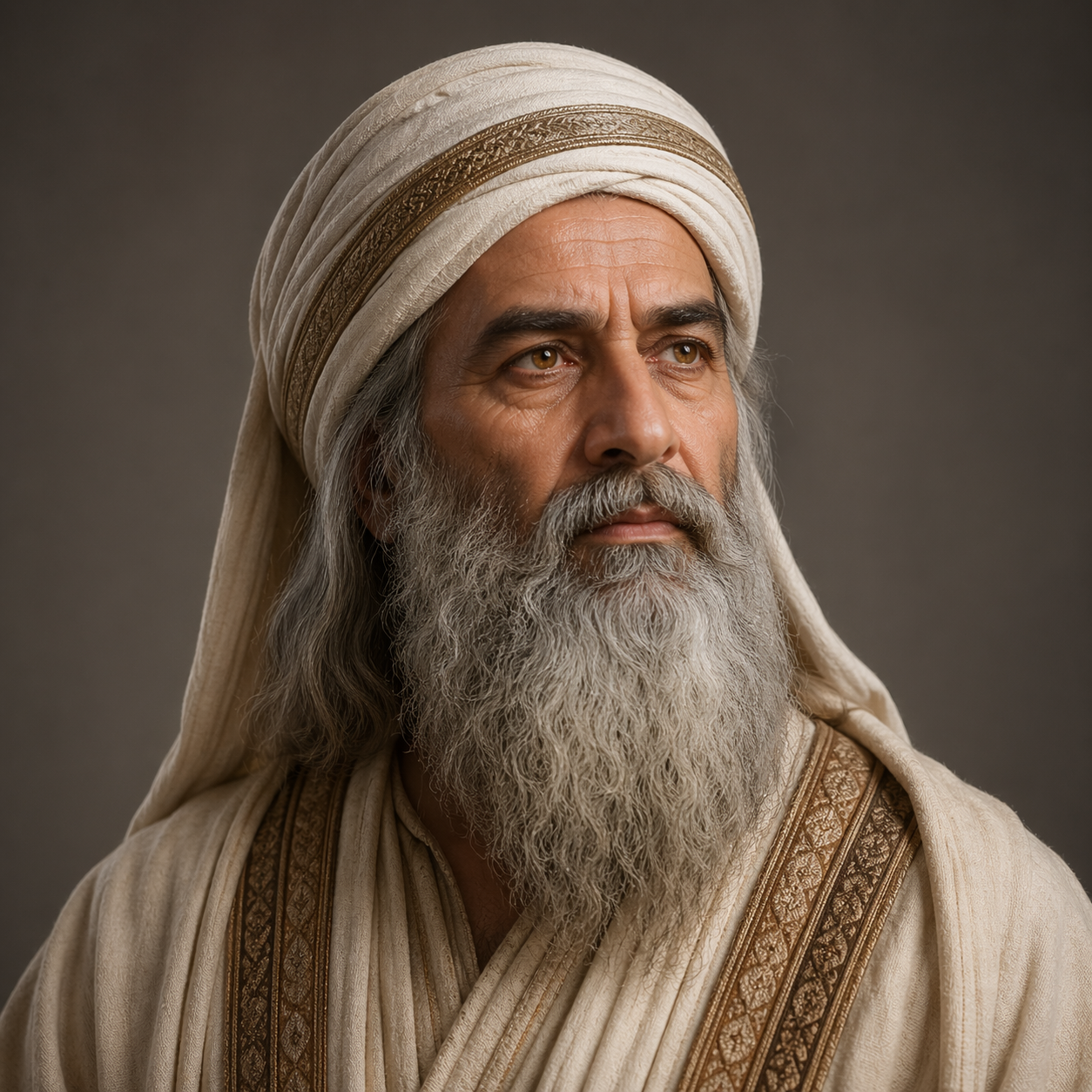
Zoroaster — "I declare the truth to all who will listen."
I declare the truth to all who will listen.
I declare the truth to all who will listen.
Click any product to generate a realistic preview. Up to 3 at a time.
* Initial load can take up to 90 seconds — revising the preview in another color is nearly instant.
"Beware of lust; it corrupteth both the body and the mind."
"He who brings forth life for the cattle and cultivates the earth with righteousness, he is the one who serves Mazda."
"The greatest wisdom is to know oneself. The second greatest is to know where you put your keys."
"He who holds the righteous man dear, and the evil man far from him, he is a friend to Ahura Mazda."
"May the divine light guide us in all our thoughts, words, and deeds."
Iranian prophet who founded Zoroastrianism, the first major religion of cosmic dualism between good (Ahura Mazda) and evil (Angra Mainyu). Closely associated with The Buddha (near-contemporary Eastern moral-cosmological revolutionary). For an intellectual contrast, see Friedrich Nietzsche, German philosopher of 'beyond good and evil' — Nietzsche appropriated Zarathustra's name for Thus Spoke Zarathustra (1883) precisely to invert the original's moral cosmology — the historical Zoroaster founded the good-versus-evil framework Nietzsche's character announces the end of.
Found in 1 providers: grok
1 source checked
The speaker commits to sharing honest understanding openly with anyone willing to hear it. There is no demand, no coercion, no private gatekeeping of wisdom. The offer stands to all, but the listener must choose to engage. Truth is treated as something to be proclaimed publicly rather than hoarded, and responsibility shifts to the audience to actually pay attention and weigh what is said.
Zoroaster positioned himself as a prophet delivering revelation from Ahura Mazda, the single wise god, after rejecting the polytheistic priesthood he was trained in. His Gathas, the hymns attributed to him, repeatedly address seekers directly and invite free moral choice between truth (asha) and the lie (druj). Declaring truth openly fits his role as a reformer preaching to whoever would listen, often against hostile traditional clergy.
Zoroaster lived in ancient Iran, likely between roughly 1500 and 1000 BCE, among pastoral Indo-Iranian tribes worshipping many gods through ritual sacrifice run by a hereditary priesthood. Literacy was rare and teachings passed orally. Proposing one supreme god of truth and a personal ethical choice was radical and drew persecution. Public proclamation to any listener bypassed the closed priestly class and spread the reform across tribal and later Persian imperial society.
AI-generated insights based on extensive research and information for context. Factual errors? Email [email protected].
Your cart is empty