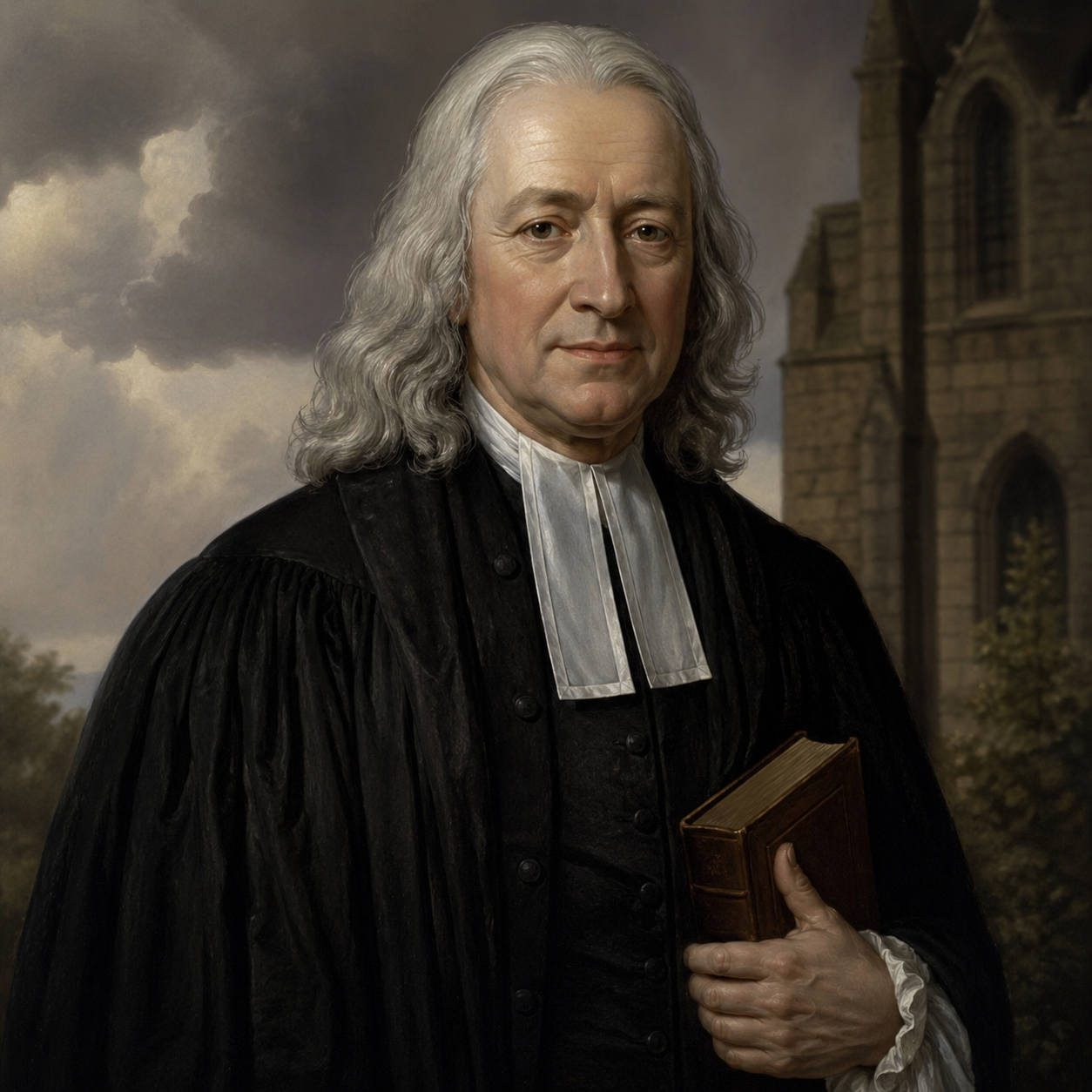
John Wesley — "I desire no other epitaph, than 'Here lies the friend of all, and the enemy of n…"
I desire no other epitaph, than 'Here lies the friend of all, and the enemy of none.'
I desire no other epitaph, than 'Here lies the friend of all, and the enemy of none.'
Click any product to generate a realistic preview. Up to 3 at a time.
* Initial load can take up to 90 seconds — revising the preview in another color is nearly instant.
"I am not afraid of the devil himself."
"Cleanliness is indeed next to godliness."
"I have often wondered that any man, who has tasted of the pleasures of retirement, can ever be prevailed upon to quit them."
"The first thing that I would advise you to do, is, to get a clear and distinct notion of the state of the world."
"I am a debtor both to the wise and to the unwise."
English Anglican cleric and founder of Methodism, whose open-air preaching and class-meeting structure created the largest 18th-century evangelical revival. Closely associated with Charles Wesley (his hymn-writing brother) and George Whitefield (early co-revivalist, later doctrinal opponent). For an intellectual contrast, see George Whitefield, Calvinist evangelical revivalist — Whitefield's predestinarian Calvinism vs Wesley's free-grace Arminian theology split the early Methodist movement permanently in the 1739-41 break. The founding evangelical Calvinist-Arminian schism — the two parallel evangelical traditions American Christianity descends from.
Found in 1 providers: grok
1 source checked
The speaker wants to be remembered purely for universal friendship and absence of hostility — a life defined not by achievement, power, or doctrine, but by how he treated every person he encountered. It is a wish to be known as someone who never made enemies, never excluded anyone, and extended warmth and goodwill across all social boundaries without exception or favoritism.
Wesley traveled 250,000 miles on horseback preaching across Britain, entering coal mines, prisons, and slums to reach the poor whom the Church of England ignored. His Methodism was radically inclusive — open-air sermons welcomed any listener. He opposed slavery vigorously and organized mutual aid societies. His entire ministry was structured around friendship with the marginalized, making this epitaph a precise summary of his evangelical mission.
In 18th-century England, class hierarchy rigidly dictated social relationships — clergy served the gentry, the poor were spiritually neglected, and religious dissent was legally restricted. Wesley preached during the Industrial Revolution's early disruptions, when urbanizing workers lived in squalor outside parish structures. An epitaph claiming friendship with 'all' was a conscious rebuke of a society built on exclusion, deference, and sectarian division.
AI-generated insights based on extensive research and information for context. Factual errors? Email [email protected].
Your cart is empty