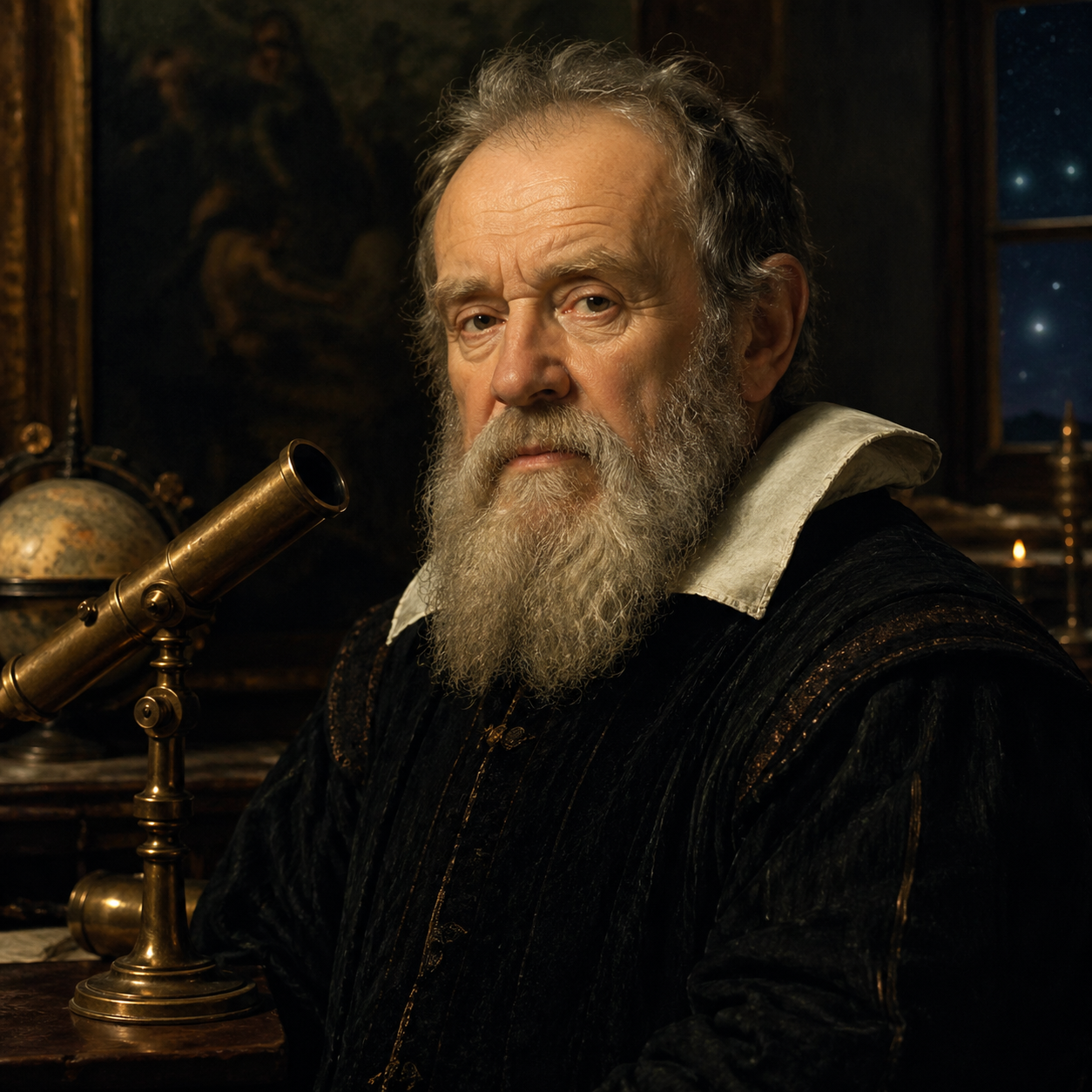
Galileo Galilei — "I do not believe that the same God who has given us senses, reason and intellect…"
I do not believe that the same God who has given us senses, reason and intellect would have us abandon their use.
I do not believe that the same God who has given us senses, reason and intellect would have us abandon their use.
Click any product to generate a realistic preview. Up to 3 at a time.
* Initial load can take up to 90 seconds — revising the preview in another color is nearly instant.
"It is necessary to examine the actual structure of the universe, and not to cling to old ideas."
"Who would set a limit to the mind of man? Who would dare assert that we know all there is to be known?"
"I have written up many reasons and refutations on the subject, but I have not dared until now to bring them into the open, being warned by the fortunes of Copernicus himself, our master, who procured …"
"By denying scientific principles, one may maintain any paradox."
"To deny the principles of philosophy is to reject reason itself."
Found in 1 providers: grok
1 source checked
God gave humans the capacity to observe, think, and reason — so using those faculties isn't irreverent, it's fulfilling our nature. Refusing to investigate the world in favor of blind acceptance would itself be a betrayal of the gift. Faith and rational inquiry aren't enemies; suppressing curiosity and evidence contradicts the very design of a Creator who equipped us to understand creation.
Galileo faced the Inquisition for defending heliocentrism against Church doctrine, and this conviction — that scientific investigation honors rather than defies God — was his shield. A devout Catholic himself, he never saw faith and astronomy as contradictory. His telescopic discoveries demanded intellectual honesty over institutional obedience, costing him his freedom but never his belief that reason was divinely sanctioned.
The early modern period saw the Catholic Church wielding enormous authority over what constituted truth. The Reformation had already fractured Christian unity, making orthodoxy a political weapon. Galileo's era punished deviation from Scripture-interpreted cosmology as heresy. His argument reframed the conflict: not science versus God, but institutional power versus a Creator who made humans rational beings — a dangerous but theologically sophisticated challenge.
AI-generated insights based on extensive research and information for context. Factual errors? Email [email protected].
Your cart is empty