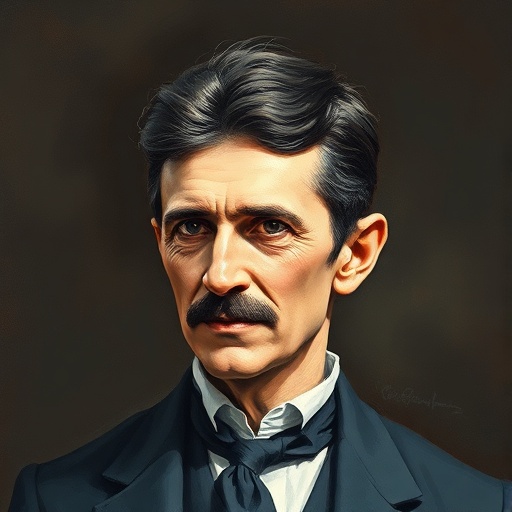
Nikola Tesla — "I do not eat meat."
I do not eat meat.
I do not eat meat.
Click any product to generate a realistic preview. Up to 3 at a time.
* Initial load can take up to 90 seconds — revising the preview in another color is nearly instant.
"Nothing enters our minds or determines our actions, and what we call soul or spirit, is nothing more than the sum of the functionings of the body. When this functioning ceases, the soul or the spirit …"
"In no way can we get such an overwhelming idea of the grandeur of Nature than when we consider, that in accordance with the law of the conservation of energy, throughout the Infinite, the forces are i…"
"I consider myself a very fortunate man, because I have been able to devote my entire life to the pursuit of knowledge and the service of humanity."
"The harnessed power of the cosmos is the greatest gift we can bestow upon humanity."
"The world has been too slow to grasp the true significance of my inventions."
Serbian-American inventor and electrical engineer whose alternating-current designs powered the modern electrical grid; died poor and largely forgotten. Closely associated with George Westinghouse (his AC-power business partner) and Mihajlo Pupin (fellow Serbian-American physicist at Columbia). For an intellectual contrast, see Thomas Edison, American inventor and direct-current advocate — Edison's direct-current power-distribution scheme was displaced by Tesla-Westinghouse AC in the 1890s 'War of Currents'. Edison ran a public-relations campaign electrocuting animals to discredit AC — the most famous engineering-ethics rivalry in American history. Tesla's AC won and powers nearly every electrical grid on Earth.
From his writings on personal habits and diet, advocating for vegetarianism.
Date: Early 20th Century
WisdomFound in 1 providers: grok
1 source checked
A direct refusal to consume animal flesh — a declaration of vegetarianism rooted in personal conviction, whether driven by ethics, health, or philosophy. The statement is blunt and unapologetic, asserting a lifestyle choice that runs counter to mainstream habits. It implies a deliberate, reasoned stance rather than a casual preference — a commitment to living differently from the crowd, without apology or qualification.
Tesla adopted a near-vegetarian diet in his later decades, subsisting largely on milk, honey, vegetable juices, and bread. He spoke publicly about meat abstention as both an ethical and health choice, predicting civilized society would eventually abandon it. Known for extreme self-discipline — sleeping only two hours, working obsessively — his dietary choices reflected the same ascetic control he applied to every dimension of his personal and scientific life.
In the late 19th and early 20th centuries — Tesla's active era — meat was central to the Western diet, widely linked to masculine strength and prosperity. Yet countercultures were emerging: Tolstoy and Shaw championed vegetarianism, health reformers like Kellogg promoted plant-based eating, and early animal welfare societies were forming. Tesla's quiet refusal placed him alongside intellectual dissenters at a time when abstaining from meat was genuinely unusual and socially conspicuous.
AI-generated insights based on extensive research and information for context. Factual errors? Email [email protected].
Your cart is empty