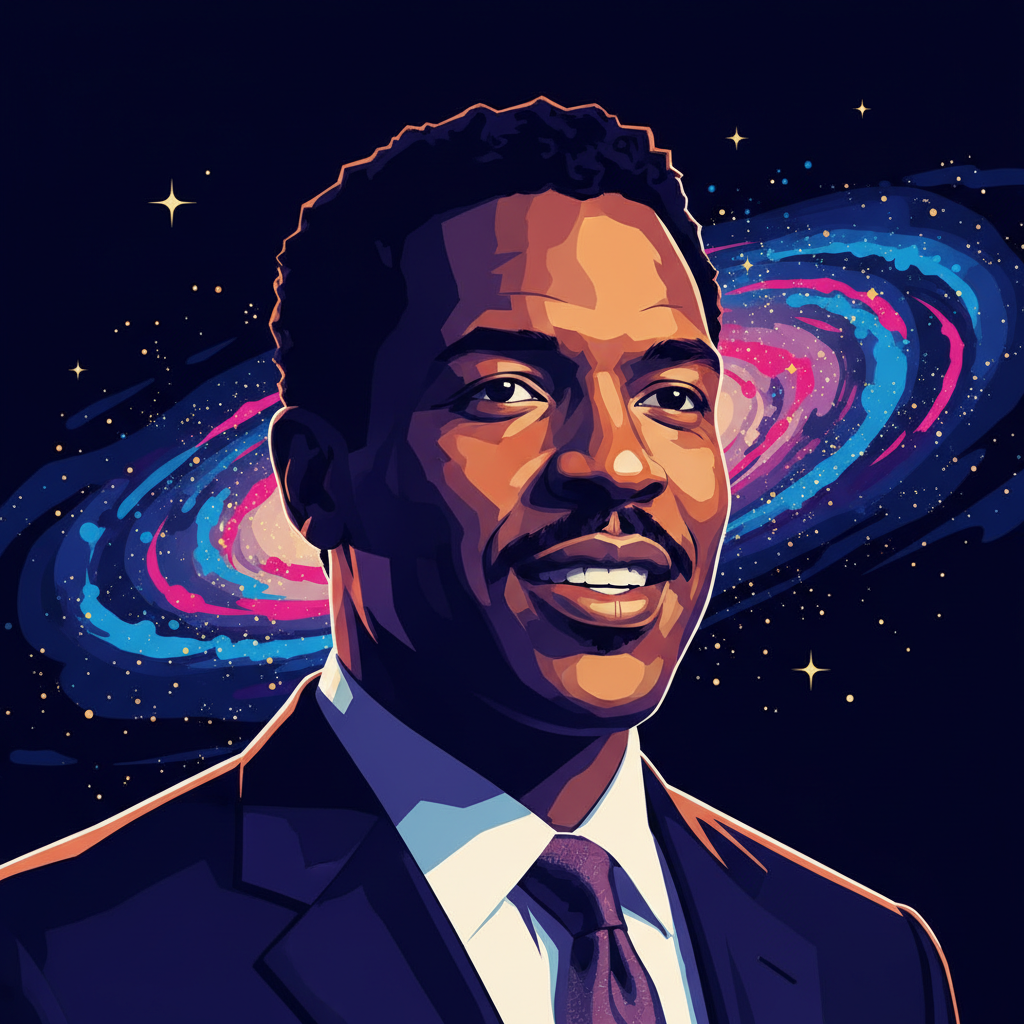
Neil deGrasse Tyson — "I think it's important to remind people that we are all made of stardust. We are…"
I think it's important to remind people that we are all made of stardust. We are all connected to the cosmos.
I think it's important to remind people that we are all made of stardust. We are all connected to the cosmos.
Click any product to generate a realistic preview. Up to 3 at a time.
* Initial load can take up to 90 seconds — revising the preview in another color is nearly instant.
"We spend the first year of a child's life teaching it to walk and talk and the rest of its life telling it to sit down and shut up. Is it any wonder the world is in the mess it's in?"
"I'm glad to be alive to see the universe unfold."
"I don't have a problem with people believing in God. I have a problem with people who believe in God and use that as an excuse to be ignorant."
"Science is not a body of facts. Science is a way of thinking."
"The more I learn about the universe, the less convinced I am that there’s some sort of benevolent intelligence behind it."
American astrophysicist, Hayden Planetarium director, and Cosmos: A Spacetime Odyssey host who carries the Carl Sagan public-science mantle. Closely associated with Bill Nye (fellow science communicator) and Brian Greene (theoretical physicist and string-theory popularizer). For an intellectual contrast, see Ken Ham, founder of Answers in Genesis and the Creation Museum — Ham's career has been organized around defending biblical 6-day creationism — exactly the science-education position Tyson's mainstream-science communication is structured to refute.
Found in 1 providers: grok
1 source checked
The atoms composing human bodies were forged inside ancient stars through nuclear fusion, then scattered across space when those stars exploded. Every carbon, oxygen, and iron atom in us has a stellar origin. This means humanity isn't separate from the universe — we are literally made of it. The quote strips away cosmic isolation and replaces it with a physical, verifiable connection to everything that exists.
Tyson, director of the Hayden Planetarium and host of Cosmos: A Spacetime Odyssey, built his career translating astrophysics into human wonder. His mentor Carl Sagan pioneered this sentiment. Tyson repeats stardust imagery across interviews, books like Astrophysics for People in a Hurry, and his StarTalk podcast, using it to inspire awe in non-scientists. It crystallizes his lifelong mission: making the universe feel personally relevant to everyone.
Tyson rose to prominence in the 2000s–2020s, an era of heightened science skepticism, creationism debates, and political attacks on climate research. The 2014 Cosmos reboot aired during deep cultural polarization. Space exploration regained attention through SpaceX and the James Webb Space Telescope. Amid tribalism and division, his stardust message offered a unifying scientific truth: human differences are trivial against a shared 13.8-billion-year cosmic origin story written in atoms.
AI-generated insights based on extensive research and information for context. Factual errors? Email [email protected].
Your cart is empty