Alexander Fleming — "I had no idea that I would be involved in such a great discovery. It was purely …"
I had no idea that I would be involved in such a great discovery. It was purely accidental.
I had no idea that I would be involved in such a great discovery. It was purely accidental.
Click any product to generate a realistic preview. Up to 3 at a time.
* Initial load can take up to 90 seconds — revising the preview in another color is nearly instant.
"I have always been interested in the fight against disease."
"Nature makes penicillin; I just found it."
"I had no idea at the time that I was making a discovery that would change the course of medicine."
"The next time you are tempted to throw away a contaminated culture, remember the penicillin."
"I have been accused of being untidy. I confess to being untidy, but I have never allowed my untidiness to interfere with my work."
Found in 1 providers: grok
1 source checked
Humility and chance converge here: a transformative discovery wasn't engineered through deliberate planning but stumbled upon by accident. The quote captures how scientific greatness sometimes emerges not from targeted ambition but from an open, observant mind that pauses on an unexpected finding and asks why. Luck plays a role in discovery, but only those trained to recognize significance in the anomalous can act on it.
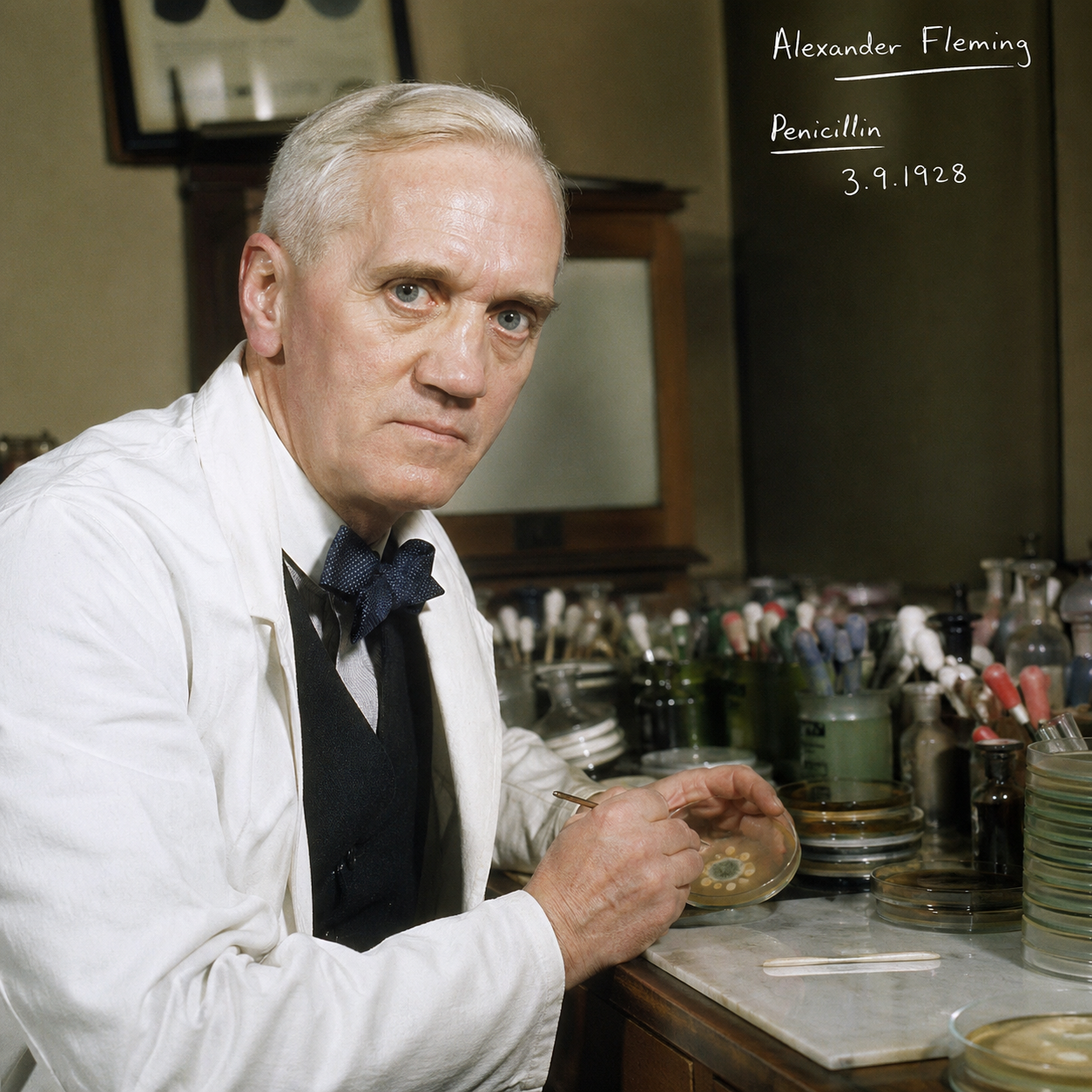
Fleming was a bacteriologist at St. Mary's Hospital, London — meticulous in analysis but famously untidy in lab habits. In 1928, a contaminated petri dish left before vacation revealed mold killing surrounding staphylococcus colonies. Rather than discarding it, he investigated. This wasn't his first serendipitous find: he had discovered lysozyme in 1923 similarly. His career embodied prepared-mind science — accidents only matter to those equipped to interpret them.
In 1928, bacterial infections — pneumonia, sepsis, tuberculosis, infected wounds — killed routinely with no reliable cure. World War I had shown how septicemia claimed as many lives as bullets. Fleming's accidental discovery launched the antibiotic era: mass-produced penicillin by the 1940s transformed battlefield medicine and civilian healthcare, defeating diseases that had plagued humanity for millennia and fundamentally redefining what medicine could promise.
AI-generated insights based on extensive research and information for context. Factual errors? Email [email protected].
Your cart is empty