Alexander Fleming — "The greatest discovery of my life was not penicillin, but the fact that I was wr…"
The greatest discovery of my life was not penicillin, but the fact that I was wrong about something.
The greatest discovery of my life was not penicillin, but the fact that I was wrong about something.
Click any product to generate a realistic preview. Up to 3 at a time.
* Initial load can take up to 90 seconds — revising the preview in another color is nearly instant.
"My only merit is that I did not discard the cultures at an early stage."
"It is not wise to be too dogmatic in science. One must always be prepared to change one's mind."
"The public will probably never understand the difficulties that beset the path of the original investigator."
"I am sometimes asked what I think of the future of penicillin. I think it has a great future, but it must be used wisely."
"The purification of penicillin was a major triumph of chemistry."
Found in 1 providers: grok
1 source checked
Recognizing your own errors matters more than any single achievement. Intellectual humility — the capacity to admit you were wrong — is the deepest form of discovery a person can make. Failure and correction are not setbacks but the engine of genuine understanding. Most people cling to prior beliefs; the willingness to overturn your own certainties is rarer and more valuable than any external accomplishment.
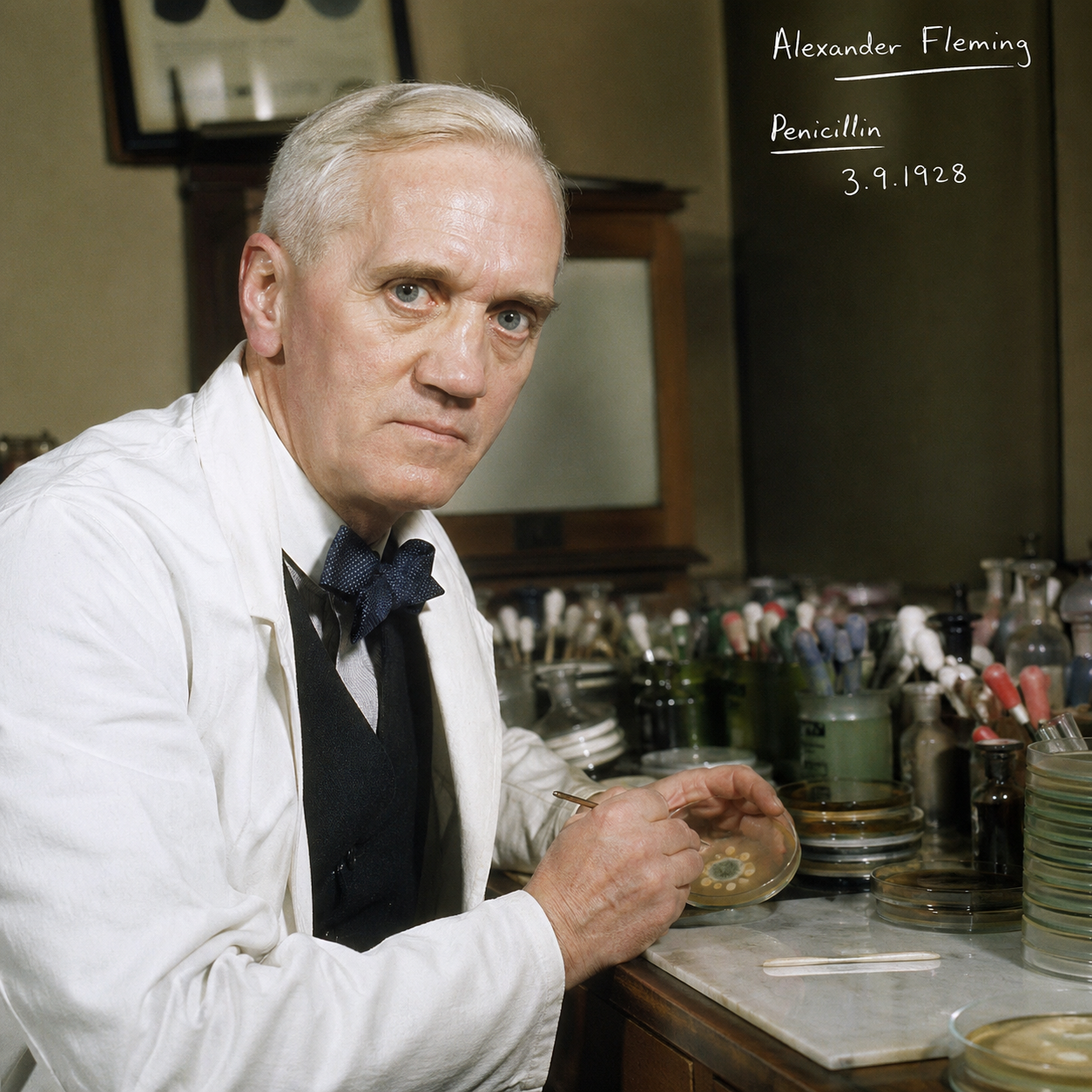
Fleming's greatest scientific discovery — penicillin — came precisely because he was wrong to dismiss a contaminated petri dish as a ruined experiment. His openness to unexpected results in 1928 revealed mold killing bacteria. During WWI, he challenged prevailing dogma that antiseptics helped infected wounds, finding they often worsened outcomes. His entire career was a sequence of overturned assumptions, making this quote a direct reflection of how he actually practiced science.
Fleming's era — spanning two World Wars and the birth of modern medicine — was defined by scientific authority and institutional certainty. Wound infections killed more soldiers than bullets in WWI, yet accepted antiseptic treatments were largely ineffective, and few dared challenge them. The 1920s–50s had rigid scientific hierarchies where admitting error risked professional credibility. Fleming's public embrace of fallibility ran counter to a culture that equated unwavering confidence with scientific competence.
AI-generated insights based on extensive research and information for context. Factual errors? Email [email protected].
Your cart is empty